







Question: In this mini-project you will use principal component analysis (PCA) to cluster images of human faces under varying illuminations. To this end we will use
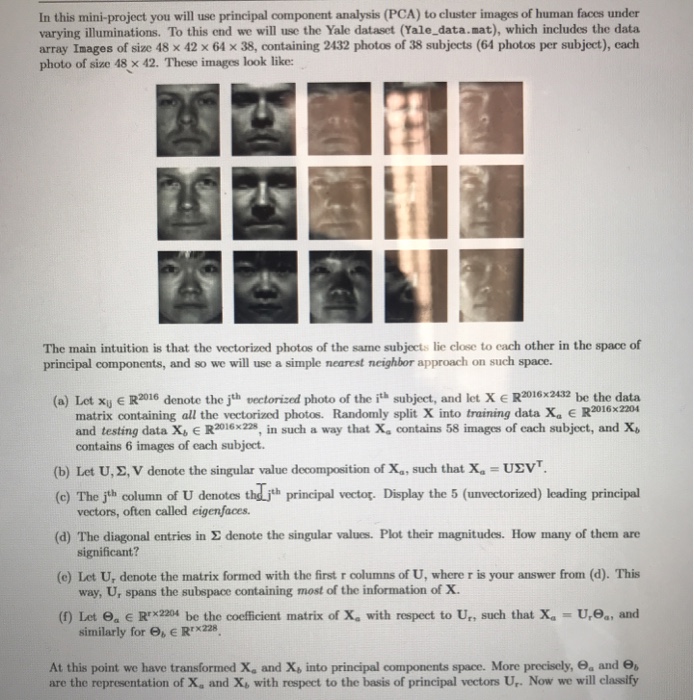
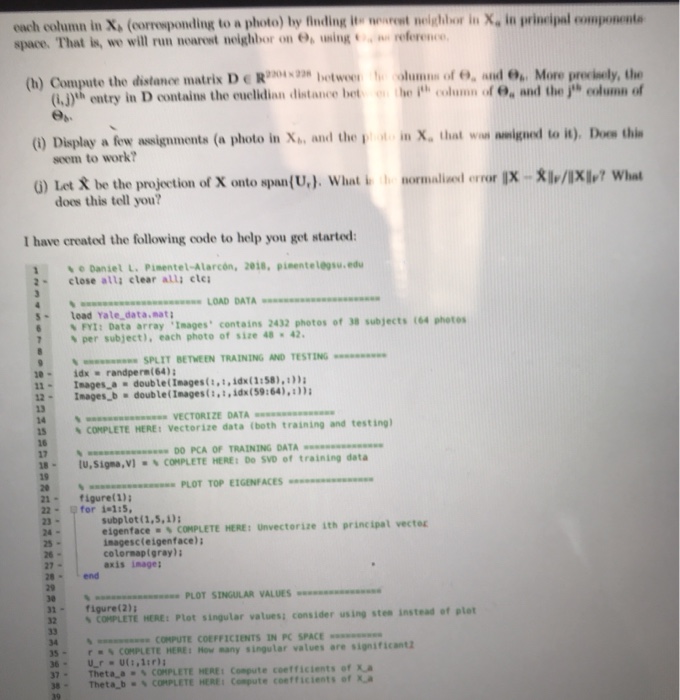
In this mini-project you will use principal component analysis (PCA) to cluster images of human faces under varying illuminations. To this end we will use the Yale dataset (Yale_data.mat), which includes the data array Images of size 48x 42 64 38, containing 2432 photos of 38 subjects (64 photos per subject), each photo of size 48 x 42. These images look like: The main intuition is that the veetorized photos of the same subjects lie close to each other in the space of principal components, and so we will use a simple nearest neighbor approach on such space. (a) let xu E R2016 denote the juh tectorized photo of the ith subject, and let X e R2016 x2432 be the data matrix containing all the vectorized photos. Randomly split X into training data X, e R2016x2204 and testing data Xb E R2016228 in such a way that ??contains 58 images of each subject, and ?. contains 6 images of each subject (b) Let U, ?,V denote the singular value decomposition of X., such that X?-U?VT (c) The jth column of U denotes theith principal vector. Display the 5 (unvectorized) leading principal (d) The diagonal entries in denote the singular values. Plot their magnitudes. How many of them are (e) Let U, denote the matrix formed with the first r columns of U, where r is your answer from (d). This (f) Let ?. E Rrx2204 be the coefficient matrix of X. with respect to Un such that Xa-Urea, and vectors, often called eigenfaces significant? way, Ur spans the subspace containing most of the information of x. similarly for 6, E Rr228. At this point we have transformed ?, and X. into principal components space. More precisely, e, and 6, are the representation of X. and X with respect to the basis of principal vectors Ur-Now we will classify In this mini-project you will use principal component analysis (PCA) to cluster images of human faces under varying illuminations. To this end we will use the Yale dataset (Yale_data.mat), which includes the data array Images of size 48x 42 64 38, containing 2432 photos of 38 subjects (64 photos per subject), each photo of size 48 x 42. These images look like: The main intuition is that the veetorized photos of the same subjects lie close to each other in the space of principal components, and so we will use a simple nearest neighbor approach on such space. (a) let xu E R2016 denote the juh tectorized photo of the ith subject, and let X e R2016 x2432 be the data matrix containing all the vectorized photos. Randomly split X into training data X, e R2016x2204 and testing data Xb E R2016228 in such a way that ??contains 58 images of each subject, and ?. contains 6 images of each subject (b) Let U, ?,V denote the singular value decomposition of X., such that X?-U?VT (c) The jth column of U denotes theith principal vector. Display the 5 (unvectorized) leading principal (d) The diagonal entries in denote the singular values. Plot their magnitudes. How many of them are (e) Let U, denote the matrix formed with the first r columns of U, where r is your answer from (d). This (f) Let ?. E Rrx2204 be the coefficient matrix of X. with respect to Un such that Xa-Urea, and vectors, often called eigenfaces significant? way, Ur spans the subspace containing most of the information of x. similarly for 6, E Rr228. At this point we have transformed ?, and X. into principal components space. More precisely, e, and 6, are the representation of X. and X with respect to the basis of principal vectors Ur-Now we will classify
Step by Step Solution
There are 3 Steps involved in it
It looks like youve uploaded images related to the miniproject that involves Principal Component Analysis PCA to cluster images of human faces under v... View full answer

Get step-by-step solutions from verified subject matter experts
 Study Help