







Question: In this module we have explored chapters 2, 6, 10.3 & 11.4 of the Tanenbaum and Bos text along with scheduling and deadlocking simulations. To
In this module we have explored chapters 2, 6, 10.3 & 11.4 of the Tanenbaum and Bos text along with scheduling and deadlocking simulations. To complete the work for this module I would like you to answer the following questions that deal with processor management:
- Identify the three main states that a process can be in.
- Describe the meaning of each state briefly. (25%)
- Redraw Fig 2-2 adding two new states: New and Terminated.
- When a process is created, it is initially in the New state. When it exits, it is in the Terminated state. (25%)
- In this module you experienced a little about how simulation can be applied in analyzing scheduling and deadlock problems.
- Do you think if this is the only available analysis tool? Be sure to explain why or why not.
- If not, list an alternative analysis method, and explain two advantages and two disadvantages of simulation versus this method. (50%)
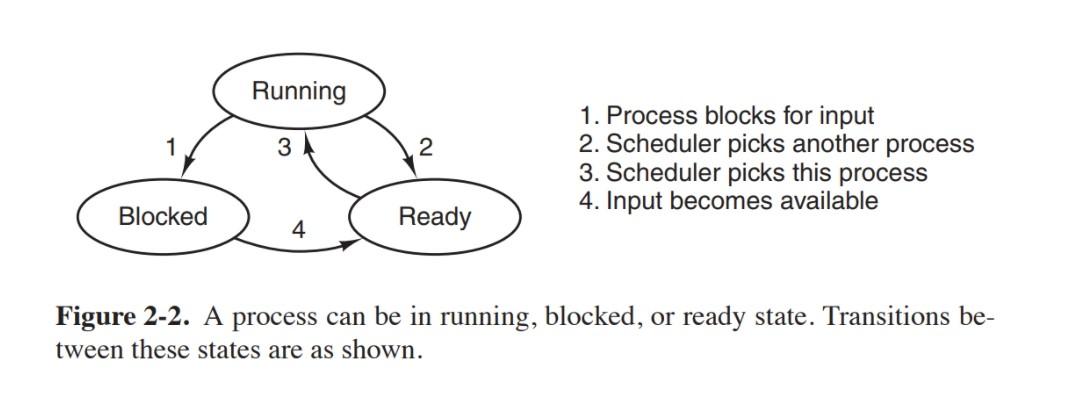
Running 1 3 2 1. Process blocks for input 2. Scheduler picks another process 3. Scheduler picks this process 4. Input becomes available Blocked Ready 4 Figure 2-2. A process can be in running, blocked, or ready state. Transitions be- tween these states are as shown
Step by Step Solution
There are 3 Steps involved in it
1 Expert Approved Answer
Step: 1 Unlock

Question Has Been Solved by an Expert!
Get step-by-step solutions from verified subject matter experts
Step: 2 Unlock
Step: 3 Unlock
 Study Help