







Question: In this problem we will explore a simple way to model oscillatory motion. The model in this problem could be used to approximate the motion
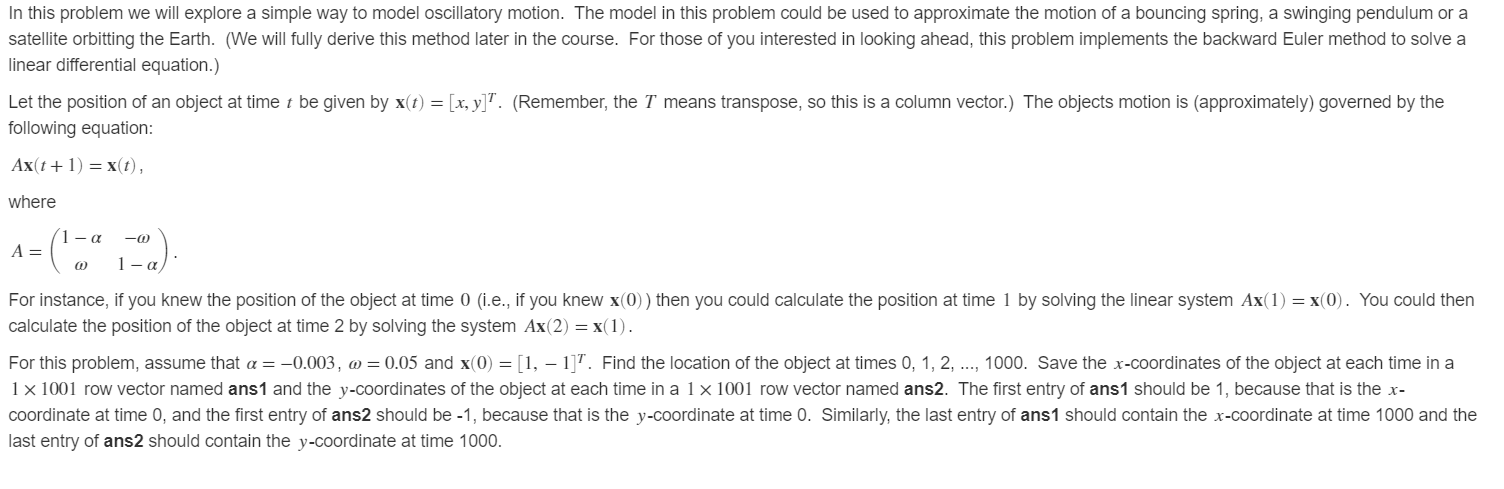
In this problem we will explore a simple way to model oscillatory motion. The model in this problem could be used to approximate the motion of a bouncing spring, a swinging pendulum or a satellite orbitting the Earth. (We will fully derive this method later in the course. For those of you interested in looking ahead, this problem implements the backward Euler method to solve a linear differential equation.) Let the position of an object at time t be given by x(t) = (x, y]T. (Remember, the T means transpose, so this is a column vector.) The objects motion is (approximately) governed by the following equation: Ax(t+1) = xt), where (1-a -o Al 1-a: For instance, if you knew the position of the object at time 0 (i.e., if you knew x(0)) then you could calculate the position at time 1 by solving the linear system Ax(1) = x(0). You could then calculate the position of the object at time 2 by solving the system Ax 2) = x(1). For this problem, assume that a= -0.003, 0 = 0.05 and x(0) = [1, -1]". Find the location of the object at times 0, 1, 2, ..., 1000. Save the x-coordinates of the object at each time in a 1 x 1001 row vector named ans 1 and the y-coordinates of the object at each time in a 1x 1001 row vector named ans2. The first entry of ans 1 should be 1, because that is the x- coordinate at time 0, and the first entry of ans2 should be -1, because that is the y-coordinate at time 0. Similarly, the last entry of ans 1 should contain the x-coordinate at time 1000 and the last entry of ans2 should contain the y-coordinate at time 1000
Step by Step Solution
There are 3 Steps involved in it

Get step-by-step solutions from verified subject matter experts
 Study Help