







Question: In this problem we will study LFSRs in somewhat more detail. LFSRs come in three flavors LFSRs which generate a maximum-length sequence. These LFSRs are
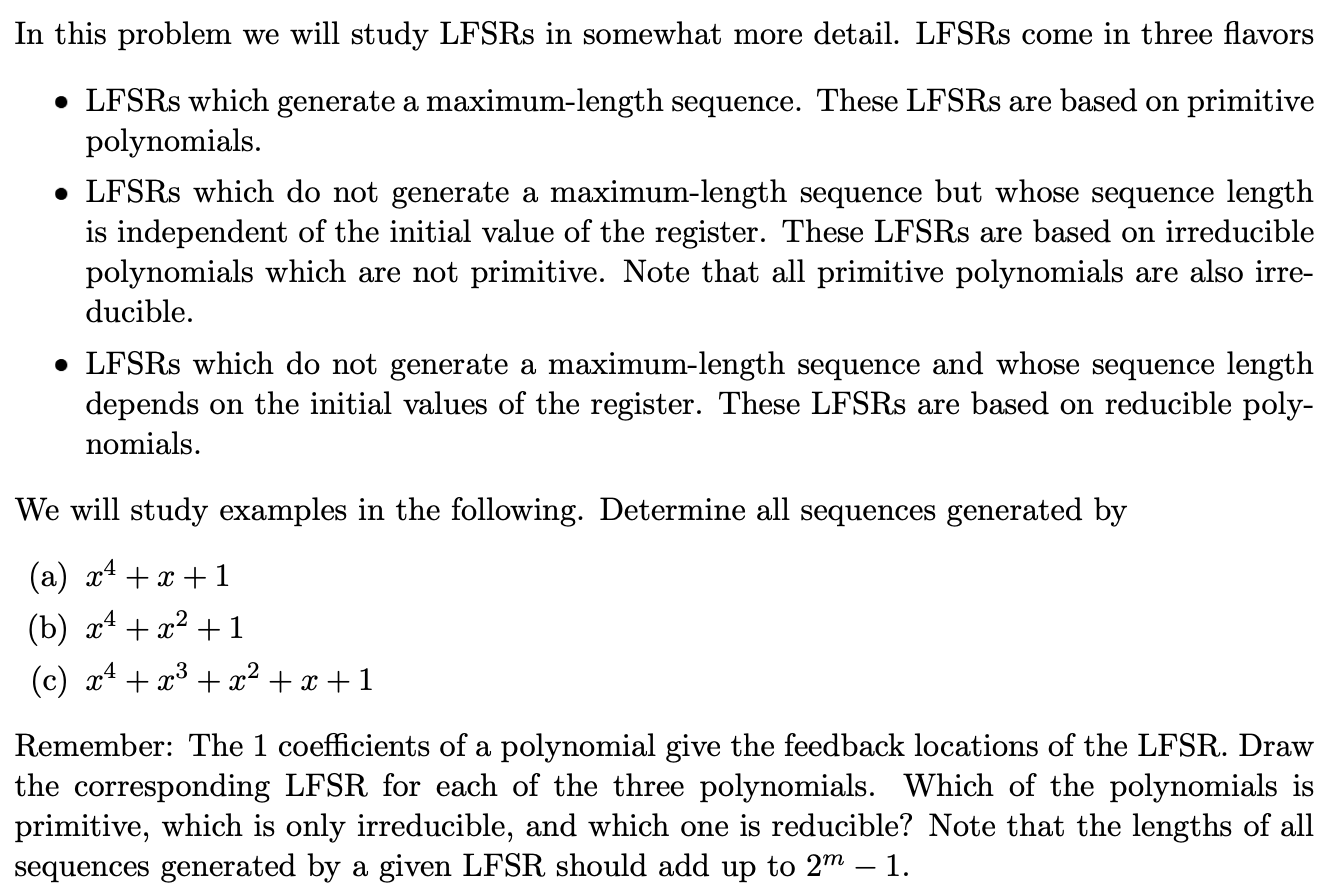
In this problem we will study LFSRs in somewhat more detail. LFSRs come in three flavors LFSRs which generate a maximum-length sequence. These LFSRs are based on primitive polynomials. LFSRs which do not generate a maximum-length sequence but whose sequence length is independent of the initial value of the register. These LFSRs are based on irreducible polynomials which are not primitive. Note that all primitive polynomials are also irre- ducible. LFSRs which do not generate a maximum-length sequence and whose sequence length depends on the initial values of the register. These LFSRs are based on reducible poly- nomials. We will study examples in the following. Determine all sequences generated by (a) x4 + x + 1 (b) x4 + x2 +1 (c) x4 + x3 + x2 + x +1 Remember: The 1 coefficients of a polynomial give the feedback locations of the LFSR. Draw the corresponding LFSR for each of the three polynomials. Which of the polynomials is primitive, which is only irreducible, and which one is reducible? Note that the lengths of all sequences generated by a given LFSR should add up to 2m 1
Step by Step Solution
There are 3 Steps involved in it

Get step-by-step solutions from verified subject matter experts
 Study Help