







Question: . In this problem, you are going to develop a Nave Bayes classifier. You will work with two classes, {Passed, Failed}, and each of your
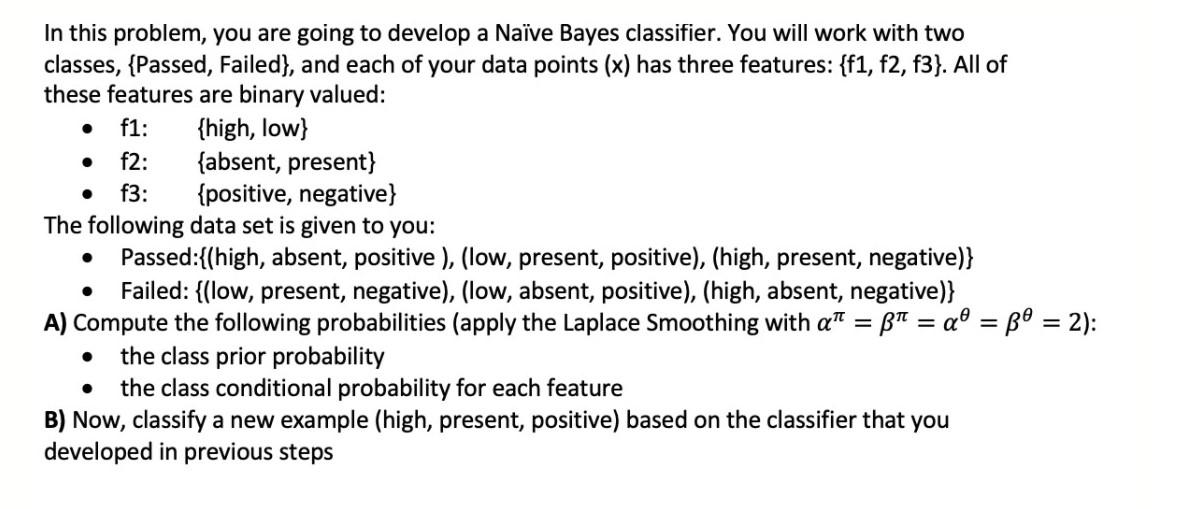
. In this problem, you are going to develop a Nave Bayes classifier. You will work with two classes, {Passed, Failed}, and each of your data points (x) has three features: {f1, f2, f3}. All of these features are binary valued: f1: {high, low} f2: {absent, present} f3: {positive, negative} The following data set is given to you: Passed:{(high, absent, positive ), (low, present, positive), (high, present, negative)} Failed: {(low, present, negative), (low, absent, positive), (high, absent, negative)} A) Compute the following probabilities (apply the Laplace Smoothing with a = BT = a = p = 2): the class prior probability the class conditional probability for each feature B) Now, classify a new example (high, present, positive) based on the classifier that you developed in previous steps . = . . In this problem, you are going to develop a Nave Bayes classifier. You will work with two classes, {Passed, Failed}, and each of your data points (x) has three features: {f1, f2, f3}. All of these features are binary valued: f1: {high, low} f2: {absent, present} f3: {positive, negative} The following data set is given to you: Passed:{(high, absent, positive ), (low, present, positive), (high, present, negative)} Failed: {(low, present, negative), (low, absent, positive), (high, absent, negative)} A) Compute the following probabilities (apply the Laplace Smoothing with a = BT = a = p = 2): the class prior probability the class conditional probability for each feature B) Now, classify a new example (high, present, positive) based on the classifier that you developed in previous steps . =
Step by Step Solution
There are 3 Steps involved in it

Get step-by-step solutions from verified subject matter experts
 Study Help