







Question: In this problem, you will design a circuit that determines the winner of a certain election. In this election, up to 16 people can
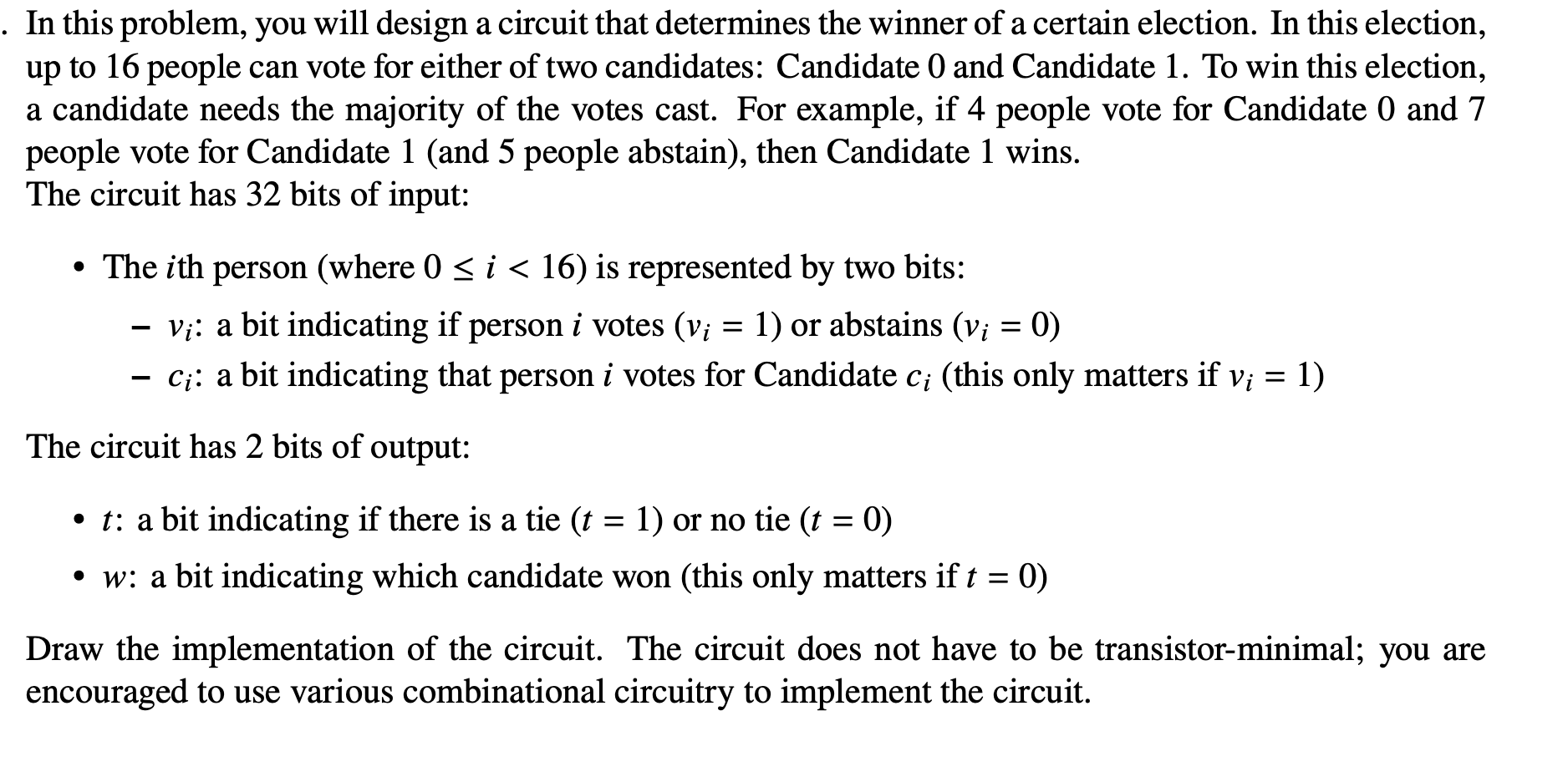
In this problem, you will design a circuit that determines the winner of a certain election. In this election, up to 16 people can vote for either of two candidates: Candidate 0 and Candidate 1. To win this election, a candidate needs the majority of the votes cast. For example, if 4 people vote for Candidate 0 and 7 people vote for Candidate 1 (and 5 people abstain), then Candidate 1 wins. The circuit has 32 bits of input: The ith person (where 0 i 16) is represented by two bits: - v: a bit indicating if person i votes (v; = 1) or abstains (v; = 0) ci: a bit indicating that person i votes for Candidate c; (this only matters if v; = 1) The circuit has 2 bits of output: t: a bit indicating if there is a tie (t = 1) or no tie (t = 0) w: a bit indicating which candidate won (this only matters if t = 0) Draw the implementation of the circuit. The circuit does not have to be transistor-minimal; you are encouraged to use various combinational circuitry to implement the circuit.
Step by Step Solution
There are 3 Steps involved in it

Get step-by-step solutions from verified subject matter experts
 Study Help