







Question: In this question we are working with the density parameters Q. Assume A = 0 and k 0. %3D Moreover consider a matter-dominated universe.
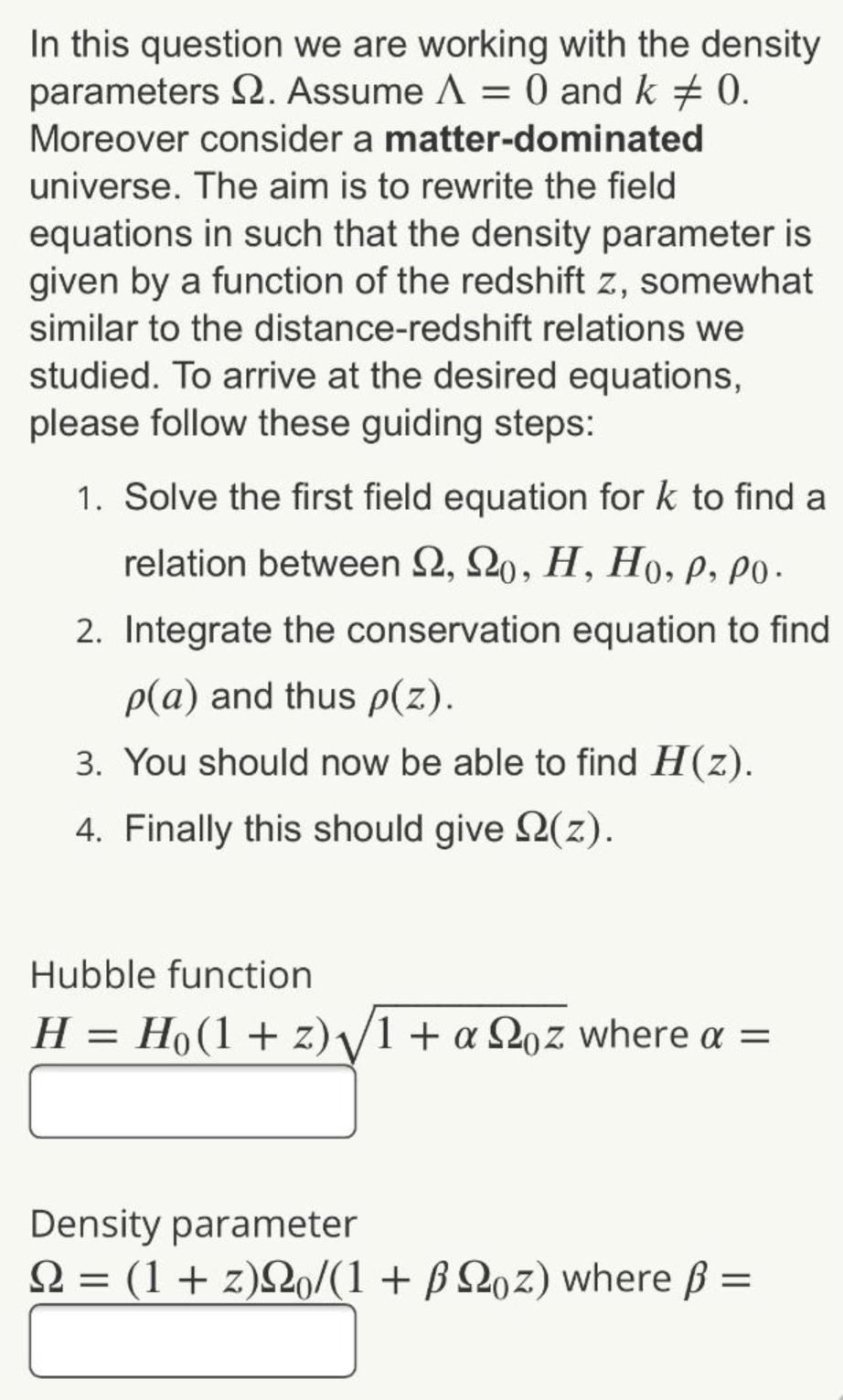
In this question we are working with the density parameters Q. Assume A = 0 and k 0. %3D Moreover consider a matter-dominated universe. The aim is to rewrite the field equations in such that the density parameter is given by a function of the redshift z, somewhat similar to the distance-redshift relations we studied. To arrive at the desired equations, please follow these guiding steps: 1. Solve the first field equation for k to find a relation between 2, 20, H, Ho, p, po 2. Integrate the conservation equation to find p(a) and thus p(z). 3. You should now be able to find H(z). 4. Finally this should give 2(z). Hubble function H = Ho(1+ z)/1+ a Qoz where a = Density parameter 2 = (1+ z)Qo/(1 + B 2oz) where %3D
Step by Step Solution
3.33 Rating (162 Votes )
There are 3 Steps involved in it
we knecU 13 field oqualer So a K 3D a 8m S7 8 yaccem In ... View full answer

Get step-by-step solutions from verified subject matter experts
 Study Help