







Question: IN VHDL CODE ONLY Design a parameterized computation unit that can do all the operations listed below. Add, subtract, multiply, greater than, less than, greater
IN VHDL CODE ONLY
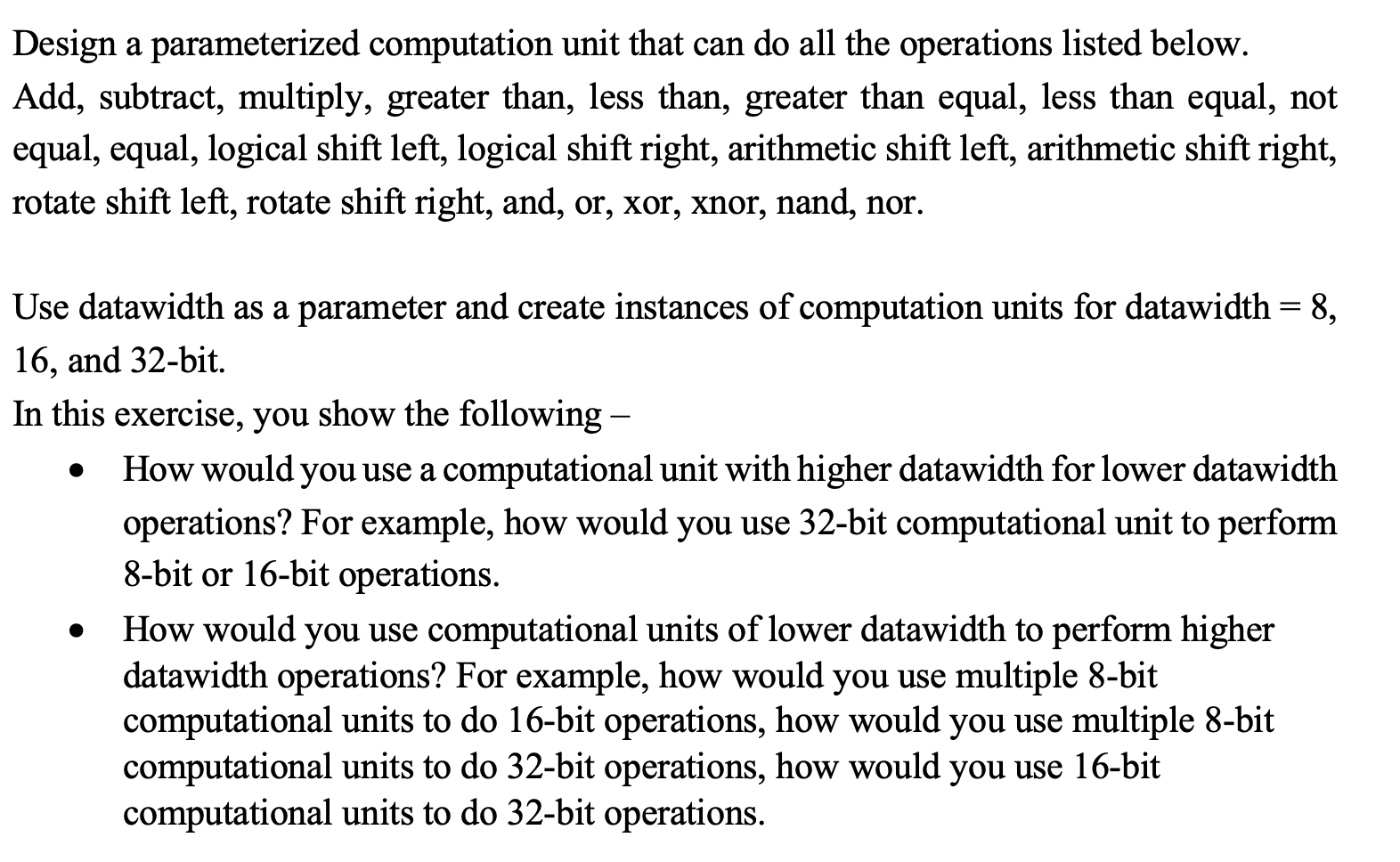
Design a parameterized computation unit that can do all the operations listed below. Add, subtract, multiply, greater than, less than, greater than equal, less than equal, not equal, equal, logical shift left, logical shift right, arithmetic shift left, arithmetic shift right, rotate shift left, rotate shift right, and, or, xor, xnor, nand, nor. Use datawidth as a parameter and create instances of computation units for datawidth = 8, 16, and 32-bit. In this exercise, you show the following - How would you use a computational unit with higher datawidth for lower datawidth operations? For example, how would you use 32-bit computational unit to perform 8-bit or 16-bit operations. How would you use computational units of lower datawidth to perform higher datawidth operations? For example, how would you use multiple 8-bit computational units to do 16-bit operations, how would you use multiple 8-bit computational units to do 32-bit operations, how would you use 16-bit computational units to do 32-bit operations. Design a parameterized computation unit that can do all the operations listed below. Add, subtract, multiply, greater than, less than, greater than equal, less than equal, not equal, equal, logical shift left, logical shift right, arithmetic shift left, arithmetic shift right, rotate shift left, rotate shift right, and, or, xor, xnor, nand, nor. Use datawidth as a parameter and create instances of computation units for datawidth = 8, 16, and 32-bit. In this exercise, you show the following - How would you use a computational unit with higher datawidth for lower datawidth operations? For example, how would you use 32-bit computational unit to perform 8-bit or 16-bit operations. How would you use computational units of lower datawidth to perform higher datawidth operations? For example, how would you use multiple 8-bit computational units to do 16-bit operations, how would you use multiple 8-bit computational units to do 32-bit operations, how would you use 16-bit computational units to do 32-bit operations
Step by Step Solution
There are 3 Steps involved in it

Get step-by-step solutions from verified subject matter experts
 Study Help