Question: In what ways does Bezoss decision to develop and deliver the Kindle, Amazon Prime, and Amazon web service lines show systematic and intuitive thinking? How
In what ways does Bezoss decision to develop and deliver the Kindle, Amazon Prime, and Amazon web service lines show systematic and intuitive thinking?
How do you describe the competitive risk in Amazons environment as other retailers, including Walmart and Apple, strengthen their online offerings?
Case study:
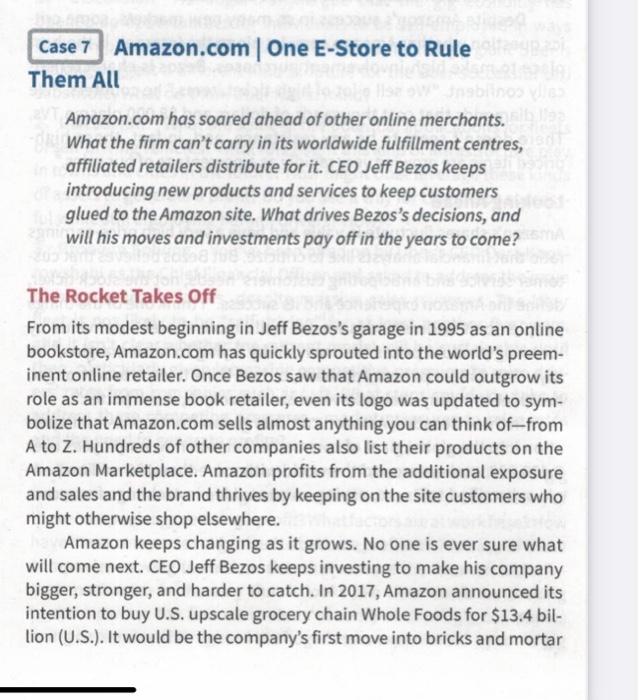
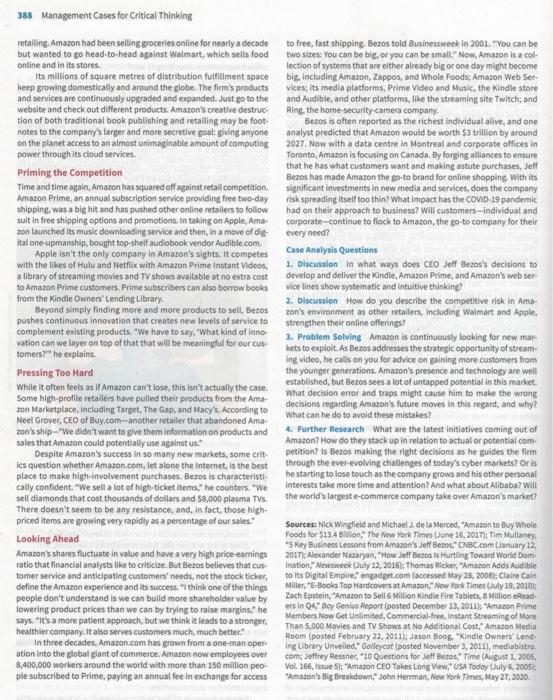
Case 7 Amazon.com | One E-Store to Rule Them All Amazon.com has soared ahead of other online merchants. What the firm can't carry in its worldwide fulfillment centres, affiliated retailers distribute for it. CEO Jeff Bezos keeps introducing new products and services to keep customers glued to the Amazon site. What drives Bezos's decisions, and will his moves and investments pay off in the years to come? The Rocket Takes Off From its modest beginning in Jeff Bezos's garage in 1995 as an online bookstore, Amazon.com has quickly sprouted into the world's preem- inent online retailer. Once Bezos saw that Amazon could outgrow its role as an immense book retailer, even its logo was updated to sym- bolize that Amazon.com sells almost anything you can think of-from A to Z. Hundreds of other companies also list their products on the Amazon Marketplace. Amazon profits from the additional exposure and sales and the brand thrives by keeping on the site customers who might otherwise shop elsewhere. Amazon keeps changing as it grows. No one is ever sure what will come next. CEO Jeff Bezos keeps investing to make his company bigger, stronger, and harder to catch. In 2017, Amazon announced its intention to buy U.S. upscale grocery chain Whole Foods for $13.4 bil- lion (U.S.). It would be the company's first move into bricks and mortar 388 Management Cases for Critical Thinking retailing. Amazon had been selling groceries online for nearly a decade but wanted to go head-to-head against Walmart, which sells food online and in its stores. Its millions of square metres of distribution fulfilment space keep growing domestically and around the globe. The firm's products and services are continuously upgraded and expanded. Just go to the website and check out different products. Amazon's creative destruc- tion of both traditional book publishing and retailing may be foot- notes to the company's larger and more secretive goals giving anyone on the planet access to an almost unimaginable amount of computing power through its cloud services Priming the Competition Time and time again, Amazon has squared off against retail competition, Amazon Prime, an annual subscription service providing free two-day shipping, was a big hit and has pushed other online retailers to follow suit in free shipping options and promotions. In taking on Apple, Ama zon launched its music downloading service and then, in a move of dig. ital one-upmanship, bought top-shelf audiobook vendor Audible.com Apple isn't the only company in Amazon's sights. It competes with the likes of Hulu and Netflix with Amazon Prime Instant Videos, a library of streaming movies and TV shows available at no extra cost to Amazon Prime customers. Prime subscribers can also borrow books from the Kindle Owners' Lending Library Beyond simply finding more and more products to sell, Bezos pushes continuous Innovation that creates new levels of service to complement existing products. "We have to say, "What kind of iono vation can we layer on top of that that will be meaningful for our cus tomers?" he explains Pressing Too Hard While it often feels as if Amazon can't lose, this isn't actually the case. Some high-profile retailers have pulled their products from the Ama zon Marketplace, including Target, The Gap, and Macy's. According to Neel Grover, CEO of Buy.com-another retailer that abandoned Ama 2on's ship-"We didn't want to give them information on products and sales that Amazon could potentially use against us. Despite Amazon's success in so many new markets, some crit- ics question whether Amazon.com, let alone the Internet, is the best place to make high-involvement purchases. Bezos is characteristi- cally confident. "We sell a lot of high-ticket items," he counters. "We sell diamonds that cost thousands of dollars and $8,000 plasma TVS There doesn't seem to be any resistance, and, in fact, those high- priced items are growing very rapidly as a percentage of our sales." Looking Ahead Amazon's shares fluctuate in value and have a very high price earnings ratio that financial analysts like to criticize. But Bezos believes that cus tomer service and anticipating customers' needs, not the stock ticker, define the Amazon experience and its success. think one of the things people don't understand is we can build more shareholder value by lowering product prices thao we can by trying to raise margins," he says. "It's a more patient approach, but we think it leads to a stronger, healthier company. It also serves customers much, much better." in three decades, Amazon.com has grown from a one-man oper stion into the global plant of commerce. Amazon now employees over 8,400,000 workers around the world with more than 150 million peo ple subscribed to Prime, paying an annual fee in exchange for access to free, fast shipping. Bezos told Businessweek in 2001. "You can be two sizes. You can be big, or you can be small." Now, Amazon is a col lection of systems that are either already big or one day might become big, including Amazon, Zappos, and Whole Foods; Amazon Web Ser. vices; its media platforms, Prime Video and Music, the Kindle store and Audible, and other platforms, like the streaming site Twitch, and Ring, the home security camera company. Bezos is often reported as the richest individual alive, and one analyst predicted that Amazon would be worth $3 trillion by around 2027. Now with a data centre in Montreal and corporate offices in Toronto, Amazon is focusing on Canada. By forging alliances to ensure that he has what customers want and making astute purchases, Jeff Bezos has made Amazon the go-to brand for online shopping. With its significant investments in new media and services, does the company risk spreading itself too thin? What impact has the COVID-19 pandemic had on their approach to business? Will customers--individual and corporate-continue to flock to Amazon, the go-to company for their every need? Case Analysis Questions 1. Discussion in what ways does CEO Jeff Bezos's decisions to develop and deliver the Kindle, Amazon Prime, and Amazon's web ser vice lines show systematic and intuitive thinking? 2. Discussion How do you describe the competitive risk in Ama zon's environment as other retailers, including Walmart and Apple. strengthen their online offerings? 3. Problem Solving Amazon is continuously looking for new mar kets to exploit. As Bezos addresses the strategic opportunity of stream ing video, he calls on you for advice on gaining more customers from the younger generations. Amazon's presence and technology are well established, but Bezos sees a lot of untapped potential in this market. What decision error and traps might cause him to make the wrong decisions regarding Amazon's future moves in this regard, and why? What can he do to avoid these mistakes? 4. Further Research What are the latest initiatives coming out of Amazon? How do they stack up in relation to actual or potential com petition is Bezos making the right decisions as he guides the firm through the ever-evolving challenges of today's cyber markets? Orls he starting to lose touch as the company grows and his other personal Interests take more time and attention? And what about Alibaba? WILL the world's largest e-commerce company take over Amazon's market? Sources: Nick Wingfield and Michael J. de la Merced, "Amazon to Buy Whole Foods for $13.4 Blon." The New York Times Dune 16, 2017): Tim Mulaney, *5 Key Business Lessons from Amazon's Jeff Bezos, "CNBC.com January 12, 2017), Alexander Nazaryan,"How Jeff Bezos is Hurtling Toward World Dom Insation" Newsweek (July 12, 2016): Thomas Ricker. "Amazon Addis Audible to its Digital Empire, engadget.com (accessed May 28, 2008), Claire Cain Miller, "E-Books Top Hardcovers at Amazon, New York Times Culy 19, 2010) Zach Epstein, "Amazon to Sell 6 Million Kindle Fire Tablets, 8 Million Read ers in 04. Bey Genius Report (posted December 13, 2011). "Amazon Prime Members Now Get Unlimited, Commercial-free, Instant Streaming of More Than 5,000 Movies and TV Shows at No Additional cost." Amazon Media Room (posted February 22, 2011): Jason Boog. "Kindle Owners' Lande Ing Library Unveiled." Galleycat posted November 3, 2011), mediabistro com, Jeffrey Ressner, 20 Questions for Jeff Bezos." Time August 1, 2005, Vol 166, Issue 5"Amazon CEO Takes Long View, USA Today July 6, 2005: Amazon's Big Breakdown." John Herrman, New York Times, May 27, 2020









 Study Help