Question: In what ways does the Ikea case demonstrate the risks/challenges of expanding internationally? Should Ikeas relationship with its suppliers remain largely a commercial one or
- In what ways does the Ikea case demonstrate the risks/challenges of expanding internationally?
- Should Ikeas relationship with its suppliers remain largely a commercial one or should it expand to cover social/environmental issues? Provide justifications to your stance.
- Based on the strategic stance you have chosen, what would you recommend Marianne Barner do to address this crisis both in short and the long-term? Should the company stay or should it exit India? Describe the impact of your decision and how you would manage it.
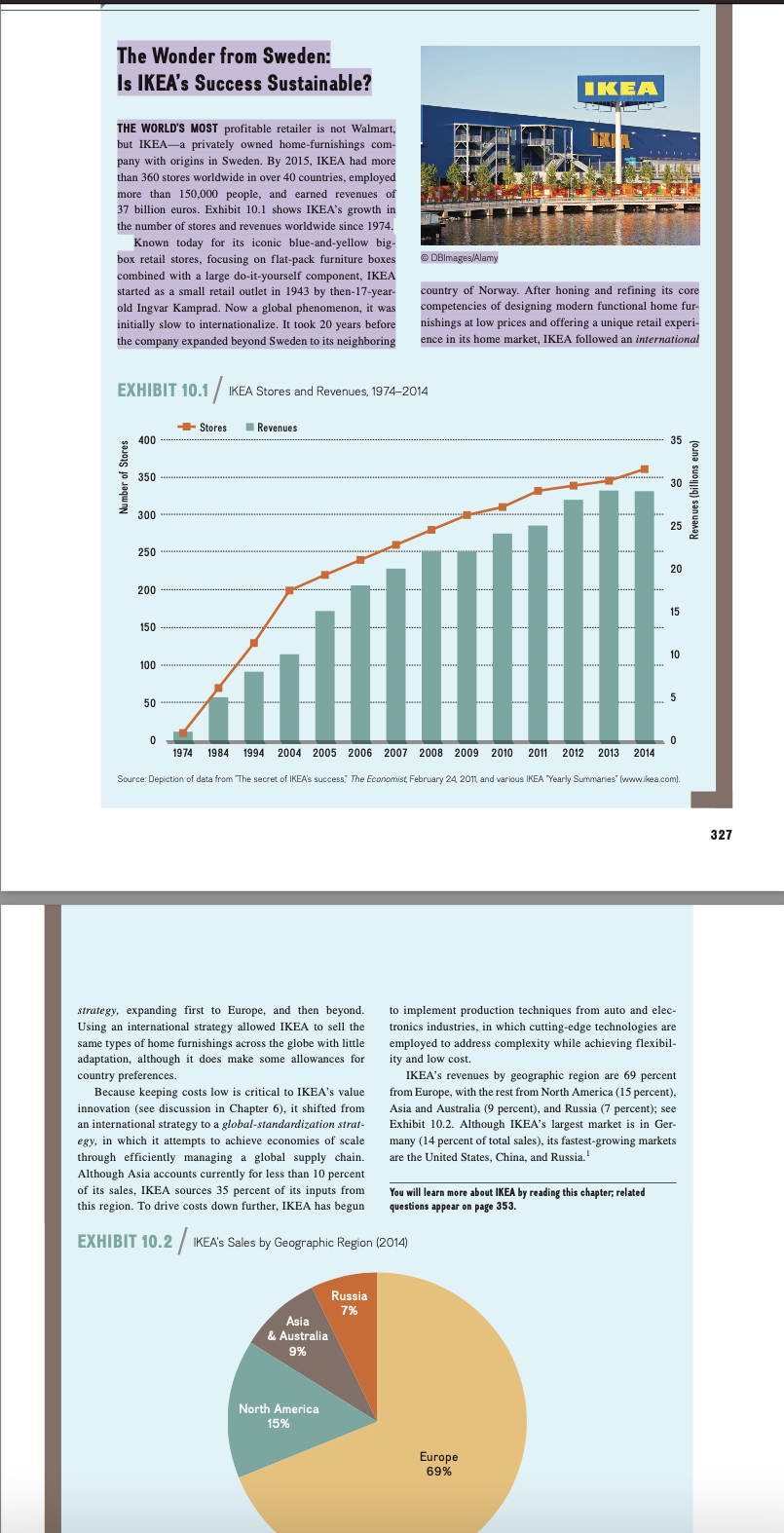
The Wonder from Sweden: Is IKEA's Success Sustainable? IKEA CC IKI THE WORLD'S MOST profitable retailer is not Walmart, but IKEA-a privately owned home-furnishings com- pany with origins in Sweden. By 2015, IKEA had more than 360 stores worldwide in over 40 countries, employed more than 150,000 people, and earned revenues of 37 billion euros. Exhibit 10.1 shows IKEA's growth in the number of stores and revenues worldwide since 1974. Known today for its iconic blue-and-yellow big- box retail stores, focusing on flat-pack furniture boxes combined with a large do-it-yourself component, IKEA started as a small retail outlet in 1943 by then-17-year- old Ingvar Kamprad. Now a global phenomenon, it was initially slow to internationalize. It took 20 years before the company expanded beyond Sweden to its neighboring @ DBimages/Alamy country of Norway. After honing and refining its core competencies of designing modern functional home fur- nishings at low prices and offering a unique retail experi- ence in its home market, IKEA followed an international EXHIBIT 10.1 IKEA Stores and Revenues, 1974-2014 Stores Revenues 400 35 Number of Stores 8350 30 Revenues (billions 300 25 250 20 200 15 150 10 100 5 50 0 0 1974 1984 1994 2004 2005 2006 2007 2008 2009 2010 2011 2012 2013 2014 Source: Depiction of data from The secret of IKEAs success." The Economist, February 24 2011 and various IKEA "Yearly Summaries" (www.ikea.com). 327 strategy, expanding first to Europe, and then beyond. Using an international strategy allowed IKEA to sell the same types of home furnishings across the globe with little adaptation, although it does make some allowances for country preferences Because keeping costs low is critical to IKEA's value innovation (see discussion in Chapter 6), it shifted from an international strategy to a global-standardization strat- egy, in which it attempts to achieve economies of scale through efficiently managing a global supply chain. Although Asia accounts currently for less than 10 percent of its sales, IKEA sources 35 percent of its inputs from this region. To drive costs down further, IKEA has begun to implement production techniques from auto and elec- tronics industries, in which cutting-edge technologies are employed to address complexity while achieving flexibil- ity and low cost. IKEA's revenues by geographic region are 69 percent from Europe, with the rest from North America (15 percent), Asia and Australia (9 percent), and Russia (7 percent); see Exhibit 10.2. Although IKEA's largest market is in Ger- many (14 percent of total sales), its fastest-growing markets are the United States, China, and Russia.' You will learn more about IKEA by reading this chapter, related questions appear on page 353. EXHIBIT 10.2 / IKEA's Sales by Geographic Region (2014) Russia 7% Asia & Australia 9% North America 15% Europe 69%









 Study Help