







Question: In your program evaluation proposals, you aren't analyzing data or writing an analysis plan. However, as you design an evaluation proposal, it's good to think
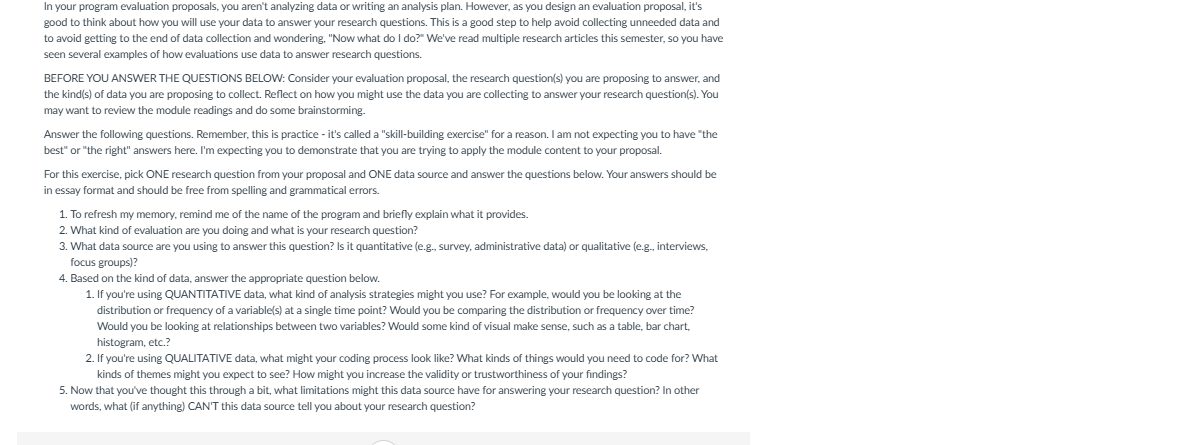
In your program evaluation proposals, you aren't analyzing data or writing an analysis plan. However, as you design an evaluation proposal, it's good to think about how you will use your data to answer your research questions. This is a good step to help avoid collecting unneeded data and to avoid getting to the end of data collection and wondering, "Now what do I do?" We've read multiple research articles this semester, so you have seen several examples of how evaluations use data to answer research questions. BEFORE YOU ANSWER THE QUESTIONS BELOW: Consider your evaluation proposal, the research question(s) you are proposing to answer, and the kind(s) of data you are proposing to collect. Reflect on how you might use the data you are collecting to answer your research question(s). You may want to review the module readings and do some brainstorming. Answer the following questions. Remember, this is practice - it's called a "skill-building exercise" for a reason. I am not expecting you to have "the best" or "the right" answers here. I'm expecting you to demonstrate that you are trying to apply the module content to your proposal. For this exercise, pick ONE research question from your proposal and ONE data source and answer the questions below. Your answers should be in essay format and should be free from spelling and grammatical errors. 1. To refresh my memory, remind me of the name of the program and briefly explain what it provides. 2. What kind of evaluation are you doing and what is your research question? 3. What data source are you using to answer this question? Is it quantitative (e.g., survey, administrative data) or qualitative (e.g., interviews, focus groups)? 4. Based on the kind of data, answer the appropriate question below. 1. If you're using QUANTITATIVE data, what kind of analysis strategies might you use? For example, would you be looking at the distribution or frequency of a variable(s) at a single time point? Would you be comparing the distribution or frequency over time? Would you be looking at relationships between two variables? Would some kind of visual make sense, such as a table, bar chart, histogram, etc.? 2. If you're using QUALITATIVE data, what might your coding process look like? What kinds of things would you need to code for? What kinds of themes might you expect to see? How might you increase the validity or trustworthiness of your findings? 5. Now that you've thought this through a bit, what limitations might this data source have for answering your research question? In other words, what (if anything) CAN'T this data source tell you about your research
Step by Step Solution
There are 3 Steps involved in it

Get step-by-step solutions from verified subject matter experts
 Study Help