







Question: In-Class Workshop: Finding a Court Case for Your Research Paper The first part of this research project will require you to locate and briefly summarize
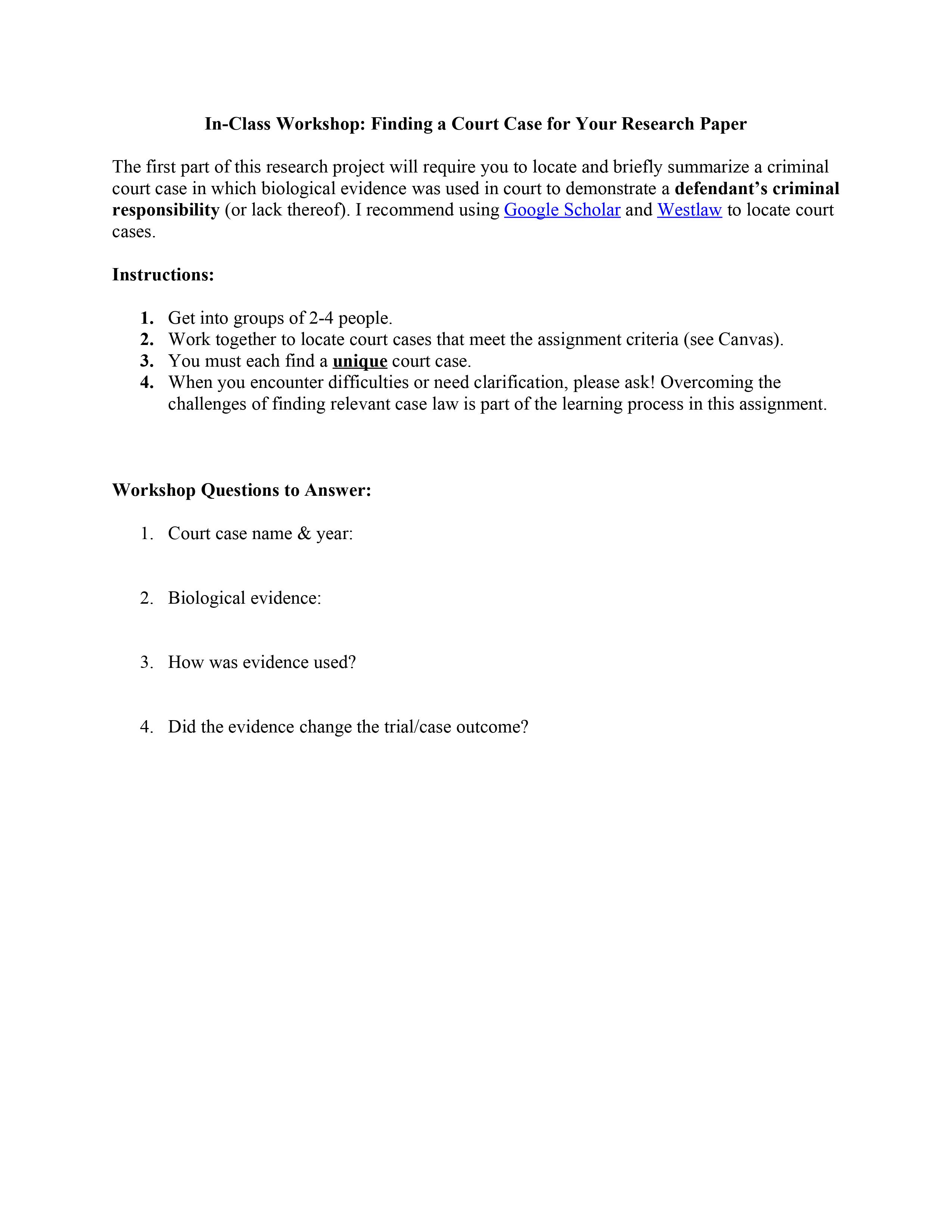
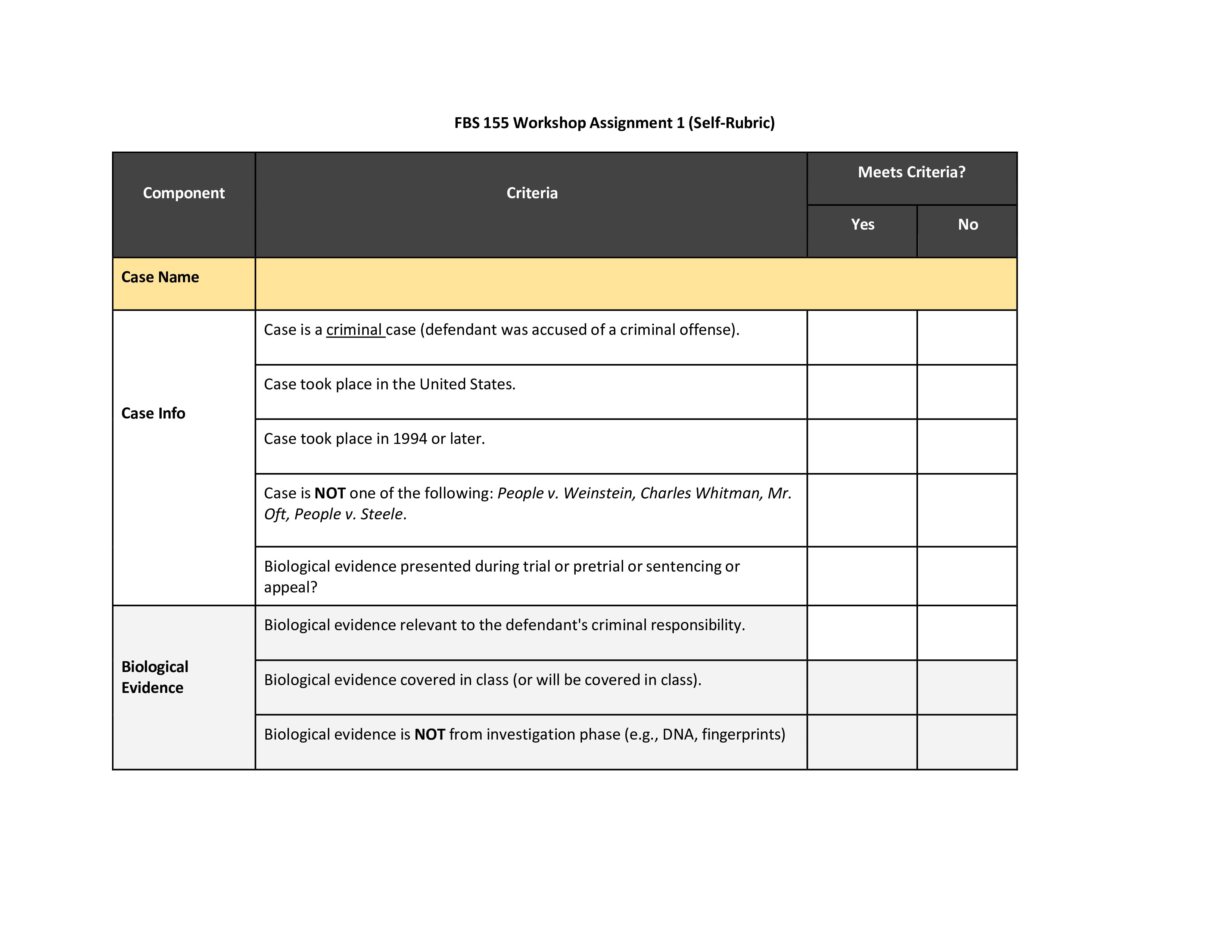
In-Class Workshop: Finding a Court Case for Your Research Paper The first part of this research project will require you to locate and briefly summarize a criminal court case in which biological evidence was used in court to demonstrate a defendant's criminal responsibility (or lack thereof). I recommend using Google Scholar and Westlaw to locate court cases. Instructions: 1. Get into groups of 2-4 people. 2. Work together to locate court cases that meet the assignment criteria (see Canvas). 3. You must each find a unique court case. 4. When you encounter difficulties or need clarification, please ask! Overcoming the challenges of finding relevant case law is part of the learning process in this assignment. Workshop Questions to Answer: 1. Court case name & year: 2. Biological evidence: 3. How was evidence used? 4. Did the evidence change the trial/case outcome? FBS 155 Workshop Assignment 1 (Self-Rubric) Meets Criteria? Component Criteria Yes No Case Name Case is a criminal case (defendant was accused of a criminal offense). Case took place in the United States. Case Info Case took place in 1994 or later. Case is NOT one of the following: People v. Weinstein, Charles Whitman, Mr. Oft, People v. Steele. Biological evidence presented during trial or pretrial or sentencing or appeal? Biological evidence relevant to the defendant's criminal responsibility. Biological Evidence Biological evidence covered in class (or will be covered in class). Biological evidence is NOT from investigation phase (e.g., DNA, fingerprints)
Step by Step Solution
There are 3 Steps involved in it

Get step-by-step solutions from verified subject matter experts
 Study Help