







Question: Increasing, constant, and decreasing returns to scale are common. The table shows esti- mates of Cobb-Douglas production functions and returns to scale in various industries.
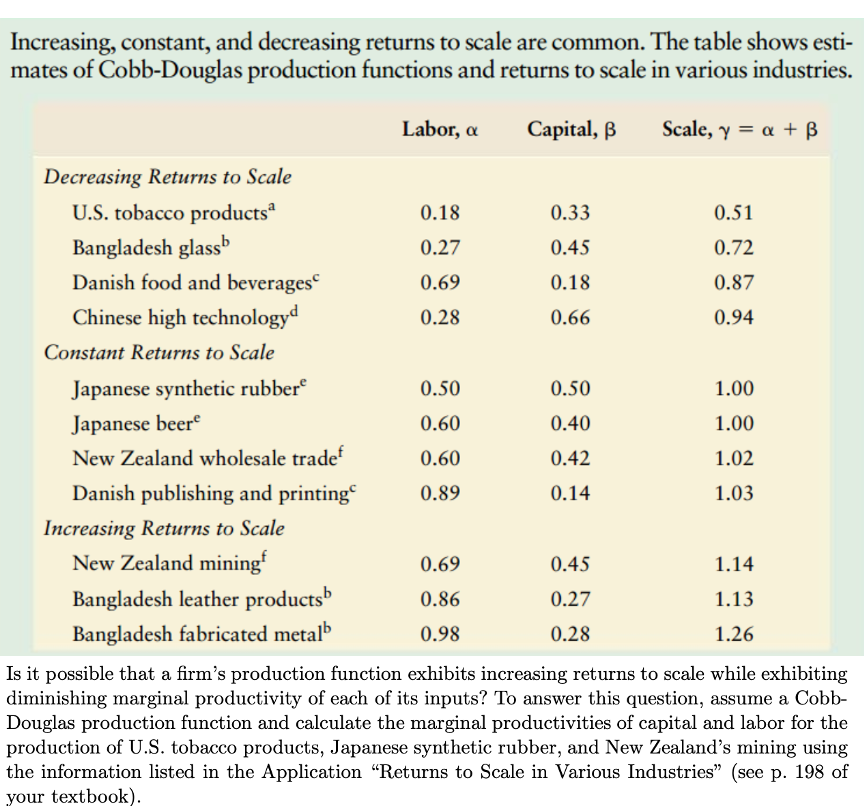
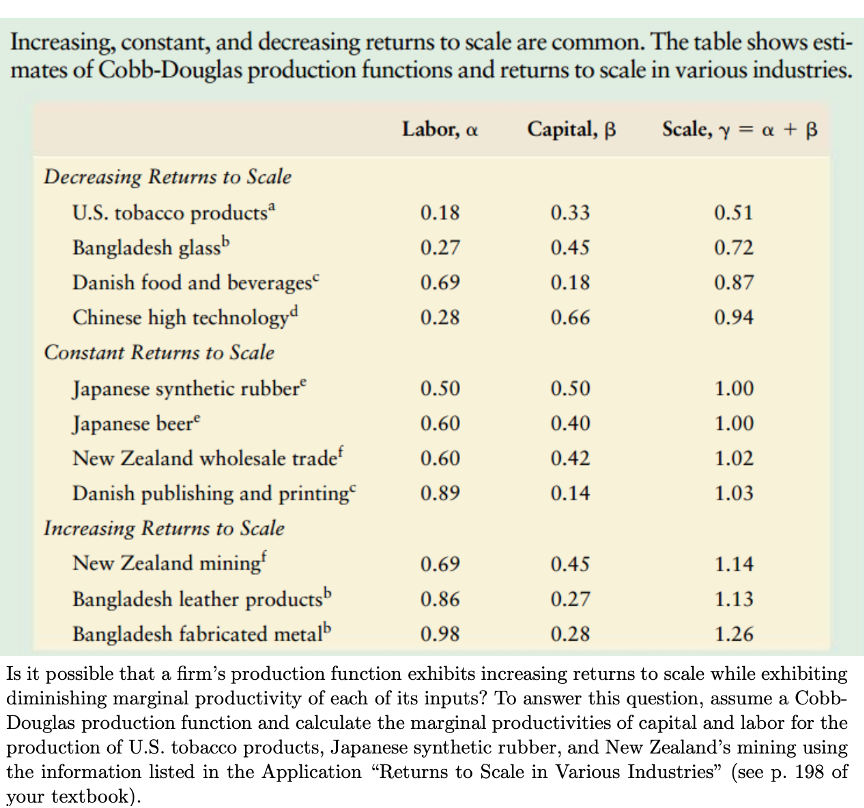
Increasing, constant, and decreasing returns to scale are common. The table shows esti- mates of Cobb-Douglas production functions and returns to scale in various industries. Labor, or Capital, B Scale, y = a + B Decreasing Returns to Scale U.S. tobacco products 0.18 0.33 0.51 Bangladesh glassb 0.27 0.45 0.72 Danish food and beverages 0.69 0.18 0.87 Chinese high technologyd 0.28 0.66 0.94 Constant Returns to Scale Japanese synthetic rubber 0.50 0.50 1.00 Japanese beer 0.60 0.40 1.00 New Zealand wholesale tradef 0.60 0.42 1.02 Danish publishing and printing 0.89 0.14 1.03 Increasing Returns to Scale New Zealand mining 0.69 0.45 1.14 Bangladesh leather products 0.86 0.27 1.13 Bangladesh fabricated metalb 0.98 0.28 1.26 Is it possible that a firm's production function exhibits increasing returns to scale while exhibiting diminishing marginal productivity of each of its inputs? To answer this question, assume a Cobb- Douglas production function and calculate the marginal productivityes of capital and labor for the production of U.S. tobacco products, Japanese synthetic rubber, and New Zealand's mining using the information listed in the Application "Returns to Scale in Various Industries" (see p. 198 of your textbook)
Step by Step Solution
There are 3 Steps involved in it

Get step-by-step solutions from verified subject matter experts
 Study Help