







Question: PLEASE USE THE ARTICLE BELOW TO ANSWER. I HIGHLIGHTED SOME SO IT CAN BE EASY FOR YOU. ARTICLE: READ AND USE THE RESEARCH ARTICLE: THE
PLEASE USE THE ARTICLE BELOW TO ANSWER. I HIGHLIGHTED SOME SO IT CAN BE EASY FOR YOU.
ARTICLE:
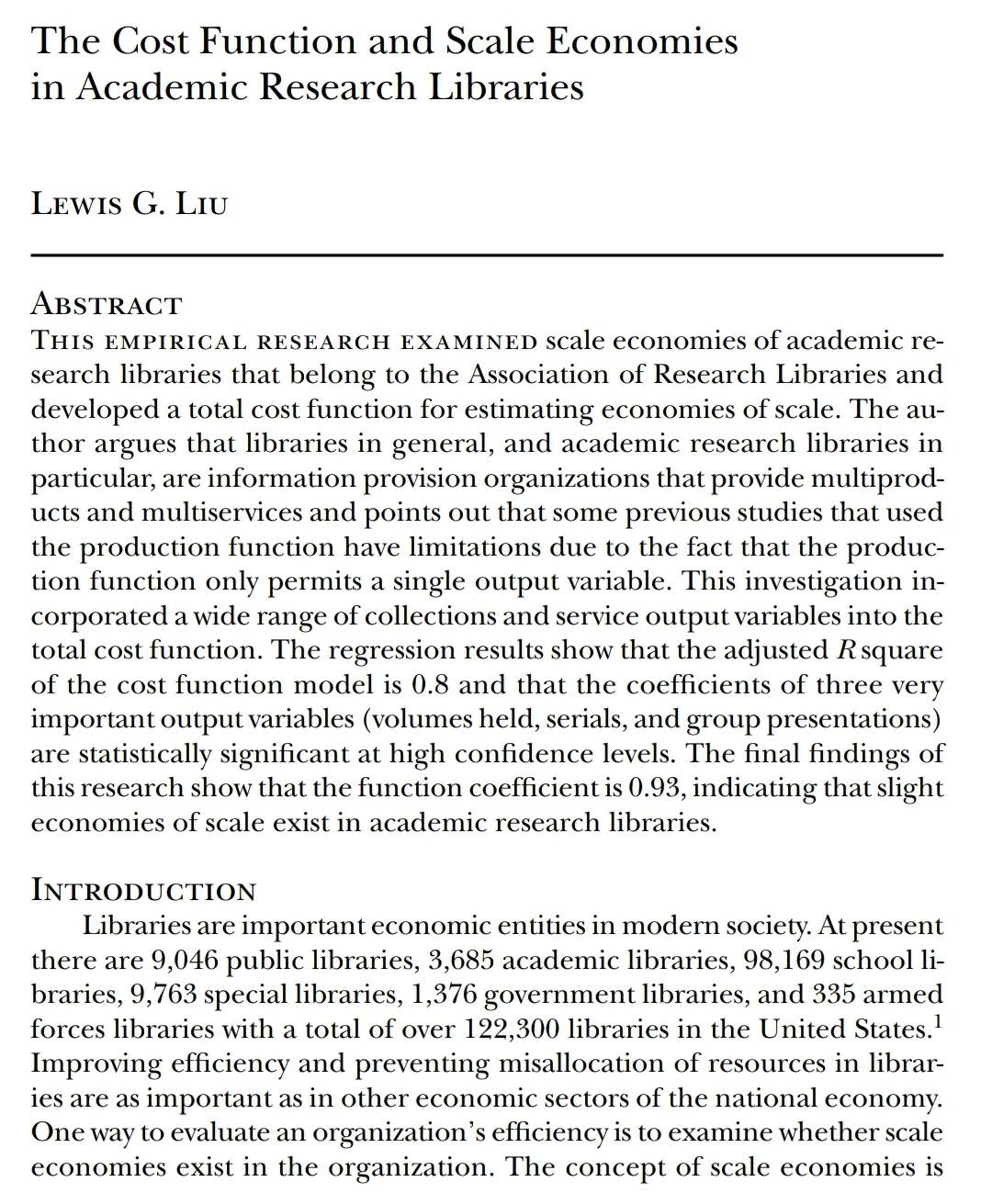
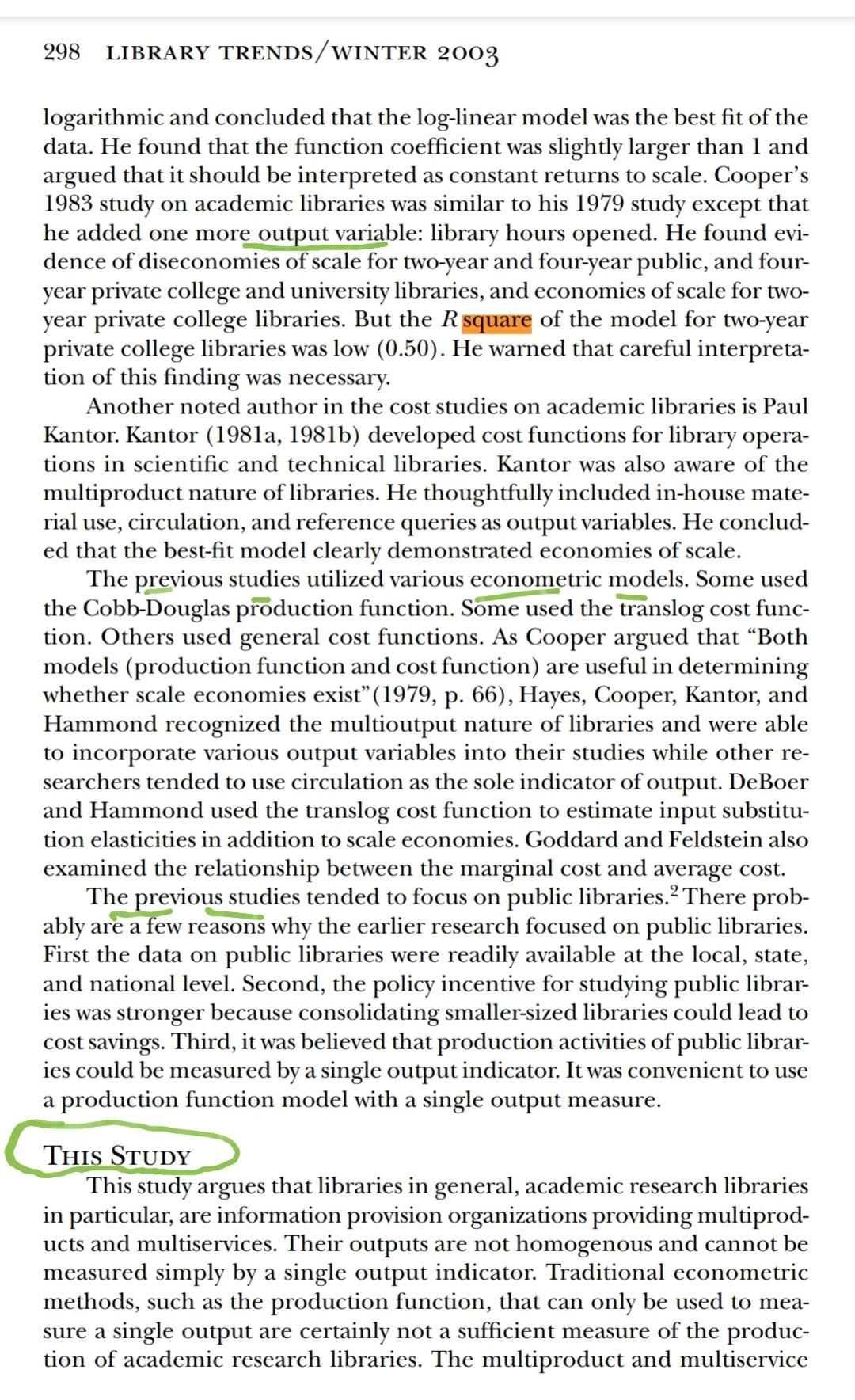
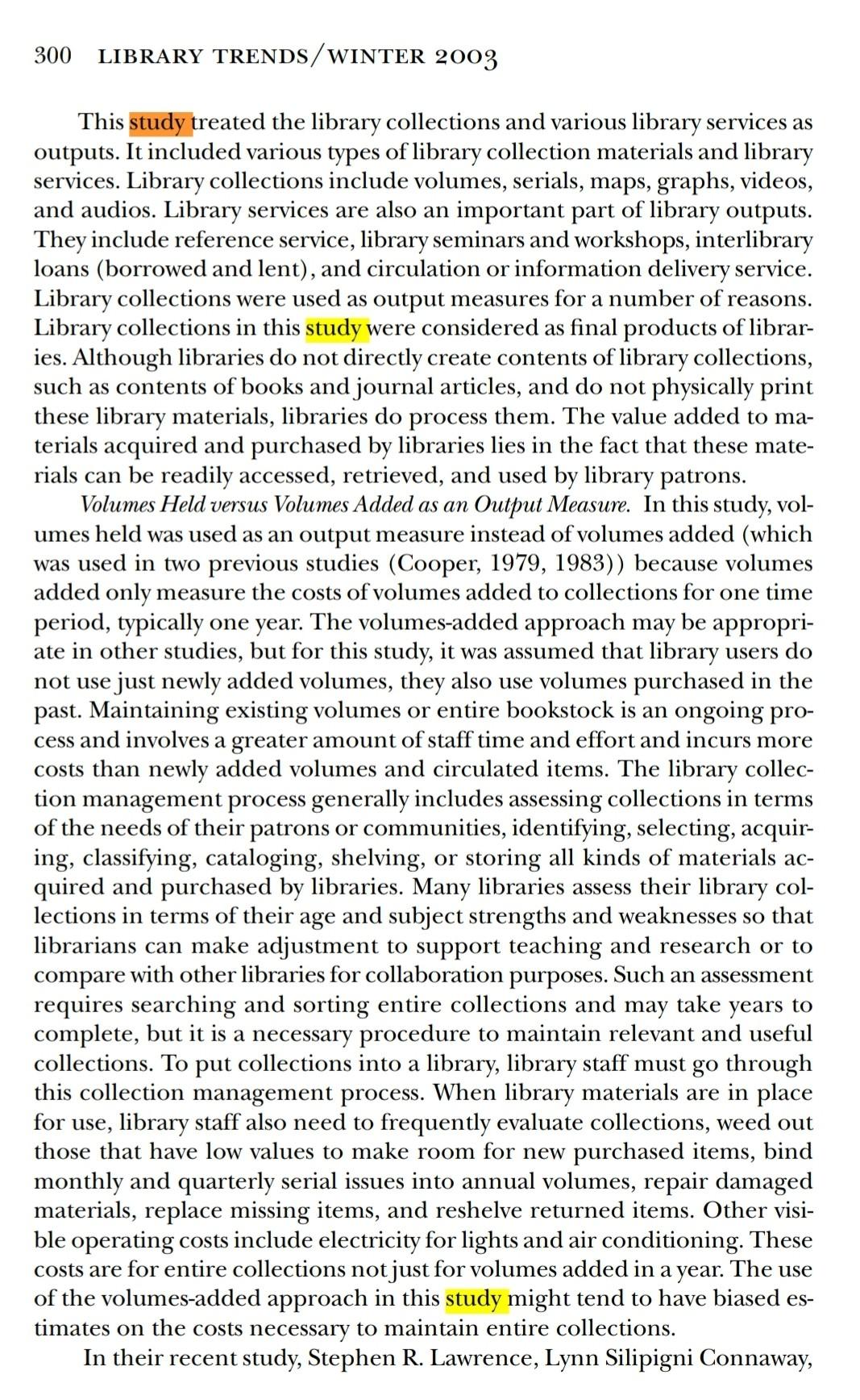
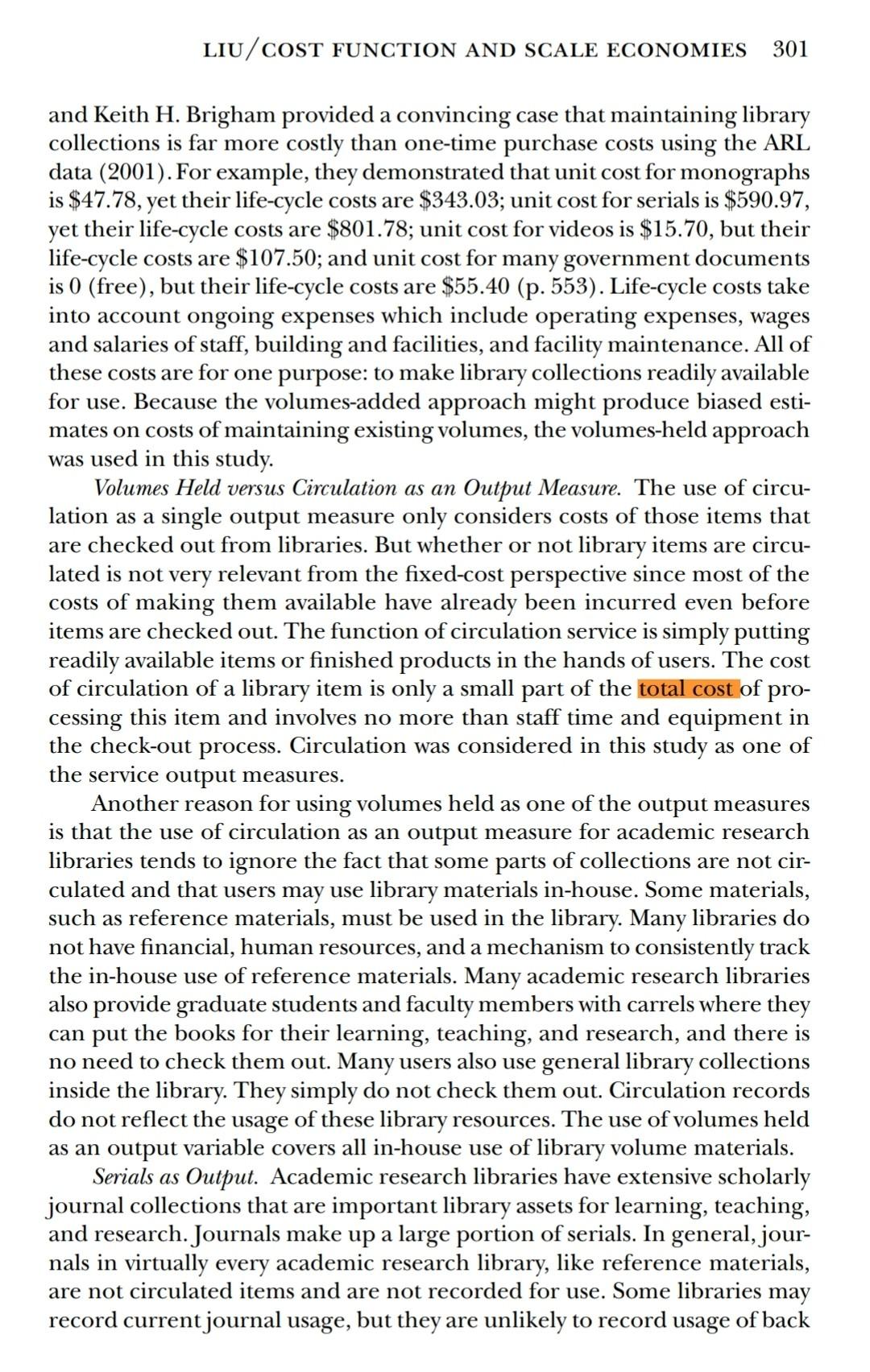
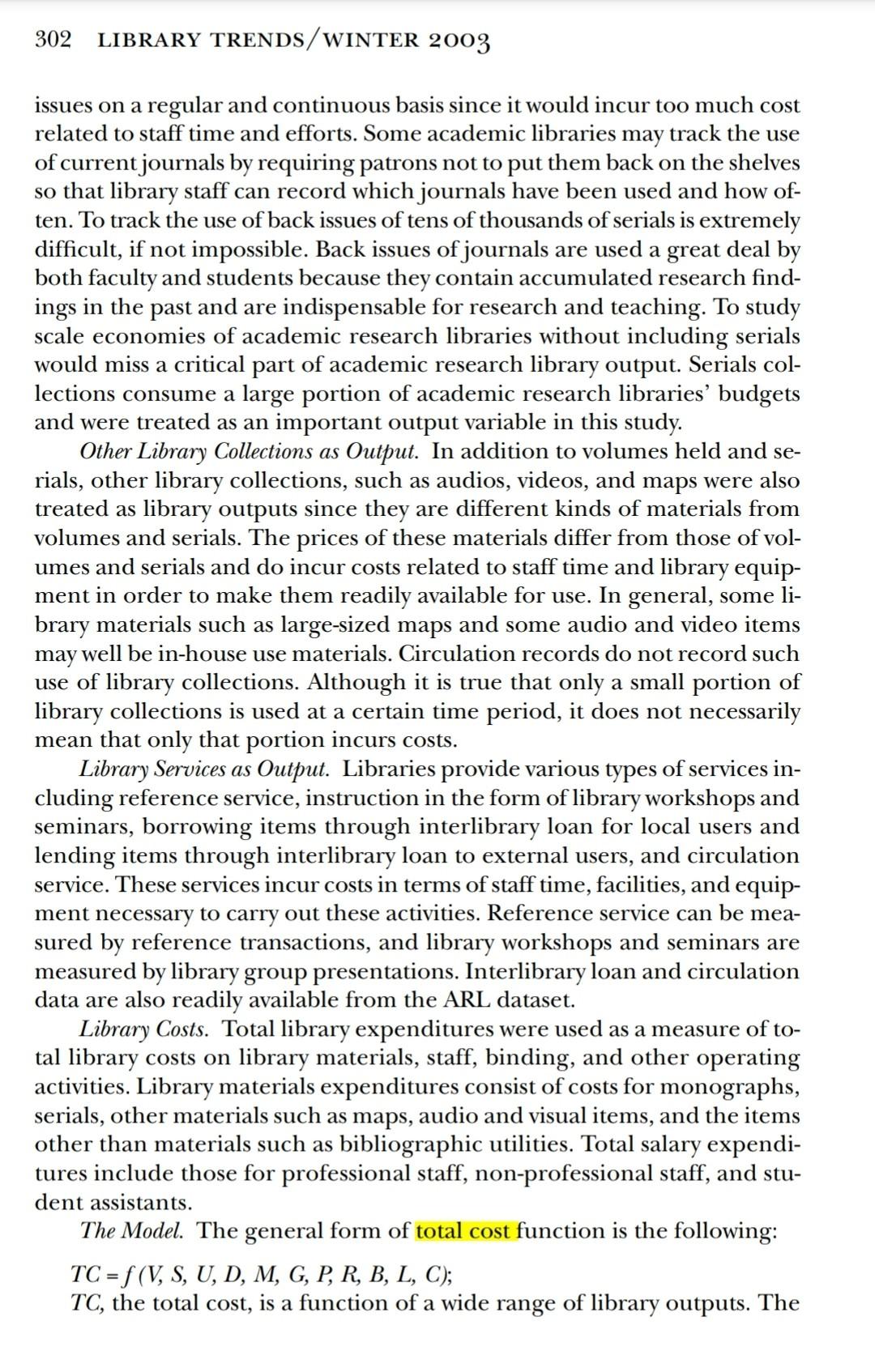
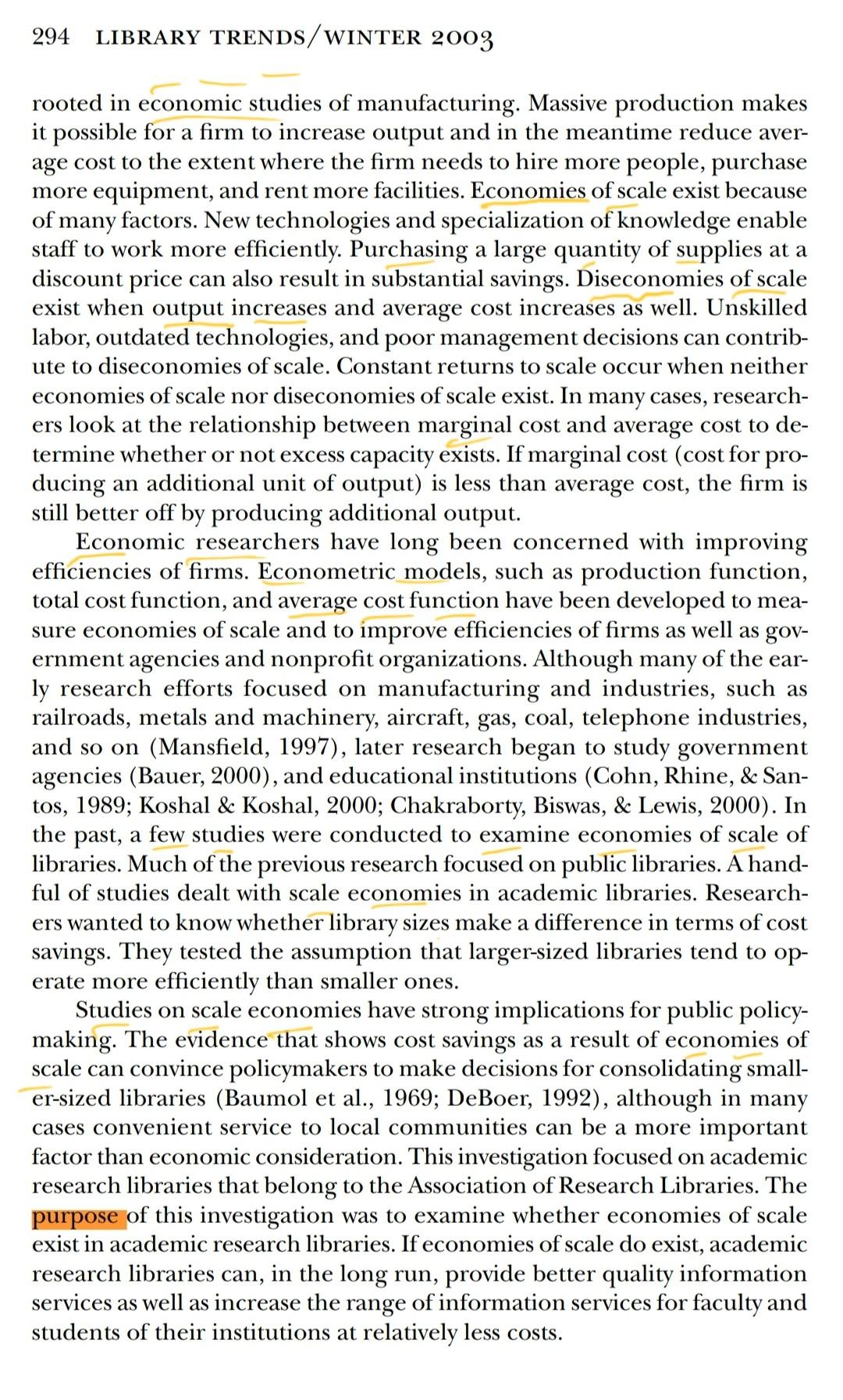
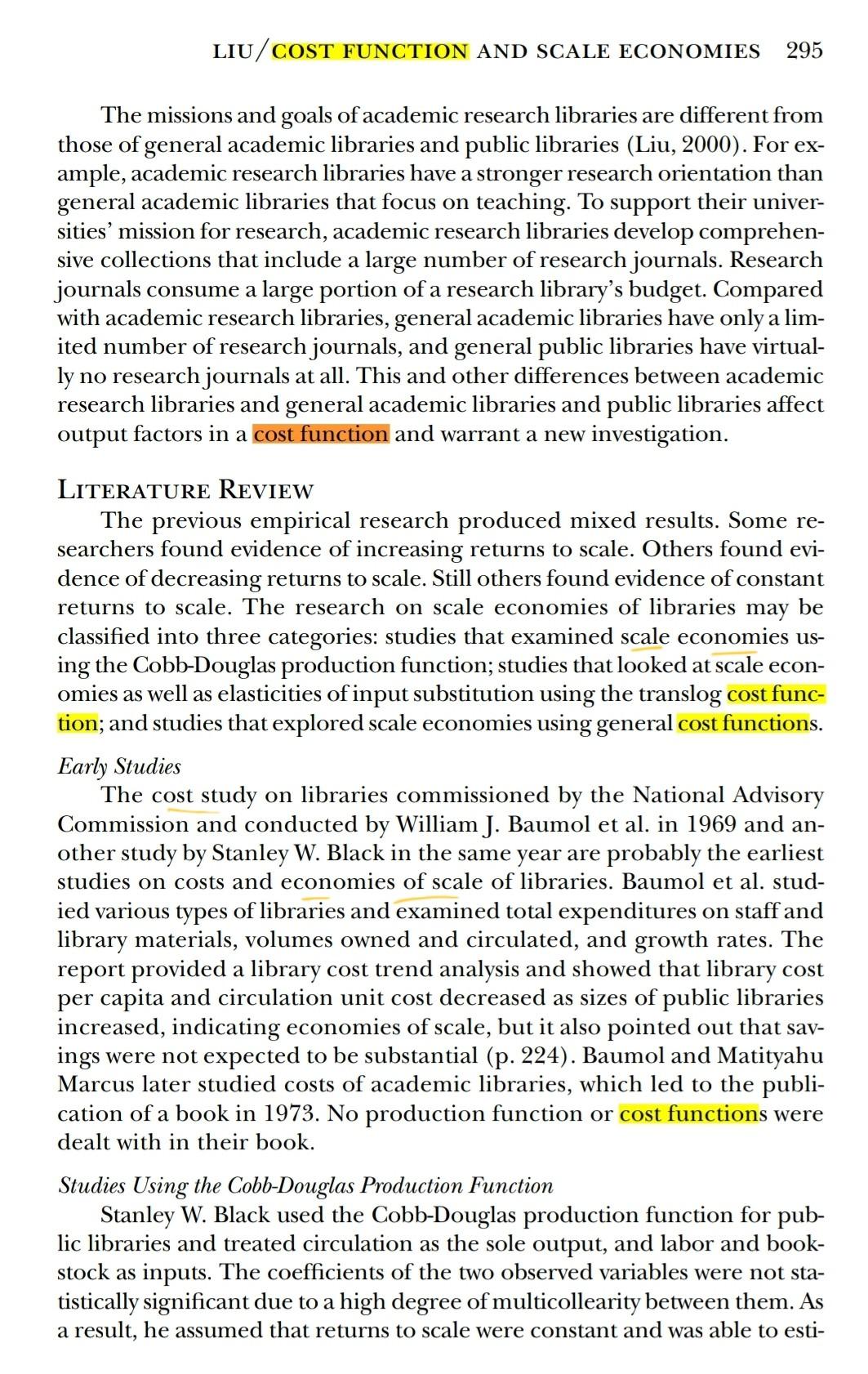
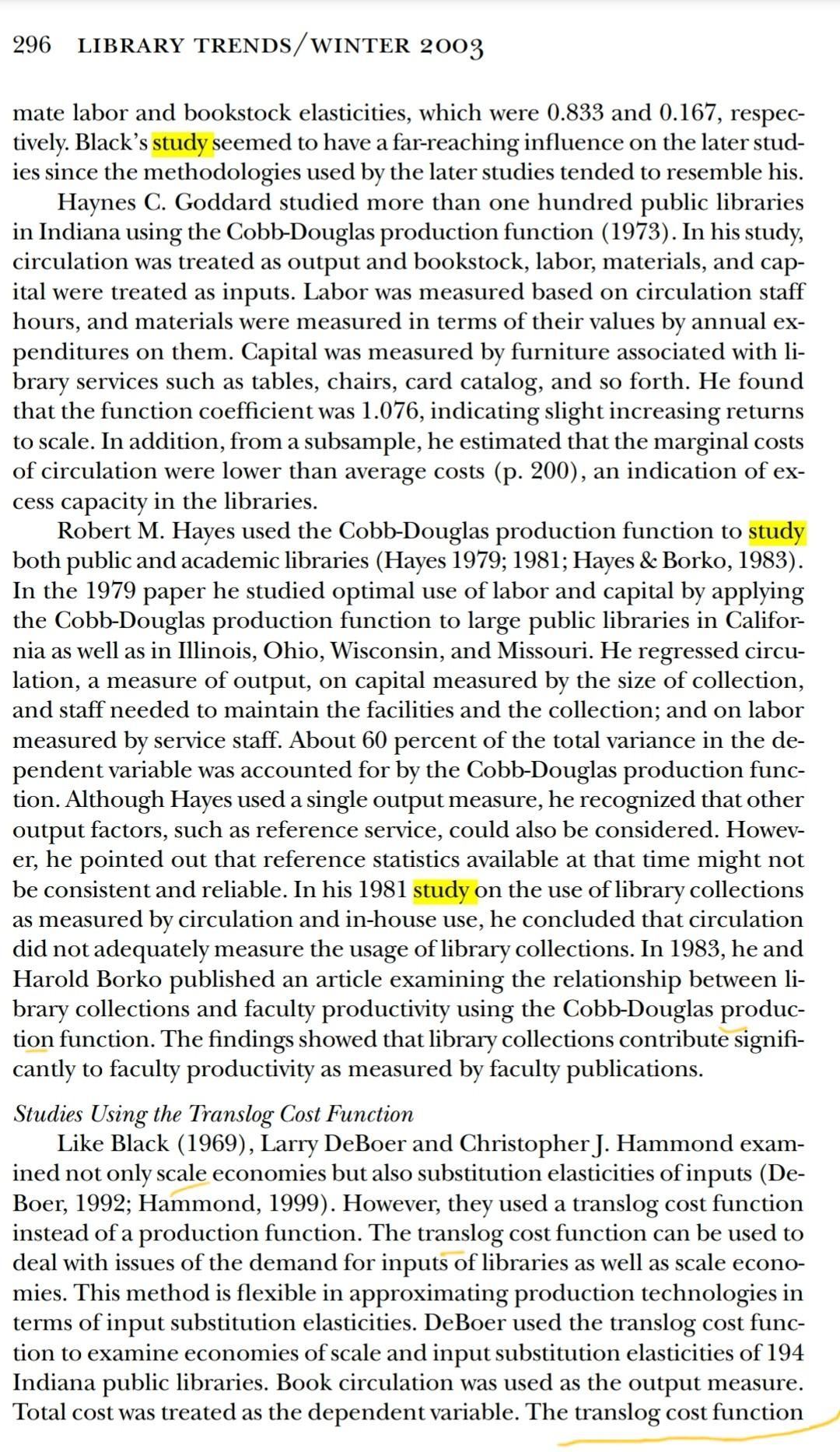
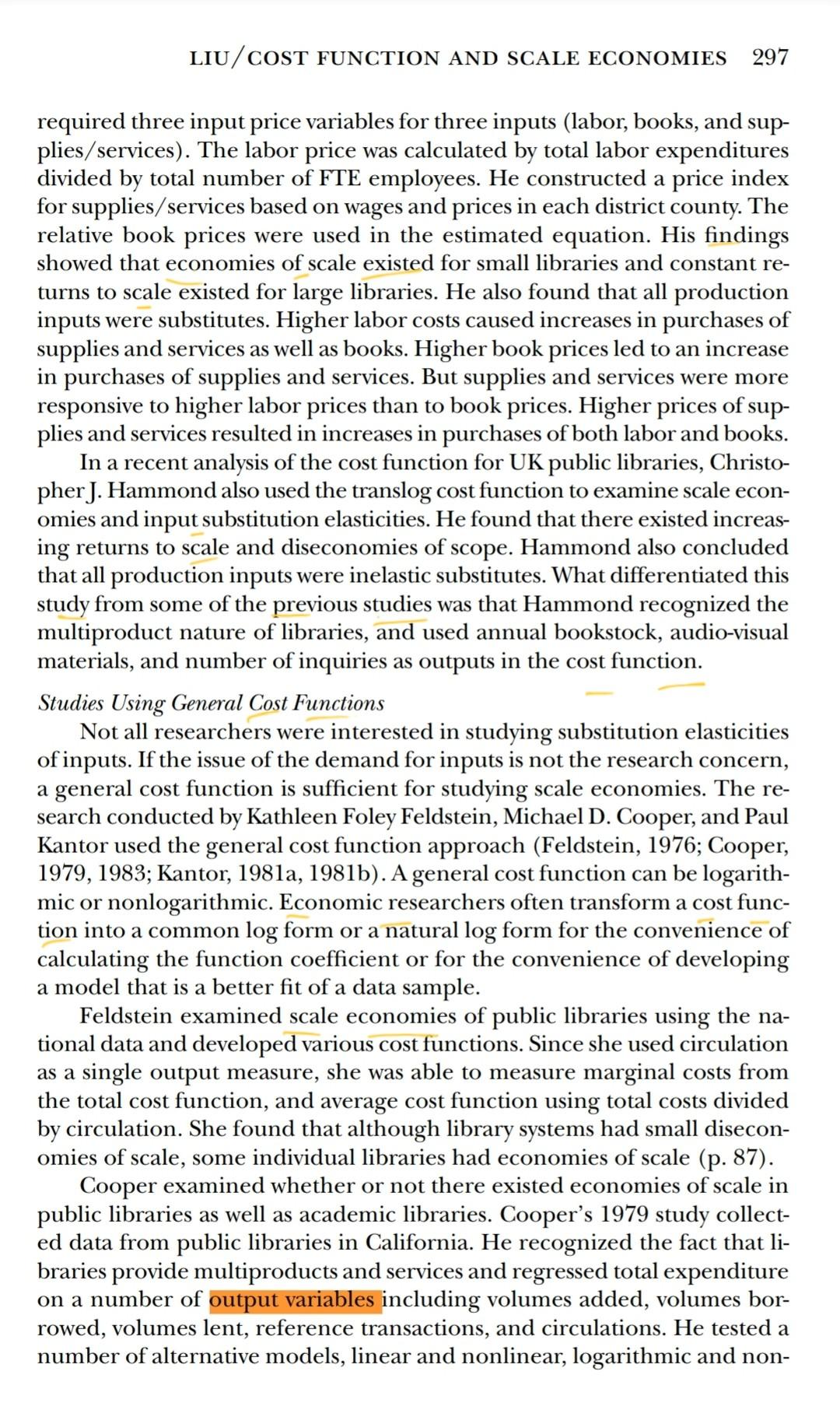
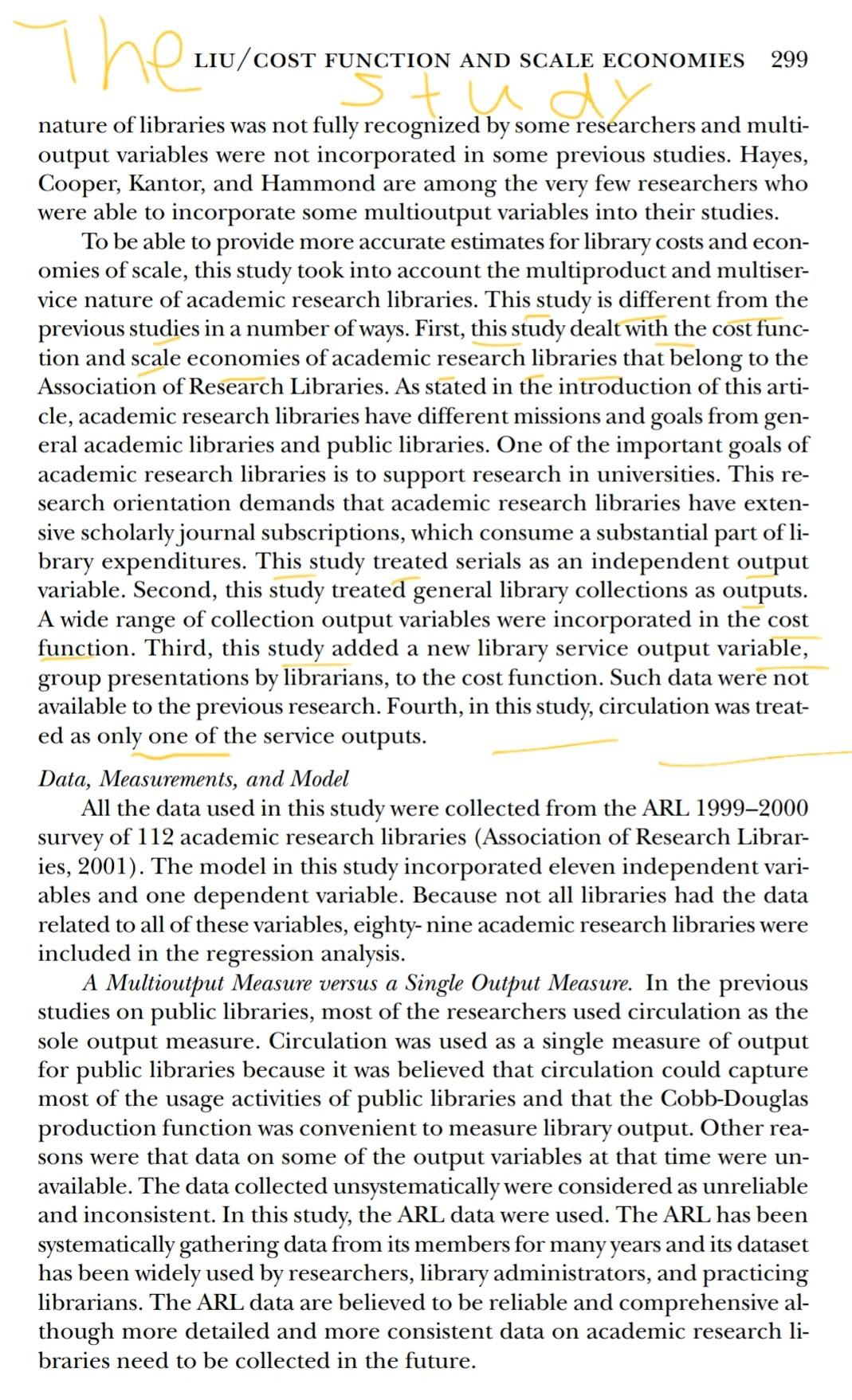
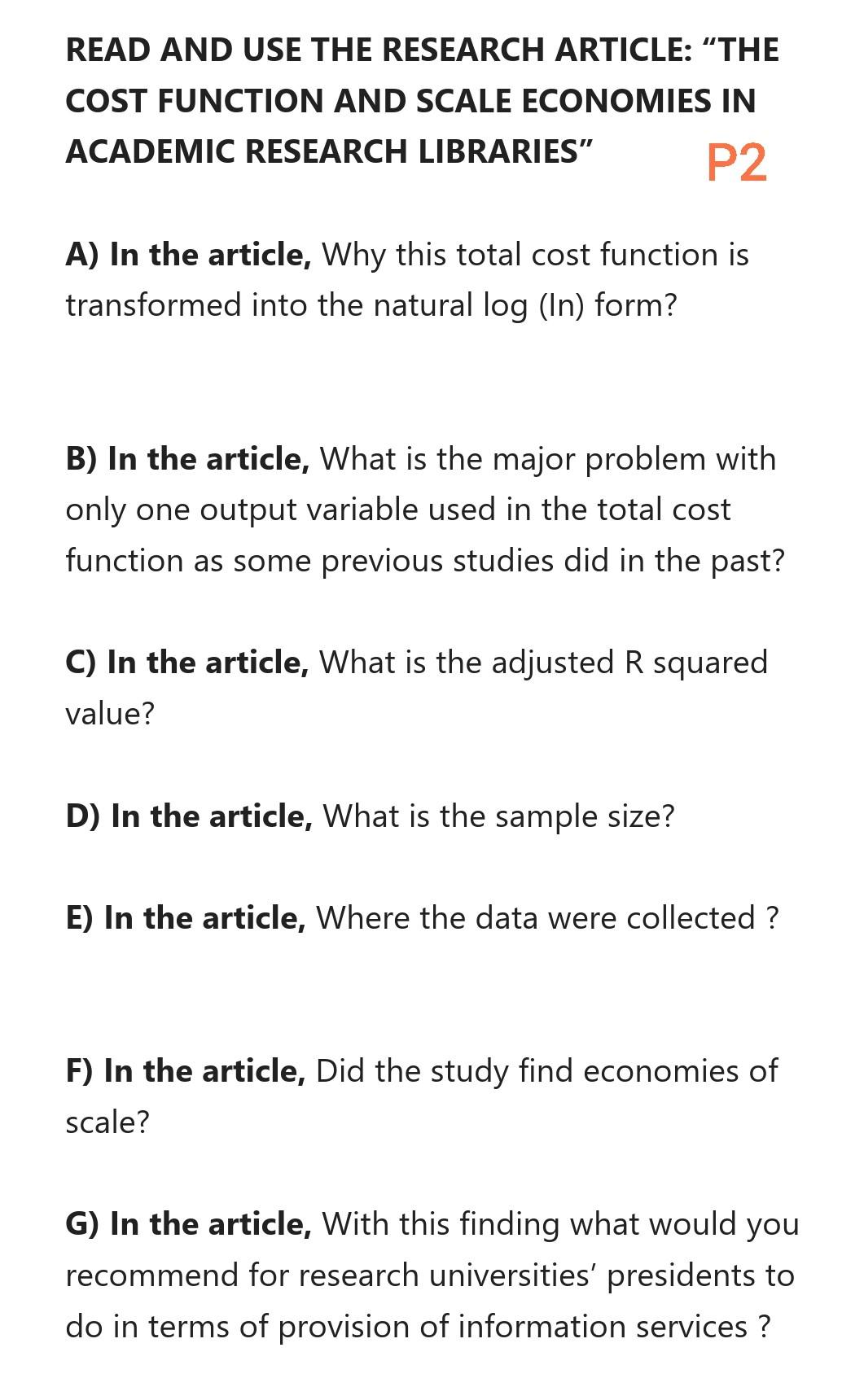
READ AND USE THE RESEARCH ARTICLE: THE COST FUNCTION AND SCALE ECONOMIES IN ACADEMIC RESEARCH LIBRARIES" P2 A) In the article, Why this total cost function is transformed into the natural log (In) form? B) In the article, What is the major problem with only one output variable used in the total cost function as some previous studies did in the past? C) In the article, What is the adjusted R squared value? D) In the article, What is the sample size? E) In the article, Where the data were collected ? F) In the article, Did the study find economies of scale? G) In the article, With this finding what would you recommend for research universities' presidents to do in terms of provision of information services ? The Cost Function and Scale Economies in Academic Research Libraries LEWIS G. LIU ABSTRACT THIS EMPIRICAL RESEARCH EXAMINED scale economies of academic re- search libraries that belong to the Association of Research Libraries and developed a total cost function for estimating economies of scale. The au- thor argues that libraries in general, and academic research libraries in particular, are information provision organizations that provide multiprod- ucts and multiservices and points out that some previous studies that used the production function have limitations due to the fact that the produc- tion function only permits a single output variable. This investigation in- corporated a wide range of collections and service output variables into the total cost function. The regression results show that the adjusted R square of the cost function model is 0.8 and that the coefficients of three very important output variables (volumes held, serials, and group presentations) are statistically significant at high confidence levels. The final findings of this research show that the function coefficient is 0.93, indicating that slight economies of scale exist in academic research libraries. INTRODUCTION Libraries are important economic entities in modern society. At present there are 9,046 public libraries, 3,685 academic libraries, 98,169 school li- braries, 9,763 special libraries, 1,376 government libraries, and 335 armed forces libraries with a total of over 122,300 libraries in the United States. Improving efficiency and preventing misallocation of resources in librar- ies are as important as in other economic sectors of the national economy. One way to evaluate an organization's efficiency is to examine whether scale economies exist in the organization. The concept of scale economies is 298 LIBRARY TRENDS/WINTER 2003 logarithmic and concluded that the log-linear model was the best fit of the data. He found that the function coefficient was slightly larger than 1 and argued that it should be interpreted as constant returns to scale. Cooper's 1983 study on academic libraries was similar to his 1979 study except that he added one more output variable: library hours opened. He found evi- dence of diseconomies of scale for two-year and four-year public, and four- year private college and university libraries, and economies of scale for two- year private college libraries. But the R square of the model for two-year private college libraries was low (0.50). He warned that careful interpreta- tion of this finding was necessary. Another noted author in the cost studies on academic libraries is Paul Kantor. Kantor (1981a, 1981b) developed cost functions for library opera- tions in scientific and technical libraries. Kantor was also aware of the multiproduct nature of libraries. He thoughtfully included in-house mate- rial use, circulation, and reference queries as output variables. He conclud- ed that the best-fit model clearly demonstrated economies of scale. The previous studies utilized various econometric models. Some used the Cobb-Douglas production function. Some used the translog cost func- tion. Others used general cost functions. As Cooper argued that Both models (production function and cost function) are useful in determining whether scale economies exist (1979, p. 66), Hayes, Cooper, Kantor, and Hammond recognized the multioutput nature of libraries and were able to incorporate various output variables into their studies while other re- searchers tended to use circulation as the sole indicator of output. DeBoer and Hammond used the translog cost function to estimate input substitu- tion elasticities in addition to scale economies. Goddard and Feldstein also examined the relationship between the marginal cost and average cost. The previous studies tended to focus on public libraries.? There prob- ably are a few reasons why the earlier research focused on public libraries. First the data on public libraries were readily available at the local, state, and national level. Second, the policy incentive for studying public librar- ies was stronger because consolidating smaller-sized libraries could lead to cost savings. Third, it was believed that production activities of public librar- ies could be measured by a single output indicator. It was convenient to use a production function model with a single output measure. This STUDY This study argues that libraries in general, academic research libraries in particular, are information provision organizations providing multiprod- ucts and multiservices. Their outputs are not homogenous and cannot be measured simply by a single output indicator. Traditional econometric methods, such as the production function, that can only be used to mea- sure a single output are certainly not a sufficient measure of the produc- tion of academic research libraries. The multiproduct and multiservice 300 LIBRARY TRENDS/WINTER 2003 This study treated the library collections and various library services as outputs. It included various types of library collection materials and library services. Library collections include volumes, serials, maps, graphs, videos, and audios. Library services are also an important part of library outputs. They include reference service, library seminars and workshops, interlibrary loans (borrowed and lent), and circulation or information delivery service. Library collections were used as output measures for a number of reasons. Library collections in this study were considered as final products of librar- ies. Although libraries do not directly create contents of library collections, such as contents of books and journal articles, and do not physically print these library materials, libraries do process them. The value added to ma- terials acquired and purchased by libraries lies in the fact that these mate- rials can be readily accessed, retrieved, and used by library patrons. Volumes Held versus Volumes Added as an Output Measure. In this study, vol- umes held was used as an output measure instead of volumes added (which was used in two previous studies (Cooper, 1979, 1983)) because volumes added only measure the costs of volumes added to collections for one time period, typically one year. The volumes-added approach may be appropri- ate in other studies, but for this study, it was assumed that library users do not use just newly added volumes, they also use volumes purchased in the past. Maintaining existing volumes or entire bookstock is an ongoing pro- cess and involves a greater amount of staff time and effort and incurs more costs than newly added volumes and circulated items. The library collec- tion management process generally includes assessing collections in terms of the needs of their patrons or communities, identifying, selecting, acquir- ing, classifying, cataloging, shelving, or storing all kinds of materials ac- quired and purchased by libraries. Many libraries assess their library col- lections in terms of their age and subject strengths and weaknesses so that librarians can make adjustment to support teaching and research or to compare with other libraries for collaboration purposes. Such an assessment requires searching and sorting entire collections and may take years to complete, but it is a necessary procedure to maintain relevant and useful collections. To put collections into a library, library staff must go through this collection management process. When library materials are in place for use, library staff also need to frequently evaluate collections, weed out those that have low values to make room for new purchased items, bind monthly and quarterly serial issues into annual volumes, repair damaged materials, replace missing items, and reshelve returned items. Other visi- ble operating costs include electricity for lights and air conditioning. These costs are for entire collections not just for volumes added in a year. The use of the volumes-added approach in this study might tend to have biased es- timates on the costs necessary to maintain entire collections. In their recent study, Stephen R. Lawrence, Lynn Silipigni Connaway, LIU/COST FUNCTION AND SCALE ECONOMIES 301 and Keith H. Brigham provided a convincing case that maintaining library collections is far more costly than one-time purchase costs using the ARL data (2001). For example, they demonstrated that unit cost for monographs is $47.78, yet their life-cycle costs are $343.03; unit cost for serials is $590.97, yet their life-cycle costs are $801.78; unit cost for videos is $15.70, but their life-cycle costs are $107.50; and unit cost for many government documents is 0 (free), but their life-cycle costs are $55.40 (p. 553). Life-cycle costs take into account ongoing expenses which include operating expenses, wages and salaries of staff, building and facilities, and facility maintenance. All of these costs are for one purpose: to make library collections readily available for use. Because the volumes-added approach might produce biased esti- mates on costs of maintaining existing volumes, the volumes-held approach was used in this study. Volumes Held versus Circulation as an Output Measure. The use of circu- lation as a single output measure only considers costs of those items that are checked out from libraries. But whether or not library items are circu- lated is not very relevant from the fixed-cost perspective since most of the costs of making them available have already been incurred even before items are checked out. The function of circulation service is simply putting readily available items or finished products in the hands of users. The cost of circulation of a library item is only a small part of the total cost of pro- cessing this item and involves no more than staff time and equipment in the check-out process. Circulation was considered in this study as one of the service output measures. Another reason for using volumes held as one of the output measures is that the use of circulation as an output measure for academic research libraries tends to ignore the fact that some parts of collections are not cir- culated and that users may use library materials in-house. Some materials, such as reference materials, must be used in the library. Many libraries do not have financial, human resources, and a mechanism to consistently track the in-house use of reference materials. Many academic research libraries also provide graduate students and faculty members with carrels where they can put the books for their learning, teaching, and research, and there is no need to check them out. Many users also use general library collections inside the library. They simply do not check them out. Circulation records do not reflect the usage of these library resources. The use of volumes held as an output variable covers all in-house use of library volume materials. Serials as Output. Academic research libraries have extensive scholarly journal collections that are important library assets for learning, teaching, and research. Journals make up a large portion of serials. In general, jour- nals in virtually every academic research library, like reference materials, are not circulated items and are not recorded for use. Some libraries may record current journal usage, but they are unlikely to record usage of back 302 LIBRARY TRENDS/WINTER 2003 issues on a regular and continuous basis since it would incur too much cost related to staff time and efforts. Some academic libraries may track the use of current journals by requiring patrons not to put them back on the shelves so that library staff can record which journals have been used and how of- ten. To track the use of back issues of tens of thousands of serials is extremely difficult, if not impossible. Back issues of journals are used a great deal by both faculty and students because they contain accumulated research find- ings in the past and are indispensable for research and teaching. To study scale economies of academic research libraries without including serials would miss a critical part of academic research library output. Serials col- lections consume a large portion of academic research libraries' budgets and were treated as an important output variable in this study. Other Library Collections as Output. In addition to volumes held and se- rials, other library collections, such as audios, videos, and maps were also treated as library outputs since they are different kinds of materials from volumes and serials. The prices of these materials differ from those of vol- umes and serials and do incur costs related to staff time and library equip- ment in order to make them readily available for use. In general, some li- brary materials such as large-sized maps and some audio and video items may well be in-house use materials. Circulation records do not record such use of library collections. Although it is true that only a small portion of library collections is used at a certain time period, it does not necessarily mean that only that portion incurs costs. Library Services as Output. Libraries provide various types of services in- cluding reference service, instruction in the form of library workshops and seminars, borrowing items through interlibrary loan for local users and lending items through interlibrary loan to external users, and circulation service. These services incur costs in terms of staff time, facilities, and equip- ment necessary to carry out these activities. Reference service can be mea- sured by reference transactions, and library workshops and seminars are measured by library group presentations. Interlibrary loan and circulation data are also readily available from the ARL dataset. Library Costs. Total library expenditures were used as a measure of to- tal library costs on library materials, staff, binding, and other operating activities. Library materials expenditures consist of costs for monographs, serials, other materials such as maps, audio and visual items, and the items other than materials such as bibliographic utilities. Total salary expendi- tures include those for professional staff, non-professional staff, and stu- dent assistants. The Model. The general form of total cost function is the following: TC = f (V, S, U, D, M, G, P, R, B, L, C); TC, the total cost, is a function of a wide range of library outputs. The 294 LIBRARY TRENDS/WINTER 2003 rooted in economic studies of manufacturing. Massive production makes it possible for a firm to increase output and in the meantime reduce aver- age cost to the extent where the firm needs to hire more people, purchase more equipment, and rent more facilities. Economies of scale exist because of many factors. New technologies and specialization of knowledge enable staff to work more efficiently. Purchasing a large quantity of supplies at a discount price can also result in substantial savings. Diseconomies of scale exist when output increases and average cost increases as well. Unskilled labor, outdated technologies, and poor management decisions can contrib- ute to diseconomies of scale. Constant returns to scale occur when neither economies of scale nor diseconomies of scale exist. In many cases, research- ers look at the relationship between marginal cost and average cost to de- termine whether or not excess capacity exists. If marginal cost (cost for pro- ducing an additional unit of output) is less than average cost, the firm is still better off by producing additional output. Economic researchers have long been concerned with improving efficiencies of firms. Econometric models, such as production function, total cost function, and average cost function have been developed to mea- sure economies of scale and to improve efficiencies of firms as well as gov- ernment agencies and nonprofit organizations. Although many of the ear- ly research efforts focused on manufacturing and industries, such as railroads, metals and machinery, aircraft, gas, coal, telephone industries, and so on (Mansfield, 1997), later research began to study government agencies (Bauer, 2000), and educational institutions (Cohn, Rhine, & San- tos, 1989; Koshal & Koshal, 2000; Chakraborty, Biswas, & Lewis, 2000). In the past, a few studies were conducted to examine economies of scale of libraries. Much of the previous research focused on public libraries. A hand- ful of studies dealt with scale economies in academic libraries. Research- ers wanted to know whether library sizes make a difference in terms of cost savings. They tested the assumption that larger-sized libraries tend to op- erate more efficiently than smaller ones. Studies on scale economies have strong implications for public policy- making. The evidence that shows cost savings as a result of economies of scale can convince policymakers to make decisions for consolidating small- er-sized libraries (Baumol et al., 1969; DeBoer, 1992), although in many cases convenient service to local communities can be a more important factor than economic consideration. This investigation focused on academic research libraries that belong to the Association of Research Libraries. The purpose of this investigation was to examine whether economies of scale exist in academic research libraries. If economies of scale do exist, academic research libraries can, in the long run, provide better quality information services as well as increase the range of information services for faculty and students of their institutions at relatively less costs. LIU/COST FUNCTION AND SCALE ECONOMIES 295 The missions and goals of academic research libraries are different from those of general academic libraries and public libraries (Liu, 2000). For ex- ample, academic research libraries have a stronger research orientation than general academic libraries that focus on teaching. To support their univer- sities' mission for research, academic research libraries develop comprehen- sive collections that include a large number of research journals. Research journals consume a large portion of a research library's budget. Compared with academic research libraries, general academic libraries have only a lim- ited number of research journals, and general public libraries have virtual- ly no research journals at all. This and other differences between academic research libraries and general academic libraries and public libraries affect output factors in a cost function and warrant a new investigation. LITERATURE REVIEW The previous empirical research produced mixed results. Some re- searchers found evidence of increasing returns to scale. Others found evi- dence of decreasing returns to scale. Still others found evidence of constant returns to scale. The research on scale economies of libraries may be classified into three categories: studies that examined scale economies us- ing the Cobb-Douglas production function; studies that looked at scale econ- omies as well as elasticities of input substitution using the translog cost func- tion; and studies that explored scale economies using general cost functions. Early Studies The cost study on libraries commissioned by the National Advisory Commission and conducted by William J. Baumol et al. in 1969 and an- other study by Stanley W. Black in the same year are probably the earliest studies on costs and economies of scale of libraries. Baumol et al. stud- ied various types of libraries and examined total expenditures on staff and library materials, volumes owned and circulated, and growth rates. The report provided a library cost trend analysis and showed that library cost per capita and circulation unit cost decreased as sizes of public libraries increased, indicating economies of scale, but it also pointed out that sav- ings were not expected to be substantial (p. 224). Baumol and Matityahu Marcus later studied costs of academic libraries, which led to the publi- cation of a book in 1973. No production function or cost functions were dealt with in their book. Studies Using the Cobb-Douglas Production Function Stanley W. Black used the Cobb-Douglas production function for pub- lic libraries and treated circulation as the sole output, and labor and book- stock as inputs. The coefficients of the two observed variables were not sta- tistically significant due to a high degree of multicollearity between them. As a result, he assumed that returns to scale were constant and was able to esti- 296 LIBRARY TRENDS/WINTER 2003 a mate labor and bookstock elasticities, which were 0.833 and 0.167, respec- tively. Blacks study seemed to have a far-reaching influence on the later stud- ies since the methodologies used by the later studies tended to resemble his. Haynes C. Goddard studied more than one hundred public libraries in Indiana using the Cobb-Douglas production function (1973). In his study, circulation was treated as output and bookstock, labor, materials, and cap- ital were treated as inputs. Labor was measured based on circulation staff hours, and materials were measured in terms of their values by annual ex- penditures on them. Capital was measured by furniture associated with li- brary services such as tables, chairs, card catalog, and so forth. He found that the function coefficient was 1.076, indicating slight increasing returns to scale. In addition, from a subsample, he estimated that the marginal costs of circulation were lower than average costs (p. 200), an indication of ex- cess capacity in the libraries. Robert M. Hayes used the Cobb-Douglas production function to study both public and academic libraries (Hayes 1979; 1981; Hayes & Borko, 1983). In the 1979 paper he studied optimal use of labor and capital by applying the Cobb-Douglas production function to large public libraries in Califor- nia as well as in Illinois, Ohio, Wisconsin, and Missouri. He regressed circu- lation, a measure of output, on capital measured by the size of collection, and staff needed to maintain the facilities and the collection; and on labor measured by service staff. About 60 percent of the total variance in the de- pendent variable was accounted for by the Cobb-Douglas production func- tion. Although Hayes used a single output measure, he recognized that other output factors, such as reference service, could also be considered. Howev- er, he pointed out that reference statistics available at that time might not be consistent and reliable. In his 1981 study on the use of library collections as measured by circulation and in-house use, he concluded that circulation did not adequately measure the usage of library collections. In 1983, he and Harold Borko published an article examining the relationship between li- brary collections and faculty productivity using the Cobb-Douglas produc- tion function. The findings showed that library collections contribute signifi- cantly to faculty productivity as measured by faculty publications. Studies Using the Translog Cost Function Like Black (1969), Larry DeBoer and Christopher J. Hammond exam- ined not only scale economies but also substitution elasticities of inputs (De- Boer, 1992; Hammond, 1999). However, they used a translog cost function instead of a production function. The translog cost function can be used to deal with issues of the demand for inputs of libraries as well as scale econo- mies. This method is flexible in approximating production technologies in terms of input substitution elasticities. DeBoer used the translog cost func- tion to examine economies of scale and input substitution elasticities of 194 Indiana public libraries. Book circulation was used as the output measure. Total cost was treated as the dependent variable. The translog cost function LIU/COST FUNCTION AND SCALE ECONOMIES 297 required three input price variables for three inputs (labor, books, and sup- plies/services). The labor price was calculated by total labor expenditures divided by total number of FTE employees. He constructed a price index for supplies/services based on wages and prices in each district county. The relative book prices were used in the estimated equation. His findings showed that economies of scale existed for small libraries and constant re- turns to scale existed for large libraries. He also found that all production inputs were substitutes. Higher labor costs caused increases in purchases of supplies and services as well as books. Higher book prices led to an increase in purchases of supplies and services. But supplies and services were more responsive to higher labor prices than to book prices. Higher prices of sup- plies and services resulted in increases in purchases of both labor and books. In a recent analysis of the cost function for UK public libraries, Christo- pher J. Hammond also used the translog cost function to examine scale econ- omies and input substitution elasticities. He found that there existed increas- ing returns to scale and diseconomies of scope. Hammond also concluded that all production inputs were inelastic substitutes. What differentiated this study from some of the previous studies was that Hammond recognized the multiproduct nature of libraries, and used annual bookstock, audio-visual materials, and number of inquiries as outputs in the cost function. Studies Using General Cost Functions Not all researchers were interested in studying substitution elasticities of inputs. If the issue of the demand for inputs is not the research concern, a general cost function is sufficient for studying scale economies. The re- search conducted by Kathleen Foley Feldstein, Michael D. Cooper, and Paul Kantor used the general cost function approach (Feldstein, 1976; Cooper, 1979, 1983; Kantor, 1981a, 1981b). A general cost function can be logarith- mic or nonlogarithmic. Economic researchers often transform a cost func- tion into a common log form or a natural log form for the convenience of calculating the function coefficient or for the convenience of developing a model that is a better fit of a data sample. Feldstein examined scale economies of public libraries using the na- tional data and developed various cost functions. Since she used circulation as a single output measure, she was able to measure marginal costs from the total cost function, and average cost function using total costs divided by circulation. She found that although library systems had small disecon- omies of scale, some individual libraries had economies of scale (p. 87). Cooper examined whether or not there existed economies of scale in public libraries as well as academic libraries. Cooper's 1979 study collect- ed data from public libraries in California. He recognized the fact that li- braries provide multiproducts and services and regressed total expenditure on a number of output variables including volumes added, volumes bor- rowed, volumes lent, reference transactions, and circulations. He tested a number of alternative models, linear and nonlinear, logarithmic and non- The LIU/COST FUNCTION AND SCALE ECONOMIES 299 study nature of libraries was not fully recognized by some researchers and multi- output variables were not incorporated in some previous studies. Hayes, Cooper, Kantor, and Hammond are among the very few researchers who were able to incorporate some multioutput variables into their studies. To be able to provide more accurate estimates for library costs and econ- omies of scale, this study took into account the multiproduct and multiser- vice nature of academic research libraries. This study is different from the previous studies in a number of ways. First, this study dealt with the cost func- tion and scale economies of academic research libraries that belong to the Association of Research Libraries. As stated in the introduction of this arti- cle, academic research libraries have different missions and goals from gen- eral academic libraries and public libraries. One of the important goals of academic research libraries is to support research in universities. This re- search orientation demands that academic research libraries have exten- sive scholarly journal subscriptions, which consume a substantial part of li- brary expenditures. This study treated serials as an independent output variable. Second, this study treated general library collections as outputs. A wide range of collection output variables were incorporated in the cost function. Third, this study added a new library service output variable, group presentations by librarians, to the cost function. Such data were not available to the previous research. Fourth, in this study, circulation was treat- ed as only one of the service outputs. Data, Measurements, and Model All the data used in this study were collected from the ARL 19992000 survey of 112 academic research libraries (Association of Research Librar- ies, 2001). The model in this study incorporated eleven independent vari- ables and one dependent variable. Because not all libraries had the data related to all of these variables, eighty-nine academic research libraries were included in the regression analysis. A Multioutput Measure versus a Single Output Measure. In the previous studies on public libraries, most of the researchers used circulation as the sole output measure. Circulation was used as a single measure of output for public libraries because it was believed that circulation could capture most of the usage activities of public libraries and that the Cobb-Douglas production function was convenient to measure library output. Other rea- sons were that data on some of the output variables at that time were un- available. The data collected unsystematically were considered as unreliable and inconsistent. In this study, the ARL data were used. The ARL has been systematically gathering data from its members for many years and its dataset has been widely used by researchers, library administrators, and practicing librarians. The ARL data are believed to be reliable and comprehensive al- though more detailed and more consistent data on academic research li- braries need to be collected in the future. READ AND USE THE RESEARCH ARTICLE: THE COST FUNCTION AND SCALE ECONOMIES IN ACADEMIC RESEARCH LIBRARIES" P2 A) In the article, Why this total cost function is transformed into the natural log (In) form? B) In the article, What is the major problem with only one output variable used in the total cost function as some previous studies did in the past? C) In the article, What is the adjusted R squared value? D) In the article, What is the sample size? E) In the article, Where the data were collected ? F) In the article, Did the study find economies of scale? G) In the article, With this finding what would you recommend for research universities' presidents to do in terms of provision of information services ? The Cost Function and Scale Economies in Academic Research Libraries LEWIS G. LIU ABSTRACT THIS EMPIRICAL RESEARCH EXAMINED scale economies of academic re- search libraries that belong to the Association of Research Libraries and developed a total cost function for estimating economies of scale. The au- thor argues that libraries in general, and academic research libraries in particular, are information provision organizations that provide multiprod- ucts and multiservices and points out that some previous studies that used the production function have limitations due to the fact that the produc- tion function only permits a single output variable. This investigation in- corporated a wide range of collections and service output variables into the total cost function. The regression results show that the adjusted R square of the cost function model is 0.8 and that the coefficients of three very important output variables (volumes held, serials, and group presentations) are statistically significant at high confidence levels. The final findings of this research show that the function coefficient is 0.93, indicating that slight economies of scale exist in academic research libraries. INTRODUCTION Libraries are important economic entities in modern society. At present there are 9,046 public libraries, 3,685 academic libraries, 98,169 school li- braries, 9,763 special libraries, 1,376 government libraries, and 335 armed forces libraries with a total of over 122,300 libraries in the United States. Improving efficiency and preventing misallocation of resources in librar- ies are as important as in other economic sectors of the national economy. One way to evaluate an organization's efficiency is to examine whether scale economies exist in the organization. The concept of scale economies is 298 LIBRARY TRENDS/WINTER 2003 logarithmic and concluded that the log-linear model was the best fit of the data. He found that the function coefficient was slightly larger than 1 and argued that it should be interpreted as constant returns to scale. Cooper's 1983 study on academic libraries was similar to his 1979 study except that he added one more output variable: library hours opened. He found evi- dence of diseconomies of scale for two-year and four-year public, and four- year private college and university libraries, and economies of scale for two- year private college libraries. But the R square of the model for two-year private college libraries was low (0.50). He warned that careful interpreta- tion of this finding was necessary. Another noted author in the cost studies on academic libraries is Paul Kantor. Kantor (1981a, 1981b) developed cost functions for library opera- tions in scientific and technical libraries. Kantor was also aware of the multiproduct nature of libraries. He thoughtfully included in-house mate- rial use, circulation, and reference queries as output variables. He conclud- ed that the best-fit model clearly demonstrated economies of scale. The previous studies utilized various econometric models. Some used the Cobb-Douglas production function. Some used the translog cost func- tion. Others used general cost functions. As Cooper argued that Both models (production function and cost function) are useful in determining whether scale economies exist (1979, p. 66), Hayes, Cooper, Kantor, and Hammond recognized the multioutput nature of libraries and were able to incorporate various output variables into their studies while other re- searchers tended to use circulation as the sole indicator of output. DeBoer and Hammond used the translog cost function to estimate input substitu- tion elasticities in addition to scale economies. Goddard and Feldstein also examined the relationship between the marginal cost and average cost. The previous studies tended to focus on public libraries.? There prob- ably are a few reasons why the earlier research focused on public libraries. First the data on public libraries were readily available at the local, state, and national level. Second, the policy incentive for studying public librar- ies was stronger because consolidating smaller-sized libraries could lead to cost savings. Third, it was believed that production activities of public librar- ies could be measured by a single output indicator. It was convenient to use a production function model with a single output measure. This STUDY This study argues that libraries in general, academic research libraries in particular, are information provision organizations providing multiprod- ucts and multiservices. Their outputs are not homogenous and cannot be measured simply by a single output indicator. Traditional econometric methods, such as the production function, that can only be used to mea- sure a single output are certainly not a sufficient measure of the produc- tion of academic research libraries. The multiproduct and multiservice 300 LIBRARY TRENDS/WINTER 2003 This study treated the library collections and various library services as outputs. It included various types of library collection materials and library services. Library collections include volumes, serials, maps, graphs, videos, and audios. Library services are also an important part of library outputs. They include reference service, library seminars and workshops, interlibrary loans (borrowed and lent), and circulation or information delivery service. Library collections were used as output measures for a number of reasons. Library collections in this study were considered as final products of librar- ies. Although libraries do not directly create contents of library collections, such as contents of books and journal articles, and do not physically print these library materials, libraries do process them. The value added to ma- terials acquired and purchased by libraries lies in the fact that these mate- rials can be readily accessed, retrieved, and used by library patrons. Volumes Held versus Volumes Added as an Output Measure. In this study, vol- umes held was used as an output measure instead of volumes added (which was used in two previous studies (Cooper, 1979, 1983)) because volumes added only measure the costs of volumes added to collections for one time period, typically one year. The volumes-added approach may be appropri- ate in other studies, but for this study, it was assumed that library users do not use just newly added volumes, they also use volumes purchased in the past. Maintaining existing volumes or entire bookstock is an ongoing pro- cess and involves a greater amount of staff time and effort and incurs more costs than newly added volumes and circulated items. The library collec- tion management process generally includes assessing collections in terms of the needs of their patrons or communities, identifying, selecting, acquir- ing, classifying, cataloging, shelving, or storing all kinds of materials ac- quired and purchased by libraries. Many libraries assess their library col- lections in terms of their age and subject strengths and weaknesses so that librarians can make adjustment to support teaching and research or to compare with other libraries for collaboration purposes. Such an assessment requires searching and sorting entire collections and may take years to complete, but it is a necessary procedure to maintain relevant and useful collections. To put collections into a library, library staff must go through this collection management process. When library materials are in place for use, library staff also need to frequently evaluate collections, weed out those that have low values to make room for new purchased items, bind monthly and quarterly serial issues into annual volumes, repair damaged materials, replace missing items, and reshelve returned items. Other visi- ble operating costs include electricity for lights and air conditioning. These costs are for entire collections not just for volumes added in a year. The use of the volumes-added approach in this study might tend to have biased es- timates on the costs necessary to maintain entire collections. In their recent study, Stephen R. Lawrence, Lynn Silipigni Connaway, LIU/COST FUNCTION AND SCALE ECONOMIES 301 and Keith H. Brigham provided a convincing case that maintaining library collections is far more costly than one-time purchase costs using the ARL data (2001). For example, they demonstrated that unit cost for monographs is $47.78, yet their life-cycle costs are $343.03; unit cost for serials is $590.97, yet their life-cycle costs are $801.78; unit cost for videos is $15.70, but their life-cycle costs are $107.50; and unit cost for many government documents is 0 (free), but their life-cycle costs are $55.40 (p. 553). Life-cycle costs take into account ongoing expenses which include operating expenses, wages and salaries of staff, building and facilities, and facility maintenance. All of these costs are for one purpose: to make library collections readily available for use. Because the volumes-added approach might produce biased esti- mates on costs of maintaining existing volumes, the volumes-held approach was used in this study. Volumes Held versus Circulation as an Output Measure. The use of circu- lation as a single output measure only considers costs of those items that are checked out from libraries. But whether or not library items are circu- lated is not very relevant from the fixed-cost perspective since most of the costs of making them available have already been incurred even before items are checked out. The function of circulation service is simply putting readily available items or finished products in the hands of users. The cost of circulation of a library item is only a small part of the total cost of pro- cessing this item and involves no more than staff time and equipment in the check-out process. Circulation was considered in this study as one of the service output measures. Another reason for using volumes held as one of the output measures is that the use of circulation as an output measure for academic research libraries tends to ignore the fact that some parts of collections are not cir- culated and that users may use library materials in-house. Some materials, such as reference materials, must be used in the library. Many libraries do not have financial, human resources, and a mechanism to consistently track the in-house use of reference materials. Many academic research libraries also provide graduate students and faculty members with carrels where they can put the books for their learning, teaching, and research, and there is no need to check them out. Many users also use general library collections inside the library. They simply do not check them out. Circulation records do not reflect the usage of these library resources. The use of volumes held as an output variable covers all in-house use of library volume materials. Serials as Output. Academic research libraries have extensive scholarly journal collections that are important library assets for learning, teaching, and research. Journals make up a large portion of serials. In general, jour- nals in virtually every academic research library, like reference materials, are not circulated items and are not recorded for use. Some libraries may record current journal usage, but they are unlikely to record usage of back 302 LIBRARY TRENDS/WINTER 2003 issues on a regular and continuous basis since it would incur too much cost related to staff time and efforts. Some academic libraries may track the use of current journals by requiring patrons not to put them back on the shelves so that library staff can record which journals have been used and how of- ten. To track the use of back issues of tens of thousands of serials is extremely difficult, if not impossible. Back issues of journals are used a great deal by both faculty and students because they contain accumulated research find- ings in the past and are indispensable for research and teaching. To study scale economies of academic research libraries without including serials would miss a critical part of academic research library output. Serials col- lections consume a large portion of academic research libraries' budgets and were treated as an important output variable in this study. Other Library Collections as Output. In addition to volumes held and se- rials, other library collections, such as audios, videos, and maps were also treated as library outputs since they are different kinds of materials from volumes and serials. The prices of these materials differ from those of vol- umes and serials and do incur costs related to staff time and library equip- ment in order to make them readily available for use. In general, some li- brary materials such as large-sized maps and some audio and video items may well be in-house use materials. Circulation records do not record such use of library collections. Although it is true that only a small portion of library collections is used at a certain time period, it does not necessarily mean that only that portion incurs costs. Library Services as Output. Libraries provide various types of services in- cluding reference service, instruction in the form of library workshops and seminars, borrowing items through interlibrary loan for local users and lending items through interlibrary loan to external users, and circulation service. These services incur costs in terms of staff time, facilities, and equip- ment necessary to carry out these activities. Reference service can be mea- sured by reference transactions, and library workshops and seminars are measured by library group presentations. Interlibrary loan and circulation data are also readily available from the ARL dataset. Library Costs. Total library expenditures were used as a measure of to- tal library costs on library materials, staff, binding, and other operating activities. Library materials expenditures consist of costs for monographs, serials, other materials such as maps, audio and visual items, and the items other than materials such as bibliographic utilities. Total salary expendi- tures include those for professional staff, non-professional staff, and stu- dent assistants. The Model. The general form of total cost function is the following: TC = f (V, S, U, D, M, G, P, R, B, L, C); TC, the total cost, is a function of a wide range of library outputs. The 294 LIBRARY TRENDS/WINTER 2003 rooted in economic studies of manufacturing. Massive production makes it possible for a firm to increase output and in the meantime reduce aver- age cost to the extent where the firm needs to hire more people, purchase more equipment, and rent more facilities. Economies of scale exist because of many factors. New technologies and specialization of knowledge enable staff to work more efficiently. Purchasing a large quantity of supplies at a discount price can also result in substantial savings. Diseconomies of scale exist when output increases and average cost increases as well. Unskilled labor, outdated technologies, and poor management decisions can contrib- ute to diseconomies of scale. Constant returns to scale occur when neither economies of scale nor diseconomies of scale exist. In many cases, research- ers look at the relationship between marginal cost and average cost to de- termine whether or not excess capacity exists. If marginal cost (cost for pro- ducing an additional unit of output) is less than average cost, the firm is still better off by producing additional output. Economic researchers have long been concerned with improving efficiencies of firms. Econometric models, such as production function, total cost function, and average cost function have been developed to mea- sure economies of scale and to improve efficiencies of firms as well as gov- ernment agencies and nonprofit organizations. Although many of the ear- ly research efforts focused on manufacturing and industries, such as railroads, metals and machinery, aircraft, gas, coal, telephone industries, and so on (Mansfield, 1997), later research began to study government agencies (Bauer, 2000), and educational institutions (Cohn, Rhine, & San- tos, 1989; Koshal & Koshal, 2000; Chakraborty, Biswas, & Lewis, 2000). In the past, a few studies were conducted to examine economies of scale of libraries. Much of the previous research focused on public libraries. A hand- ful of studies dealt with scale economies in academic libraries. Research- ers wanted to know whether library sizes make a difference in terms of cost savings. They tested the assumption that larger-sized libraries tend to op- erate more efficiently than smaller ones. Studies on scale economies have strong implications for public policy- making. The evidence that shows cost savings as a result of economies of scale can convince policymakers to make decisions for consolidating small- er-sized libraries (Baumol et al., 1969; DeBoer, 1992), although in many cases convenient service to local communities can be a more important factor than economic consideration. This investigation focused on academic research libraries that belong to the Association of Research Libraries. The purpose of this investigation was to examine whether economies of scale exist in academic research libraries. If economies of scale do exist, academic research libraries can, in the long run, provide better quality information services as well as increase the range of information services for faculty and students of their institutions at relatively less costs. LIU/COST FUNCTION AND SCALE ECONOMIES 295 The missions and goals of academic research libraries are different from those of general academic libraries and public libraries (Liu, 2000). For ex- ample, academic research libraries have a stronger research orientation than general academic libraries that focus on teaching. To support their univer- sities' mission for research, academic research libraries develop comprehen- sive collections that include a large number of research journals. Research journals consume a large portion of a research library's budget. Compared with academic research libraries, general academic libraries have only a lim- ited number of research journals, and general public libraries have virtual- ly no research journals at all. This and other differences between academic research libraries and general academic libraries and public libraries affect output factors in a cost function and warrant a new investigation. LITERATURE REVIEW The previous empirical research produced mixed results. Some re- searchers found evidence of increasing returns to scale. Others found evi- dence of decreasing returns to scale. Still others found evidence of constant returns to scale. The research on scale economies of libraries may be classified into three categories: studies that examined scale economies us- ing the Cobb-Douglas production function; studies that looked at scale econ- omies as well as elasticities of input substitution using the translog cost func- tion; and studies that explored scale economies using general cost functions. Early Studies The cost study on libraries commissioned by the National Advisory Commission and conducted by William J. Baumol et al. in 1969 and an- other study by Stanley W. Black in the same year are probably the earliest studies on costs and economies of scale of libraries. Baumol et al. stud- ied various types of libraries and examined total expenditures on staff and library materials, volumes owned and circulated, and growth rates. The report provided a library cost trend analysis and showed that library cost per capita and circulation unit cost decreased as sizes of public libraries increased, indicating economies of scale, but it also pointed out that sav- ings were not expected to be substantial (p. 224). Baumol and Matityahu Marcus later studied costs of academic libraries, which led to the publi- cation of a book in 1973. No production function or cost functions were dealt with in their book. Studies Using the Cobb-Douglas Production Function Stanley W. Black used the Cobb-Douglas production function for pub- lic libraries and treated circulation as the sole output, and labor and book- stock as inputs. The coefficients of the two observed variables were not sta- tistically significant due to a high degree of multicollearity between them. As a result, he assumed that returns to scale were constant and was able to esti- 296 LIBRARY TRENDS/WINTER 2003 a mate labor and bookstock elasticities, which were 0.833 and 0.167, respec- tively. Blacks study seemed to have a far-reaching influence on the later stud- ies since the methodologies used by the later studies tended to resemble his. Haynes C. Goddard studied more than one hundred public libraries in Indiana using the Cobb-Douglas production function (1973). In his study, circulation was treated as output and bookstock, labor, materials, and cap- ital were treated as inputs. Labor was measured based on circulation staff hours, and materials were measured in terms of their values by annual ex- penditures on them. Capital was measured by furniture associated with li- brary services such as tables, chairs, card catalog, and so forth. He found that the function coefficient was 1.076, indicating slight increasing returns to scale. In addition, from a subsample, he estimated that the marginal costs of circulation were lower than average costs (p. 200), an indication of ex- cess capacity in the libraries. Robert M. Hayes used the Cobb-Douglas production function to study both public and academic libraries (Hayes 1979; 1981; Hayes & Borko, 1983). In the 1979 paper he studied optimal use of labor and capital by applying the Cobb-Douglas production function to large public libraries in Califor- nia as well as in Illinois, Ohio, Wisconsin, and Missouri. He regressed circu- lation, a measure of output, on capital measured by the size of collection, and staff needed to maintain the facilities and the collection; and on labor measured by service staff. About 60 percent of the total variance in the de- pendent variable was accounted for by the Cobb-Douglas production func- tion. Although Hayes used a single output measure, he recognized that other output factors, such as reference service, could also be considered. Howev- er, he pointed out that reference statistics available at that time might not be consistent and reliable. In his 1981 study on the use of library collections as measured by circulation and in-house use, he concluded that circulation did not adequately measure the usage of library collections. In 1983, he and Harold Borko published an article examining the relationship between li- brary collections and faculty productivity using the Cobb-Douglas produc- tion function. The findings showed that library collections contribute signifi- cantly to faculty productivity as measured by faculty publications. Studies Using the Translog Cost Function Like Black (1969), Larry DeBoer and Christopher J. Hammond exam- ined not only scale economies but also substitution elasticities of inputs (De- Boer, 1992; Hammond, 1999). However, they used a translog cost function instead of a production function. The translog cost function can be used to deal with issues of the demand for inputs of libraries as well as scale econo- mies. This method is flexible in approximating production technologies in terms of input substitution elasticities. DeBoer used the translog cost func- tion to examine economies of scale and input substitution elasticities of 194 Indiana public libraries. Book circulation was used as the output measure. Total cost was treated as the dependent variable. The translog cost function LIU/COST FUNCTION AND SCALE ECONOMIES 297 required three input price variables for three inputs (labor, books, and sup- plies/services). The labor price was calculated by total labor expenditures divided by total number of FTE employees. He constructed a price index for supplies/services based on wages and prices in each district county. The relative book prices were used in the estimated equation. His findings showed that economies of scale existed for small libraries and constant re- turns to scale existed for large libraries. He also found that all production inputs were substitutes. Higher labor costs caused increases in purchases of supplies and services as well as books. Higher book prices led to an increase in purchases of supplies and services. But supplies and services were more responsive to higher labor prices than to book prices. Higher prices of sup- plies and services resulted in increases in purchases of both labor and books. In a recent analysis of the cost function for UK public libraries, Christo- pher J. Hammond also used the translog cost function to examine scale econ- omies and input substitution elasticities. He found that there existed increas- ing returns to scale and diseconomies of scope. Hammond also concluded that all production inputs were inelastic substitutes. What differentiated this study from some of the previous studies was that Hammond recognized the multiproduct nature of libraries, and used annual bookstock, audio-visual materials, and number of inquiries as outputs in the cost function. Studies Using General Cost Functions Not all researchers were interested in studying substitution elasticities of inputs. If the issue of the demand for inputs is not the research concern, a general cost function is sufficient for studying scale economies. The re- search conducted by Kathleen Foley Feldstein, Michael D. Cooper, and Paul Kantor used the general cost function approach (Feldstein, 1976; Cooper, 1979, 1983; Kantor, 1981a, 1981b). A general cost function can be logarith- mic or nonlogarithmic. Economic researchers often transform a cost func- tion into a common log form or a natural log form for the convenience of calculating the function coefficient or for the convenience of developing a model that is a better fit of a data sample. Feldstein examined scale economies of public libraries using the na- tional data and developed various cost functions. Since she used circulation as a single output measure, she was able to measure marginal costs from the total cost function, and average cost function using total costs divided by circulation. She found that although library systems had small disecon- omies of scale, some individual libraries had economies of scale (p. 87). Cooper examined whether or not there existed economies of scale in public libraries as well as academic libraries. Cooper's 1979 study collect- ed data from public libraries in California. He recognized the fact that li- braries provide multiproducts and services and regressed total expenditure on a number of output variables including volumes added, volumes bor- rowed, volumes lent, reference transactions, and circulations. He tested a number of alternative models, linear and nonlinear, logarithmic and non- The LIU/COST FUNCTION AND SCALE ECONOMIES 299 study nature of libraries was not fully recognized by some researchers and multi- output variables were not incorporated in some previous studies. Hayes, Cooper, Kantor, and Hammond are among the very few researchers who were able to incorporate some multioutput variables into their studies. To be able to provide more accurate estimates for library costs and econ- omies of scale, this study took into account the multiproduct and multiser- vice nature of academic research libraries. This study is different from the previous studies in a number of ways. First, this study dealt with the cost func- tion and scale economies of academic research libraries that belong to the Association of Research Libraries. As stated in the introduction of this arti- cle, academic research libraries have different missions and goals from gen- eral academic libraries and public libraries. One of the important goals of academic research libraries is to support research in universities. This re- search orientation demands that academic research libraries have exten- sive scholarly journal subscriptions, which consume a substantial part of li- brary expenditures. This study treated serials as an independent output variable. Second, this study treated general library collections as outputs. A wide range of collection output variables were incorporated in the cost function. Third, this study added a new library service output variable, group presentations by librarians, to the cost function. Such data were not available to the previous research. Fourth, in this study, circulation was treat- ed as only one of the service outputs. Data, Measurements, and Model All the data used in this study were collected from the ARL 19992000 survey of 112 academic research libraries (Association of Research Librar- ies, 2001). The model in this study incorporated eleven independent vari- ables and one dependent variable. Because not all libraries had the data related to all of these variables, eighty-nine academic research libraries were included in the regression analysis. A Multioutput Measure versus a Single Output Measure. In the previous studies on public libraries, most of the researchers used circulation as the sole output measure. Circulation was used as a single measure of output for public libraries because it was believed that circulation could capture most of the usage activities of public libraries and that the Cobb-Douglas production function was convenient to measure library output. Other rea- sons were that data on some of the output variables at that time were un- available. The data collected unsystematically were considered as unreliable and inconsistent. In this study, the ARL data were used. The ARL has been systematically gathering data from its members for many years and its dataset has been widely used by researchers, library administrators, and practicing librarians. The ARL data are believed to be reliable and comprehensive al- though more detailed and more consistent data on academic research li- braries need to be collected in the future
Step by Step Solution
There are 3 Steps involved in it
1 Expert Approved Answer
Step: 1 Unlock

Question Has Been Solved by an Expert!
Get step-by-step solutions from verified subject matter experts
Step: 2 Unlock
Step: 3 Unlock
 Study Help