Question: In-depth customer knowledge is needed for effective marketing-strategy planning. Without that understanding, it would be difficult to zero in on the right target market, or
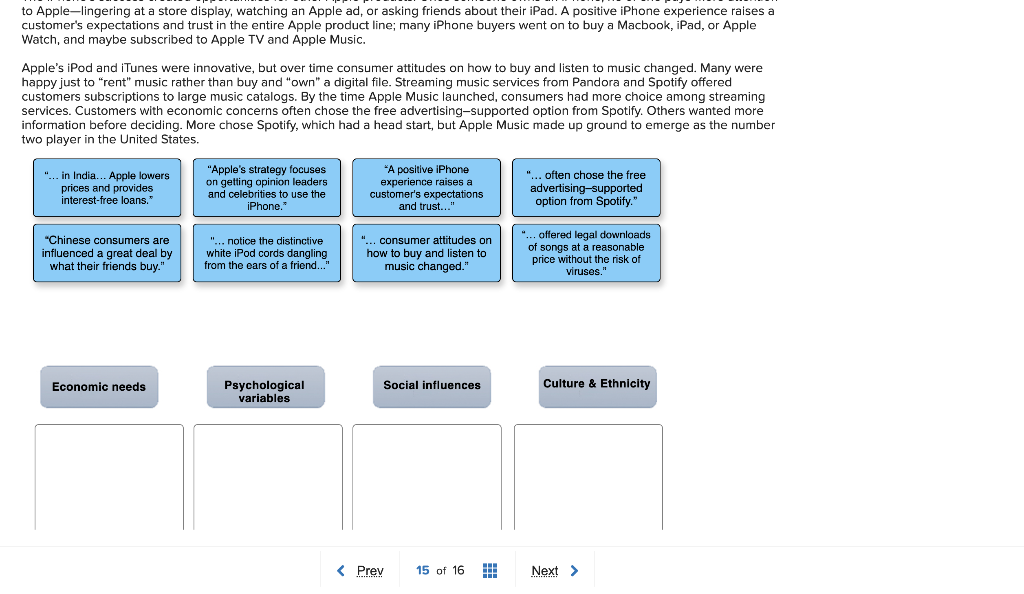
In-depth customer knowledge is needed for effective marketing-strategy planning. Without that understanding, it would be difficult to zero in on the right target market, or to develop and adapt a marketing mix that will be the best value for customers. Different fields like economics, psychology, sociology, and other behavioral disciplines can assist in developing an understanding of how and why customers make purchase decisions. The goal of this exercise is to demonstrate your understanding of the different types of influences on the consumer decision process by choosing quotes from an Apple case study and placing them in the appropriate category. Read the case "Apple Understands Consumer Behavior" and then drag and drop each quote into the influence on the consumer decision process it best represents. Apple Understands Consumer Behavior In the late 1990s, the new MP3 format offered quality music from a digital file that played on a computer or portable player. Many music buffs liked the idea of having songs at their fingertips, but getting the digital files was just too complicated. Further, music companies filed lawsuits charging some with illegally downloading MP3 music files. All of this slowed the initial adoption of MP3 players. Attitudes quickly changed when Apple offered an innovative marketing mix that addressed these customer needs. The online iTunes store offered legal downloads of songs at a reasonable price without the risk of viruses. The iPod was stylish and easy to use ads generated awareness and interest of the new concept among customers with the promise of "a thousand songs in your pocket." Even skeptics who ignored the ads couldn't help but notice the distinctive white iPod cords dangling from the ears of a friend who was "in" on this cool new product. That prompted a lot of product conversations and on-the-spot iPod demos. Testimonials on blogs, online consumer reviews, and posts on social media also helped spread the word. Apple also reinvented the cell phone market when it introduced the iPhone. These days most American consumers already own a smartphone, and growth has slowed. So Apple looks to international markets for new growth opportunities. Here it finds consumers with different needs. For example, in India, where consumers have less disposable income, Apple lowers prices and provides interestfree loans. Chinese consumers are influenced a great deal by what their friends buy. So Apple's strategy focuses on getting opinion leaders and celebrities to use the iPhone. The iPhone's success created opportunities for other Apple products. Once someone owns an iPhone, he or she pays more attention to Apple-lingering at a store display, watching an Apple ad, or asking friends about their iPad. A positive iPhone experience raises a to Apple-lingering at a store display, watching an Apple ad, or asking friends about their iPad. A positive iPhone experience raises a customer's expectations and trust in the entire Apple product line; many iPhone buyers went on to buy a Macbook, iPad, or Apple Watch, and maybe subscribed to Apple TV and Apple Music. Apple's iPod and iTunes were innovative, but over time consumer attitudes on how to buy and listen to music changed. Many were happy just to "rent" music rather than buy and "own" a digital file. Streaming music services from Pandora and Spotify offered 1 more number









 Study Help