







Question: Indicate whether each phrase is more descriptive of financial accounting or managerial accounting. (a) May be subjective Financial accounting Managerial accounting (b) Often used to
Indicate whether each phrase is more descriptive of financial accounting or managerial accounting.
(a) May be subjective
Financial accounting
Managerial accounting
(b) Often used to obtain financing
Financial accounting
Managerial accounting
(c) Typically prepared quarterly or annually
Financial accounting
Managerial accounting
(d) May measure time or customer satisfaction
Financial accounting
Managerial accounting
(e) Future oriented
Financial accounting
Managerial accounting
(f) Has a greater emphasis on cost-benefit analysis
Financial accounting
Managerial accounting
(g) Keeps records of assets and liabilities
Financial accounting
Managerial accounting
(h) Highly aggregated statements
Financial accounting
Managerial accounting
(i) Must conform to external standards
Financial accounting
Managerial accounting
(j) Special-purpose reports
Financial accounting
Managerial accounting
(k) Decision-making tool
Financial accounting
Managerial accounting
(l) Income statement, balance sheet, and statement of cash flows
Financial accounting
Managerial accounting
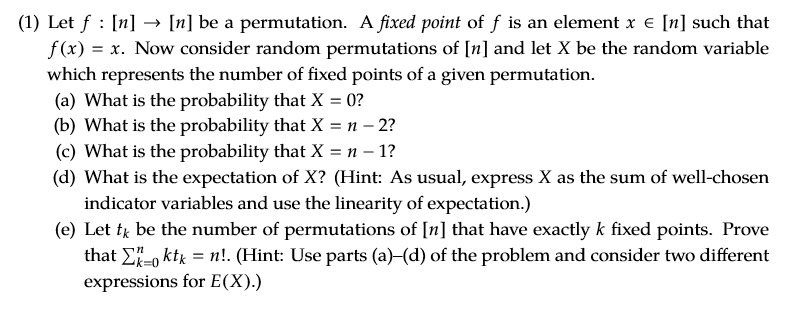
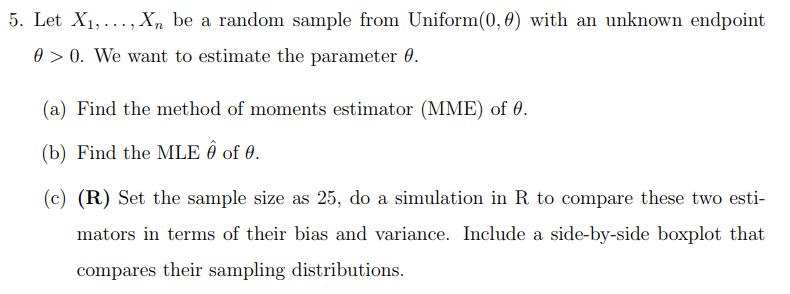
(1) Let f : [n] r [n] be a permutation. Axed point of f is an element x E [n] such that f(x) = x. Now consider random permutations of [n] and let X be the random variable which represents the number of xed points of a given permutation. {a} What is the probability that X = 0? {b} What is the probability thatX = n 2? (c) What is the probability that X = n 1? {d} What is the expectation of X? (Hint: As usual, express X as the sum of wellchosen indicator variables and use the linearity of expectation.) (e) Let tk be the number of permutations of [n] that have exactly I: fixed points. Prove that 23:\" ktk = n!. (Hint: Use parts {aHd) of the problem and consider two different expressions for E 00.) 5. Let X1, ..., Xn be a random sample from Uniform(0, 0) with an unknown endpoint 0 > 0. We want to estimate the parameter 0. (a) Find the method of moments estimator (MME) of 0. (b) Find the MLE 0 of 0. (c) (R) Set the sample size as 25, do a simulation in R to compare these two esti- mators in terms of their bias and variance. Include a side-by-side boxplot that compares their sampling distributions
Step by Step Solution
There are 3 Steps involved in it

Get step-by-step solutions from verified subject matter experts
 Study Help