







Question: Indicator random variables Indicator random variables are random variables that take the value 1 if the event happens and 0 if the event does not
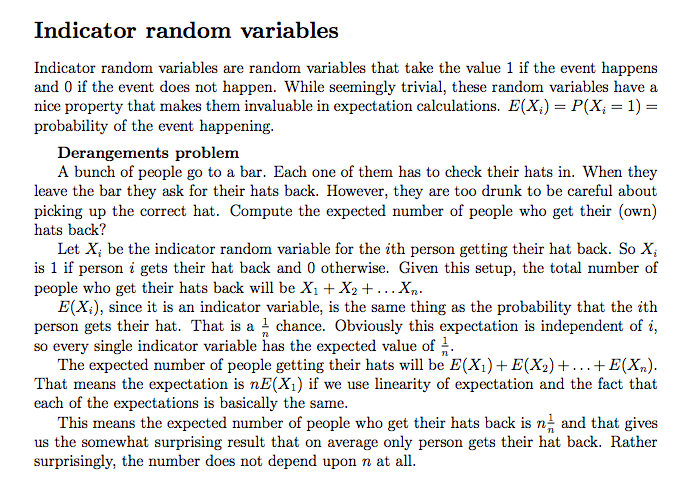
Indicator random variables Indicator random variables are random variables that take the value 1 if the event happens and 0 if the event does not happen. While seemingly trivial, these random variables have a nice property that makes them invaluable in expectation calculations. E(X,) PX 1)- probability of the event happening Derangements problem A bunch of people go to a bar. Each one of them has to check their hats in. When they leave the bar they ask for their hats back. However, they are too drunk to be careful about picking up the correct hat. Compute the expected number of people who get their (own) hats back? Let X, be the indicator random variable for the ith person getting their hat back. So X, is 1 if person i gets their hat back and 0 otherwise. Given this setup, the total number of people who get their hats back will be Xi + X2+...Xn. E(Xi), since it is an indicator variable, is the same thing as the probability that the ith person gets their hat. That is a chance. Obviously this expectation is independent of i, so every single indicator variable has the expected value of The expected number of people getting their hats will be E(Xi)+E(X2)+...+E(X) That means the expectation is nE(Xi) if we use linearity of expectation and the fact that each of the expectations is basically the same This means the expected number of people who get their hats back is n and that gives us the somewhat surprising result that on average only person gets their hat back. Rather surprisingly, the number does not depend upon n at all
Step by Step Solution
There are 3 Steps involved in it

Get step-by-step solutions from verified subject matter experts
 Study Help