







Question: Individual Assignment 1: Case Study: Microsoft's Intelligent Personal Assistant Cortana is an intelligent personal assistant integrated into the Windows 10 operating system and uses Microsoft's
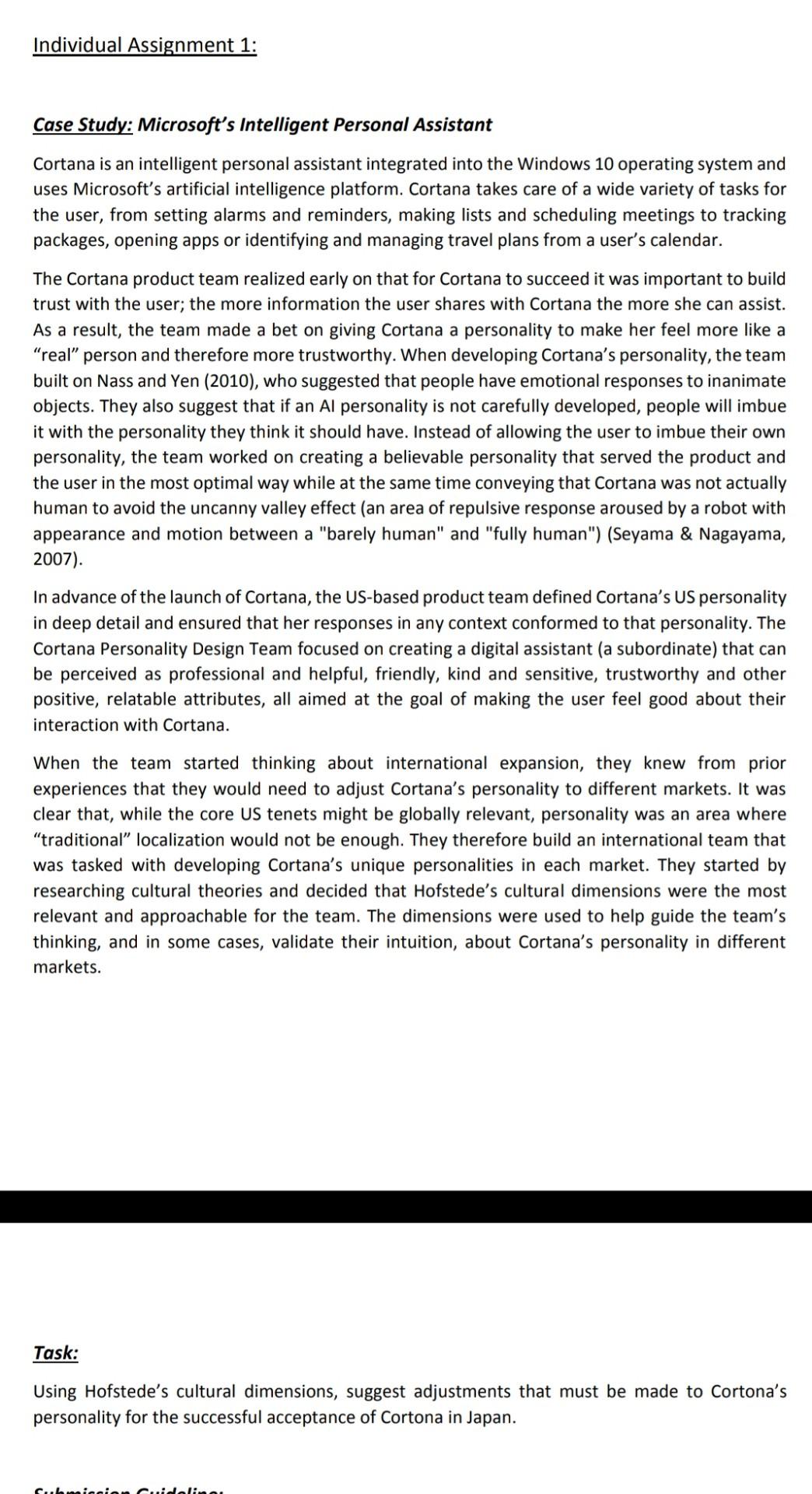
Individual Assignment 1: Case Study: Microsoft's Intelligent Personal Assistant Cortana is an intelligent personal assistant integrated into the Windows 10 operating system and uses Microsoft's artificial intelligence platform. Cortana takes care of a wide variety of tasks for the user, from setting alarms and reminders, making lists and scheduling meetings to tracking packages, opening apps or identifying and managing travel plans from a user's calendar. The Cortana product team realized early on that for Cortana to succeed it was important to build trust with the user; the more information the user shares with Cortana the more she can assist. As a result, the team made a bet on giving Cortana a personality to make her feel more like a "real" person and therefore more trustworthy. When developing Cortana's personality, the team built on Nass and Yen (2010), who suggested that people have emotional responses to inanimate objects. They also suggest that if an Al personality is not carefully developed, people will imbue it with the personality they think it should have. Instead of allowing the user to imbue their own personality, the team worked on creating a believable personality that served the product and the user in the most optimal way while at the same time conveying that Cortana was not actually human to avoid the uncanny valley effect (an area of repulsive response aroused by a robot with appearance and motion between a "barely human" and "fully human") (Seyama & Nagayama, 2007). In advance of the launch of Cortana, the US-based product team defined Cortana's US personality in deep detail and ensured that her responses in any context conformed to that personality. The Cortana Personality Design Team focused on creating a digital assistant (a subordinate) that can be perceived as professional and helpful, friendly, kind and sensitive, trustworthy and other positive, relatable attributes, all aimed at the goal of making the user feel good about their interaction with Cortana. When the team started thinking about international expansion, they knew from prior experiences that they would need to adjust Cortana's personality to different markets. It was clear that, while the core US tenets might be globally relevant, personality was an area where "traditional localization would not be enough. They therefore build an international team that was tasked with developing Cortana's unique personalities in each market. They started by researching cultural theories and decided that Hofstede's cultural dimensions were the most relevant and approachable for the team. The dimensions were used to help guide the team's thinking, and in some cases, validate their intuition, about Cortana's personality in different markets. Task: Using Hofstede's cultural dimensions, suggest adjustments that must be made to Cortona's personality for the successful acceptance of Cortona in Japan. Submission
Step by Step Solution
There are 3 Steps involved in it
1 Expert Approved Answer
Step: 1 Unlock

Question Has Been Solved by an Expert!
Get step-by-step solutions from verified subject matter experts
Step: 2 Unlock
Step: 3 Unlock
 Study Help