







Question: Industry (Five Forces) Analysis List one MOST INFLUENTIAL forces for the INDUSTRY. -Rate forces as High/Moderate/Low for the INDUSTRY, with brief reasons using one factors.
 Industry (Five Forces) Analysis
List one MOST INFLUENTIAL forces for the INDUSTRY.
-Rate forces as High/Moderate/Low for the INDUSTRY, with brief reasons using one factors.
-Assess industry attractiveness for both INCUMBENTS and NEW ENTRANTS, with brief reasons for each.
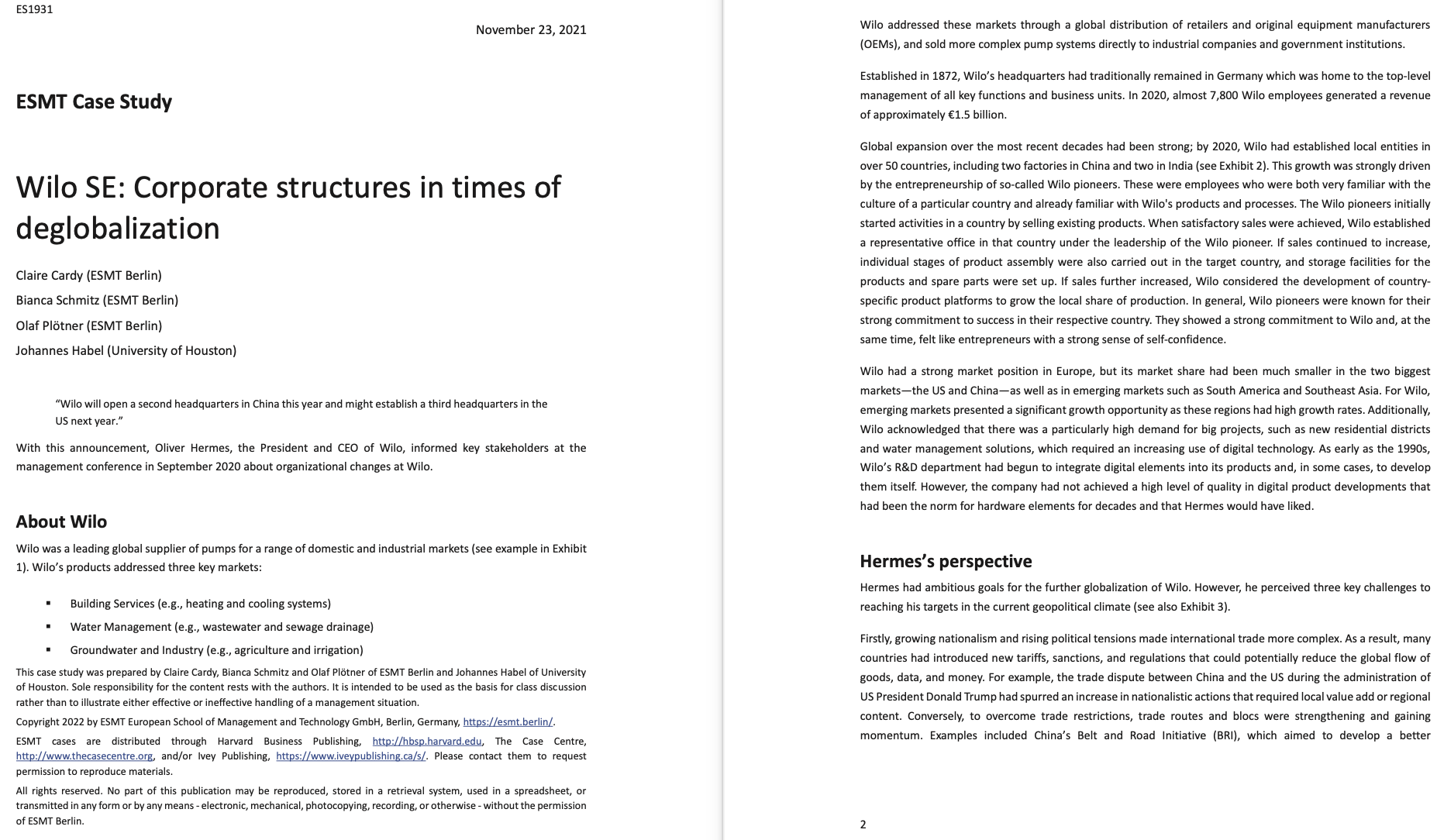
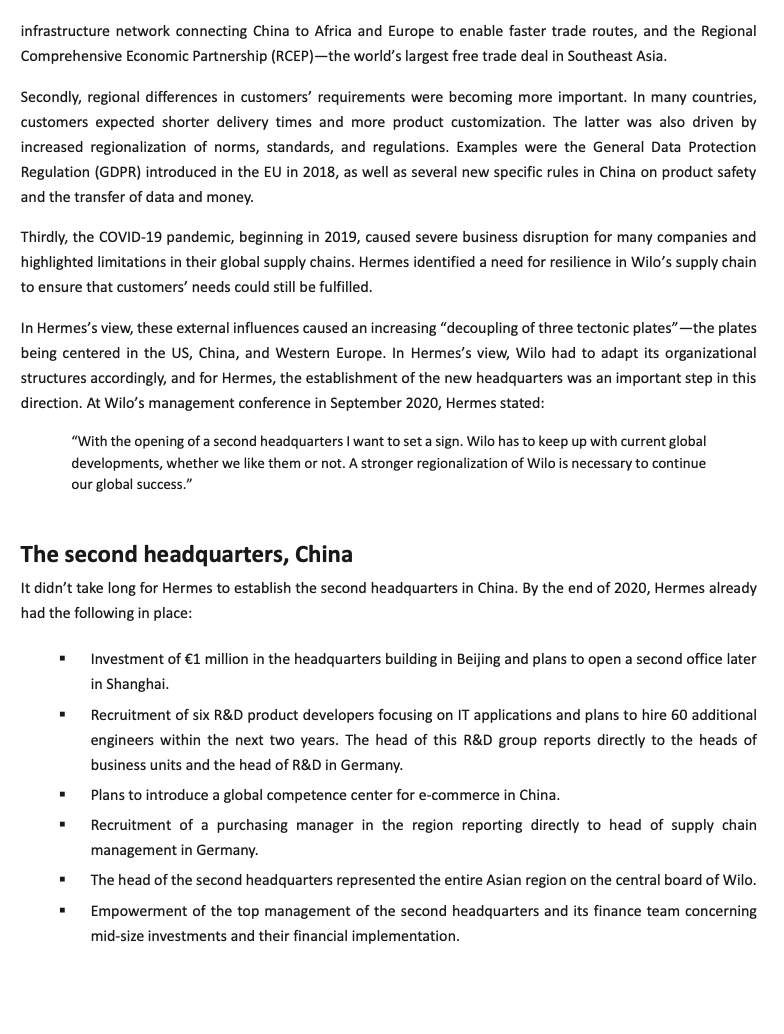
November 23, 2021 Wilo addressed these markets through a global distribution of retailers and original equipment manufacturers (OEMs), and sold more complex pump systems directly to industrial companies and government institutions. Established in 1872, Wilo's headquarters had traditionally remained in Germany which was home to the top-level ESMT Case Study management of all key functions and business units. In 2020, almost 7,800 Wilo employees generated a revenue of approximately 1.5 billion. Global expansion over the most recent decades had been strong; by 2020, Wilo had established local entities in over 50 countries, including two factories in China and two in India (see Exhibit 2). This growth was strongly driven Wilo SE: Corporate structures in times of by the entrepreneurship of so-called Wilo pioneers. These were employees who were both very familiar with the culture of a particular country and already familiar with Wilo's products and processes. The Wilo pioneers initially deglobalization started activities in a country by selling existing products. When satisfactory sales were achieved, Wilo established a representative office in that country under the leadership of the Wilo pioneer. If sales continued to increase, individual stages of product assembly were also carried out in the target country, and storage facilities for the Claire Cardy (ESMT Berlin) products and spare parts were set up. If sales further increased, Wilo considered the development of country- Bianca Schmitz (ESMT Berlin) specific product platforms to grow the local share of production. In general, Wilo pioneers were known for their Olaf Pltner (ESMT Berlin) strong commitment to success in their respective country. They showed a strong commitment to Wilo and, at the same time, felt like entrepreneurs with a strong sense of self-confidence. Johannes Habel (University of Houston) Wilo had a strong market position in Europe, but its market share had been much smaller in the two biggest markets-the US and China-as well as in emerging markets such as South America and Southeast Asia. For Wilo, "Wilo will open a second headquarters in China this year and might establish a third headquarters in the emerging markets presented a significant growth opportunity as these regions had high growth rates. Additionally, Wilo acknowledged that there was a particularly high demand for big projects, such as new residential districts With this announcement, Oliver Hermes, the President and CEO of Wilo, informed key stakeholders at the and water management solutions, which required an increasing use of digital technology. As early as the 1990s, management conference in September 2020 about organizational changes at Wilo. Wilo's R\&D department had begun to integrate digital elements into its products and, in some cases, to develop them itself. However, the company had not achieved a high level of quality in digital product developments that had been the norm for hardware elements for decades and that Hermes would have liked. About Wilo Wilo was a leading global supplier of pumps for a range of domestic and industrial markets (see example in Exhibit 1). Wilo's products addressed three key markets: Hermes's perspective Hermes had ambitious goals for the further globalization of Wilo. However, he perceived three key challenges to - Building Services (e.g., heating and cooling systems) reaching his targets in the current geopolitical climate (see also Exhibit 3). - Water Management (e.g., wastewater and sewage drainage) Firstly, growing nationalism and rising political tensions made international trade more complex. As a result, many - Groundwater and Industry (e.g., agriculture and irrigation) countries had introduced new tariffs, sanctions, and regulations that could potentially reduce the global flow of This case study was prepared by Claire Cardy, Bianca Schmitz and Olaf Pltner of ESMT Berlin and Johannes Habel of University goods, data, and money. For example, the trade dispute between China and the US during the administration of of Houston. Sole responsibility for the content rests with the authors. It is intended to be used as the basis for class discussion rather than to illustrate either effective or ineffective handling of a management situation. US President Donald Trump had spurred an increase in nationalistic actions that required local value add or regional Copyright 2022 by ESMT European School of Management and Technology GmbH, Berlin, Germany, https://esmt.berlin/. content. Conversely, to overcome trade restrictions, trade routes and blocs were strengthening and gaining momentum. Examples included China's Belt and Road Initiative (BRI), which aimed to develop a better ESMT cases are distributed through Harvard Business Publishing, http://hbsp.harvard.edu, The Case Centre, http://www.thecasecentre.org, and/or Ivey Publishing, https://www.iveypublishing.ca/s/. Please contact them to request permission to reproduce materials. All rights reserved. No part of this publication may be reproduced, stored in a retrieval system, used in a spreadsheet, or transmitted in any form or by any means - electronic, mechanical, photocopying, recording, or otherwise - without the permission of ESMT Berlin. 2 infrastructure network connecting China to Africa and Europe to enable faster trade routes, and the Regional Comprehensive Economic Partnership (RCEP)-the world's largest free trade deal in Southeast Asia. Secondly, regional differences in customers' requirements were becoming more important. In many countries, customers expected shorter delivery times and more product customization. The latter was also driven by increased regionalization of norms, standards, and regulations. Examples were the General Data Protection Regulation (GDPR) introduced in the EU in 2018, as well as several new specific rules in China on product safety and the transfer of data and money. Thirdly, the COVID-19 pandemic, beginning in 2019, caused severe business disruption for many companies and highlighted limitations in their global supply chains. Hermes identified a need for resilience in Wilo's supply chain to ensure that customers' needs could still be fulfilled. In Hermes's view, these external influences caused an increasing "decoupling of three tectonic plates" -the plates being centered in the US, China, and Western Europe. In Hermes's view, Wilo had to adapt its organizational structures accordingly, and for Hermes, the establishment of the new headquarters was an important step in this direction. At Wilo's management conference in September 2020, Hermes stated: "With the opening of a second headquarters I want to set a sign. Wilo has to keep up with current global developments, whether we like them or not. A stronger regionalization of Wilo is necessary to continue our global success." The second headquarters, China It didn't take long for Hermes to establish the second headquarters in China. By the end of 2020, Hermes already had the following in place: - Investment of 1 million in the headquarters building in Beijing and plans to open a second office later in Shanghai. - Recruitment of six R\&D product developers focusing on IT applications and plans to hire 60 additional engineers within the next two years. The head of this R\&D group reports directly to the heads of business units and the head of R\&D in Germany. - Plans to introduce a global competence center for e-commerce in China. - Recruitment of a purchasing manager in the region reporting directly to head of supply chain management in Germany. - The head of the second headquarters represented the entire Asian region on the central board of Wilo. - Empowerment of the top management of the second headquarters and its finance team concerning mid-size investments and their financial implementation
Step by Step Solution
There are 3 Steps involved in it

Get step-by-step solutions from verified subject matter experts
 Study Help