







Question: Industry: Performance Management and Downsizing need answers please: a. What are the main reasons a company would consider downsizing? b. Can companies use performance appraisal
Industry: Performance Management and Downsizing
need answers please:
a. What are the main reasons a company would consider downsizing?
b. Can companies use performance appraisal information to provide data during downsizing?
c. What should Howell do next?
d. What steps can D-Bart take to make Staff Reduction Decisions
e. How can D-Mark improve its performance appraisal process?
{ Wordcount: 3000 words }
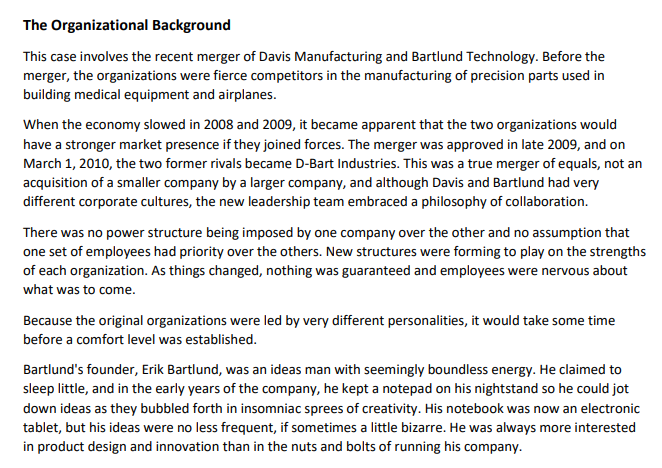
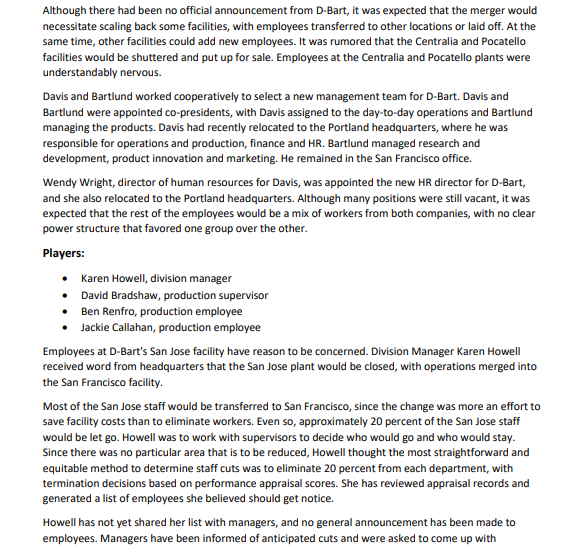
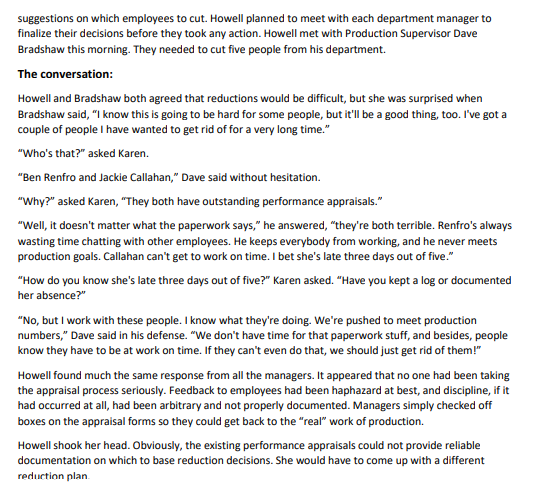
The Organizational Background This case involves the recent merger of Davis Manufacturing and Bartlund Technology. Before the merger, the organizations were fierce competitors in the manufacturing of precision parts used in building medical equipment and airplanes. When the economy slowed in 2008 and 2009, it became apparent that the two organizations would have a stronger market presence if they joined forces. The merger was approved in late 2009, and on March 1, 2010, the two former rivals became D-Bart Industries. This was a true merger of equals, not an acquisition of a smaller company by a larger company, and although Davis and Bartlund had very different corporate cultures, the new leadership team embraced a philosophy of collaboration. There was no power structure being imposed by one company over the other and no assumption that one set of employees had priority over the others. New structures were forming to play on the strengths of each organization. As things changed, nothing was guaranteed and employees were nervous about what was to come. Because the original organizations were led by very different personalities, it would take some time before a comfort level was established. Bartlund's founder, Erik Bartlund, was an ideas man with seemingly boundless energy. He claimed to sleep little, and in the early years of the company, he kept a notepad on his nightstand so he could jot down ideas as they bubbled forth in insomniac sprees of creativity. His notebook was now an electronic tablet, but his ideas were no less frequent, if sometimes a little bizarre. He was always more interested in product design and innovation than in the nuts and bolts of running his company. Although there had been no official announcement from D-Bart, it was expected that the merger would necessitate scaling back some facilities, with employees transferred to other locations or laid off. At the same time, other facilities could add new employees. It was rumored that the Centralia and Pocatello facilities would be shuttered and put up for sale. Employees at the Centralia and Pocatello plants were understandably nervous Davis and Bartlund worked cooperatively to select a new management team for D-Bart. Davis and Bartlund were appointed co-presidents, with Davis assigned to the day-to-day operations and Bartlund managing the products. Davis had recently relocated to the Portland headquarters, where he was responsible for operations and production, finance and HR. Bartlund managed research and development, product innovation and marketing. He remained in the San Francisco office. Wendy Wright, director of human resources for Davis, was appointed the new HR director for D-Bart, and she also relocated to the Portland headquarters. Although many positions were still vacant, it was expected that the rest of the employees would be a mix of workers from both companies, with no clear power structure that favored one group over the other. Players: Karen Howell, division manager David Bradshaw, production supervisor Ben Renfro, production employee Jackie Callahan, production employee Employees at D-Bart's San Jose facility have reason to be concerned. Division Manager Karen Howell received word from headquarters that the San Jose plant would be closed, with operations merged into the San Francisco facility. Most of the San Jose staff would be transferred to San Francisco, since the change was more an effort to save facility costs than to eliminate workers. Even so, approximately 20 percent of the San Jose staff would be let go. Howell was to work with supervisors to decide who would go and who would stay. Since there was no particular area that is to be reduced, Howell thought the most straightforward and equitable method to determine staff cuts was to eliminate 20 percent from each department, with termination decisions based on performance appraisal scores. She has reviewed appraisal records and generated a list of employees she believed should get notice. Howell has not yet shared her list with managers, and no general announcement has been made to employees. Managers have been informed of anticipated cuts and were asked to come up with suggestions on which employees to cut. Howell planned to meet with each department manager to finalize their decisions before they took any action. Howell met with Production Supervisor Dave Bradshaw this morning. They needed to cut five people from his department. The conversation: Howell and Bradshaw both agreed that reductions would be difficult, but she was surprised when Bradshaw said, I know this is going to be hard for some people, but it'll be a good thing, too. I've got a couple of people I have wanted to get rid of for a very long time." "Who's that?" asked Karen. "Ben Renfro and Jackie Callahan," Dave said without hesitation. "Why?" asked Karen, "They both have outstanding performance appraisals." "Well, it doesn't matter what the paperwork says," he answered, "they're both terrible. Renfro's always wasting time chatting with other employees. He keeps everybody from working, and he never meets production goals. Callahan can't get to work on time. I bet she's late three days out of five." "How do you know she's late three days out of five?" Karen asked. Have you kept a log or documented her absence?" "No, but I work with these people. I know what they're doing. We're pushed to meet production numbers," Dave said in his defense. "We don't have time for that paperwork stuff, and besides, people know they have to be at work on time. If they can't even do that, we should just get rid of them!" Howell found much the same response from all the managers. It appeared that no one had been taking the appraisal process seriously. Feedback to employees had been haphazard at best, and discipline, if it had occurred at all, had been arbitrary and not properly documented. Managers simply checked off boxes on the appraisal forms so they could get back to the "real" work of production. Howell shook her head. Obviously, the existing performance appraisals could not provide reliable documentation on which to base reduction decisions. She would have to come up with a different reduction planStep by Step Solution
There are 3 Steps involved in it
1 Expert Approved Answer
Step: 1 Unlock

Question Has Been Solved by an Expert!
Get step-by-step solutions from verified subject matter experts
Step: 2 Unlock
Step: 3 Unlock
 Study Help