Question: Develop a detailed development plan for a Human Assistant for a retail hardware chain. Despirent Methods e short and long-term ns (such as becoming Goal
Develop a detailed development plan for a Human Assistant for a retail hardware chain.
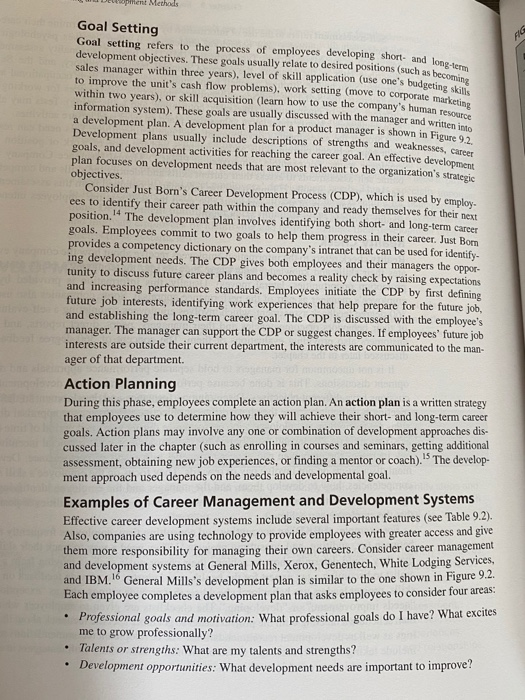
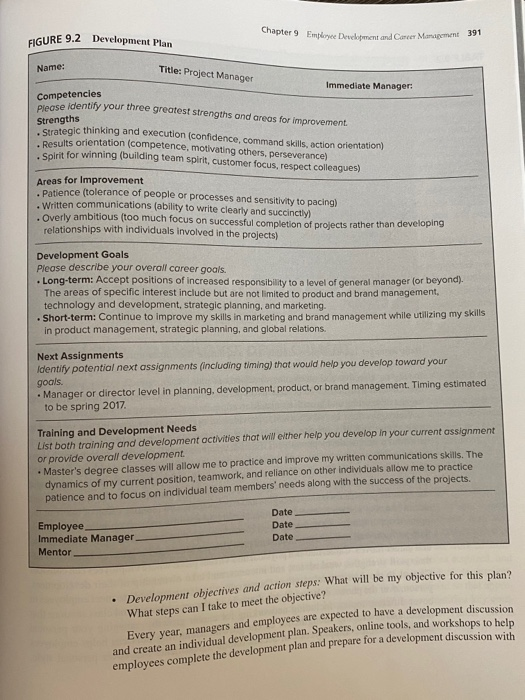
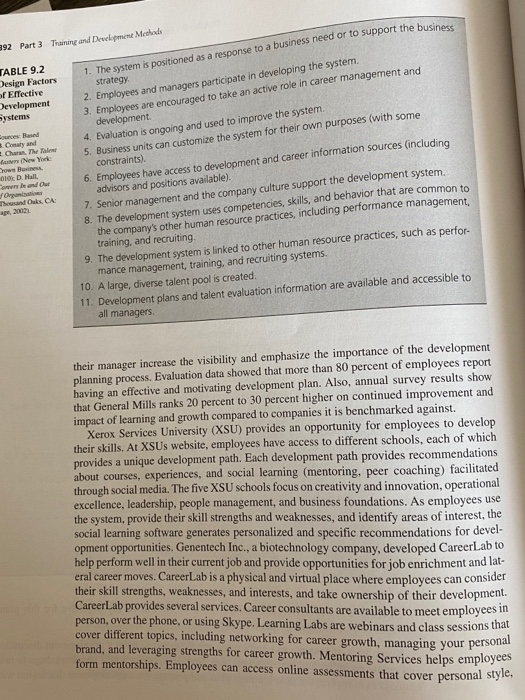
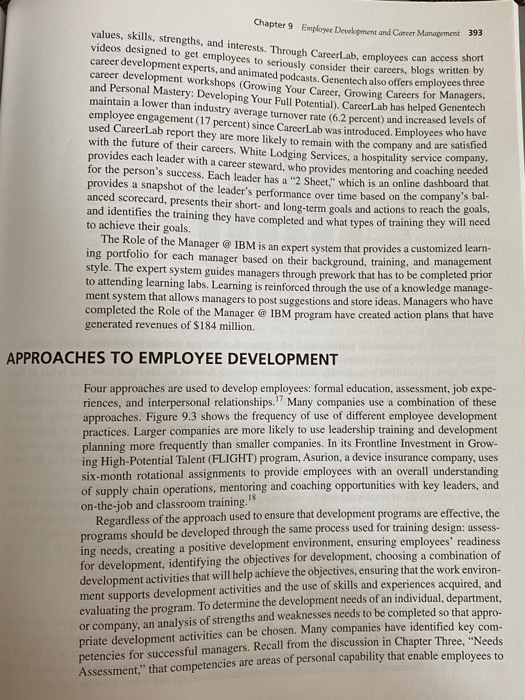
Despirent Methods e short and long-term ns (such as becoming Goal Setting Goal setting refers to the process of employees developing short and le development objectives. These goals usually relate to desired positions (such as sales manager within three years), level of skill application (use one's budgetine to improve the unit's cash flow problems), work setting (move to corporate marke within two years), or skill acquisition (learn how to use the company's human res information system). These goals are usually discussed with the manager and written a development plan. A development plan for a product manager is shown in Figure Development plans usually include descriptions of strengths and weaknesses, care goals, and development activities for reaching the career goal. An effective development plan focuses on development needs that are most relevant to the organization's strategie objectives. Consider Just Born's Career Development Process (CDP), which is used by emplos ees to identify their career path within the company and ready themselves for their next position. The development plan involves identifying both short and long-term career goals. Employees commit to two goals to help them progress in their career. Just Bom provides a competency dictionary on the company's intranet that can be used for identify ing development needs. The CDP gives both employees and their managers the oppor- tunity to discuss future career plans and becomes a reality check by raising expectations and increasing performance standards. Employees initiate the CDP by first defining future job interests, identifying work experiences that help prepare for the future job. and establishing the long-term career goal. The CDP is discussed with the employee's manager. The manager can support the CDP or suggest changes. If employees' future job interests are outside their current department, the interests are communicated to the man ager of that department. Action Planning During this phase, employees complete an action plan. An action plan is a written strategy that employees use to determine how they will achieve their short- and long-term career goals. Action plans may involve any one or combination of development approaches dis- cussed later in the chapter (such as enrolling in courses and seminars, getting additional assessment, obtaining new job experiences, or finding a mentor or coach). The develop ment approach used depends on the needs and developmental goal. Examples of Career Management and Development Systems Effective career development systems include several important features (see Table 9.2). Also, companies are using technology to provide employees with greater access and give them more responsibility for managing their own careers. Consider career management and development systems at General Mills, Xerox, Genentech, White Lodging Services, and IBM. General Mills's development plan is similar to the one shown in Figure 9.2. Each employee completes a development plan that asks employees to consider four areas: Professional goals and motivation: What professional goals do I have? What excites me to grow professionally? Talents or strengths: What are my talents and strengths? Development opportunities: What development needs are important to improve CIGURE 9.2 Development Plan Chapter 9 Employee Development and Career Management 39 Name: Title: Project Manager Immediate Manager: Competencies se identify your three greatest strengths and areas for improvement Strengths curategic thinking and execution (confidence, command skills action orientation) Desults orientation (competence, motivating others, perseverance) Spirit for winning (building team spirit, customer focus, respect colleagues) Areas for Improvement Patience (tolerance of people or processes and sensitivity to pacing) . Written communications (ability to write clearly and succinctly Overly ambitious (too much focus on successful completion of projects rather than developing relationships with individuals involved in the projects) Development Goals Please describe your overall career goals. . Long-term: Accept positions of increased responsibility to a level of general manager for beyond). The areas of specific interest include but are not limited to product and brand management technology and development, strategic planning, and marketing. Short-term: Continue to improve my skills in marketing and brand management while utilizing my skills in product management strategic planning, and global relations. Next Assignments Identify potential next assignments (including timing) that would help you develop toward your goals. Manager or director level in planning, development, product, or brand management. Timing estimated to be spring 2017 Training and Development Needs List both training and development activities that will either help you develop in your current assignment or provide overall development. Master's degree classes will allow me to practice and improve my written communications skills. The dynamics of my current position, teamwork, and reliance on other individuals allow me to practice patience and to focus on individual team members needs along with the success of the projects Employee Immediate Manager - Mentor Date Date Date Development objectives and action steps: What will be my objective for this pla What steps can I take to meet the objective? Every year, managers and employees are expected to have a development discus and create an individual development plan speakers, online tools, and workshops to employees complete the development plan and prepare for a develop te the development plan and prepare for a development discussion with 892 Part 3 Training and Development Methods 1. The system is positioned as a response to a business need or to support the businec TABLE 9.2 Design Factors of Effective Development Systems Cources Band Conaty and Charan, The Talent (New York Down Business DIOD. Hall one and Our Thesand Oaks, CA strategy 2. Employees and managers participate in developing the system. 3. Employees are encouraged to take an active role in career management and development. 4. Evaluation is ongoing and used to improve the system 5. Business units can customize the system for their own purposes (with some constraints). 6. Employees have access to development and career information sources (including advisors and positions available). 7. Senior management and the company culture support the development system 8. The development system uses competencies, skills, and behavior that are common to the company's other human resource practices, including performance management training, and recruiting. 9. The development system is linked to other human resource practices, such as perfor- mance management training, and recruiting systems. 10. A large, diverse talent pool is created. 11. Development plans and talent evaluation information are available and accessible to all managers. their manager increase the visibility and emphasize the importance of the development planning process. Evaluation data showed that more than 80 percent of employees report having an effective and motivating development plan. Also, annual survey results show that General Mills ranks 20 percent to 30 percent higher on continued improvement and impact of learning and growth compared to companies it is benchmarked against. Xerox Services University (XSU) provides an opportunity for employees to develop their skills, At XSUs website, employees have access to different schools, each of which provides a unique development path. Each development path provides recommendations about courses, experiences, and social learning (mentoring, peer coaching) facilitated through social media. The five XSU schools focus on creativity and innovation, operational excellence, leadership, people management, and business foundations. As employees use the system, provide their skill strengths and weaknesses, and identify areas of interest, the social learning software generates personalized and specific recommendations for devel- opment opportunities. Genentech Inc., a biotechnology company, developed Career Lab to help perform well in their current job and provide opportunities for iob enrichment and lat eral career moves. Career Lab is a physical and virtual place where employees can consider their skill strengths, weaknesses, and interests, and take ownership of their development. CareerLab provides several services Career consultants are available to meet employees person, over the phone, or using Skype. Learning Labs are webinars and class sessions that cover different topics, including networking for career growth, managing your personal brand, and leveraging strengths for career growth. Mentoring Services helps employees form mentorships. Employees can access online assessments that cover personal style, and Personm ent work and animSeriously ty: Develops Growing Odcasts. Gen hent (12 y aver Full Poten thers, W ard Chapter 9 Employee Development and Career Management 393 values, skills, strengths, and interests. Through Career Lab, employees can access videos designed to get employees to seriously consider their careers, blogs written career development experts, and animated podcasts. Genentech also offers employees in career development workshops (Growing Your Career. Growing Careers for Managers. and Personal Mastery: Developing Your Full Potential), Career Lab has helped Gencnice maintain a lower than industry average turnover rate (6.2 percent) and increased levels o employee engagement (17 percent) since Career Lab was introduced. Employees who have used CareerLab report they are more likely to remain with the company and are satisfied with the future of their careers, White Lodging Services hospitality service company provides each leader with a career steward, who provides mentoring and coaching nccdce for the person's success. Each leader has a "2 Sheet" which is an online dashboard that provides a snapshot of the leader's performance over time based on the company's bal anced scorecard, presents their short and long-term goals and actions to reach the goals and identities the training they have completed and what types of training they will need to achieve their goals. The Role of the Manager @ IBM is an expert system that provides a customized learn- ing portfolio for each manager based on their background, training, and management style. The expert system guides managers through prework that has to be completed prior to attending learning labs. Learning is reinforced through the use of a knowledge manage- ment system that allows managers to post suggestions and store ideas. Managers who have completed the Role of the Manager @ IBM program have created action plans that have generated revenues of $184 million. APPROACHES TO EMPLOYEE DEVELOPMENT Four approaches are used to develop employees: formal education, assessment, job expe- riences, and interpersonal relationships. Many companies use a combination of these approaches. Figure 9.3 shows the frequency of use of different employee development practices. Larger companies are more likely to use leadership training and development planning more frequently than smaller companies. In its Frontline Investment in Grow- ing High-Potential Talent (FLIGHT) program, Asurion, a device insurance company, uses six-month rotational assignments to provide employees with an overall understanding of supply chain operations, mentoring and coaching opportunities with key leaders, and on-the-job and classroom training." Regardless of the approach used to ensure that development programs are effective, the programs should be developed through the same process used for training design: assess ing needs, creating a positive development environment, ensuring employees' readiness for development, identifying the objectives for development, choosing a combination of development activities that will help achieve the objectives, ensuring that the work environ- ment supports development activities and the use of skills and experiences acquired and evaluating the program. To determine the development needs of an individual, department or company, an analysis of strengths and weaknesses needs to be completed so that appro priate development activities can be chosen. Many companies have identified key com. petencies for successful managers. Recall from the discussion in Chapter Three "Nanda Assessment." that competencies are areas of personal capability that enable employees to









 Study Help