Question: Inferential Statistics - M&M's For this, you will require 1.69 oz package of m&m's. It can be any variety (peanut m&m bags weigh a little

Inferential Statistics - M&M's For this, you will require 1.69 oz package of m&m's. It can be any variety (peanut m&m bags weigh a little bit more and peanut butter bags weigh a little bit less) so long as it has the standard colors: red, yellow, blue, green, orange and brown.
Inferential Statistics - M&M's For this, you willInferential Statistics - M&M's For this, you willInferential Statistics - M&M's For this, you will
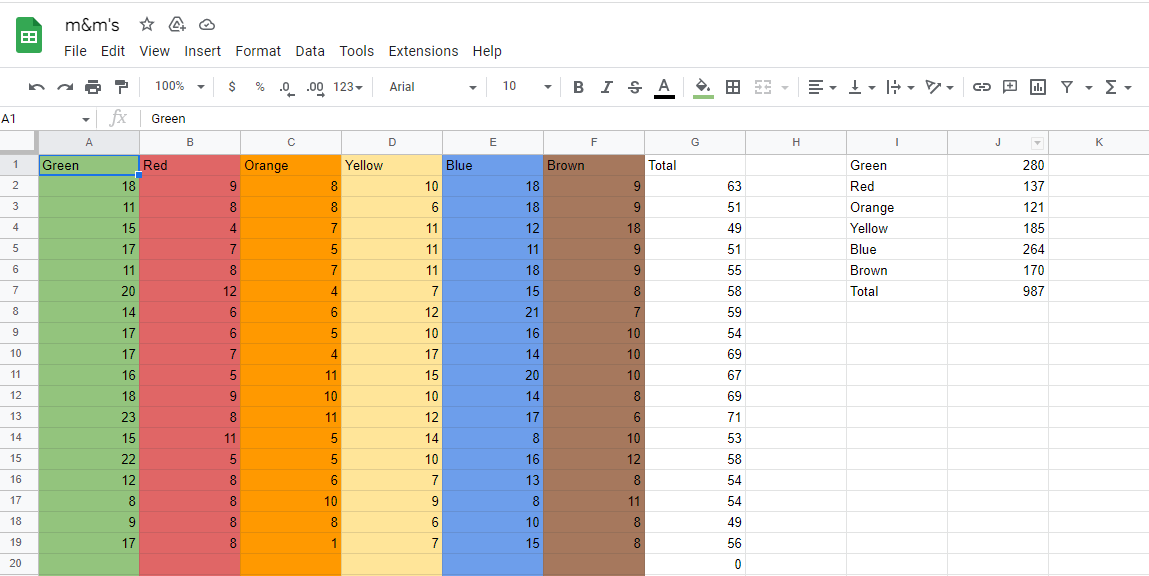
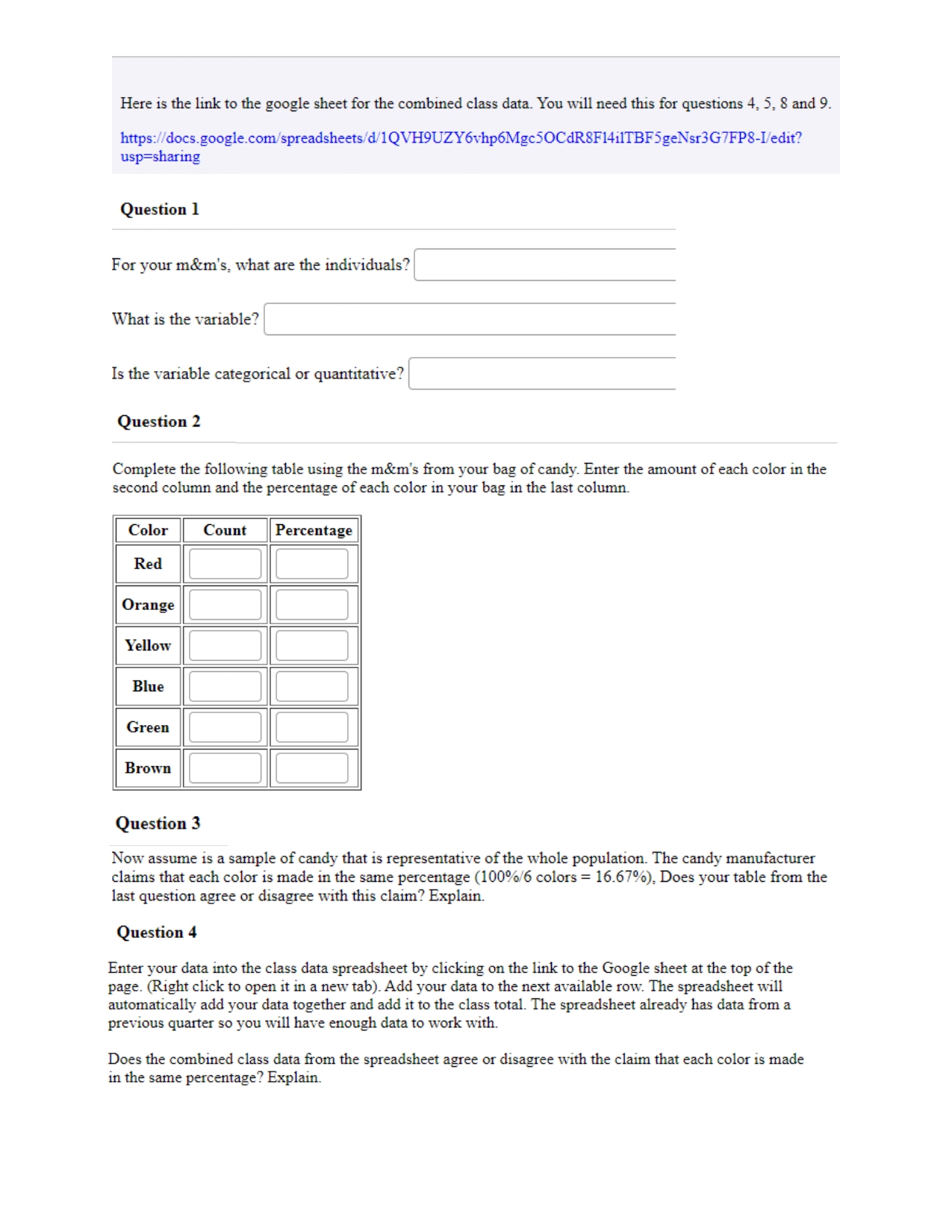
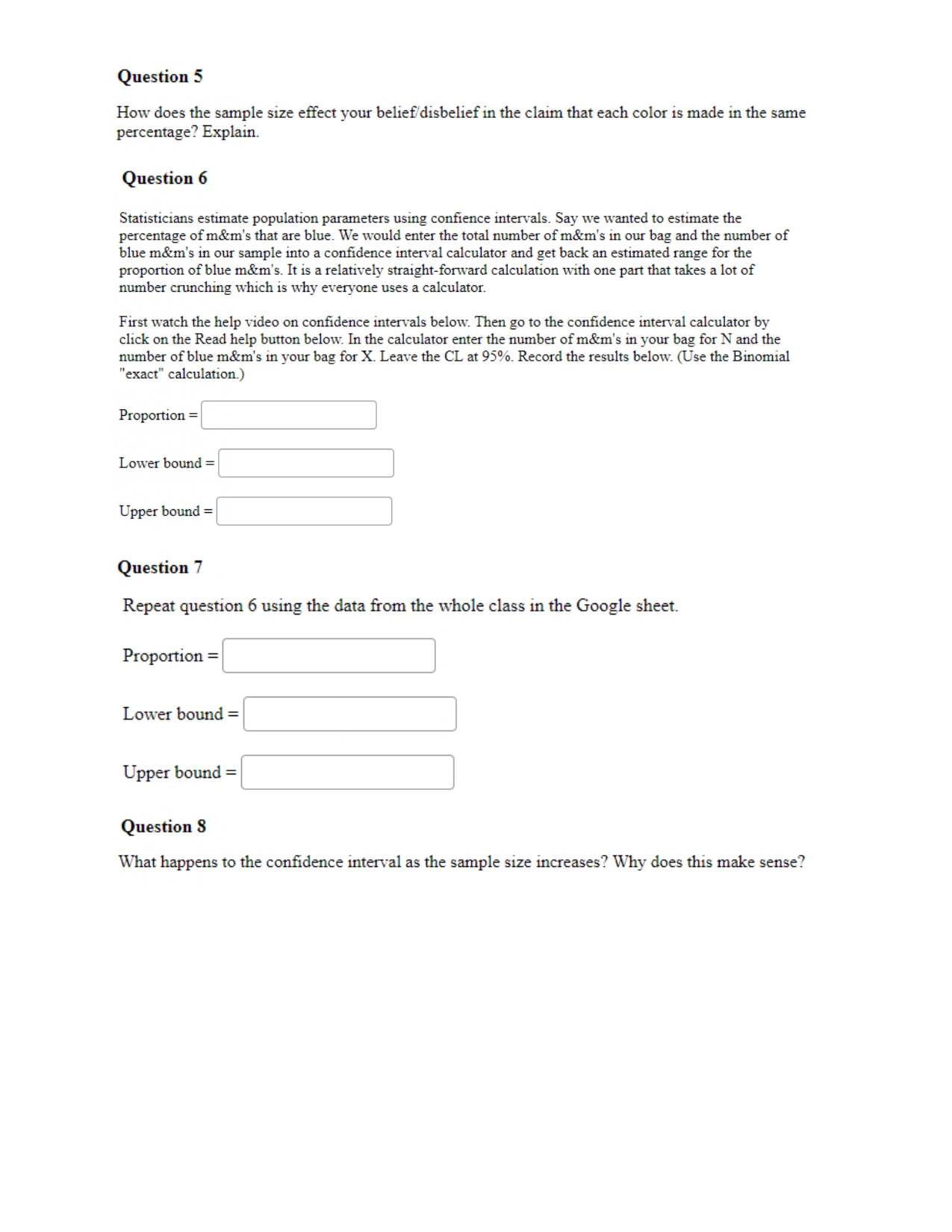
Here is the link to the google sheet for the combined class data. You will need this for questions 4, 5, 8 and 9. https://docs.google.com/spreadsheets/d/1QVHUZY6vhp6Mgc50CdR8F14ilTBF5geNsr3G7FP8-I/edit? usp=sharing Question 1 For your mom's, what are the individuals? What is the variable? Is the variable categorical or quantitative? Question 2 Complete the following table using the mam's from your bag of candy. Enter the amount of each color in the second column and the percentage of each color in your bag in the last column. Color Count Percentage Red Orange Yellow Blue Green Brown Question 3 Now assume is a sample of candy that is representative of the whole population. The candy manufacturer claims that each color is made in the same percentage (100%/6 colors = 16.67%), Does your table from the last question agree or disagree with this claim? Explain. Question 4 Enter your data into the class data spreadsheet by clicking on the link to the Google sheet at the top of the page. (Right click to open it in a new tab). Add your data to the next available row. The spreadsheet will automatically add your data together and add it to the class total. The spreadsheet already has data from a previous quarter so you will have enough data to work with. Does the combined class data from the spreadsheet agree or disagree with the claim that each color is made in the same percentage? Explain.Question 5 How does the sample size effect your belief disbelief in the claim that each color is made in the same percentage? Explain Question 6 Statisticians estimate population parameters using confience intervals. Say we wanted to estimate the percentage of mom's that are blue. We would enter the total number of mom's in our bag and the number of blue mom's in our sample into a confidence interval calculator and get back an estimated range for the proportion of blue mom's. It is a relatively straight-forward calculation with one part that takes a lot of number crunching which is why everyone uses a calculator. First watch the help video on confidence intervals below. Then go to the confidence interval calculator by click on the Read help button below. In the calculator enter the number of mom's in your bag for N and the number of blue mom's in your bag for X. Leave the CL at 95%. Record the results below. (Use the Binomial 'exact" calculation.) Proportion = Lower bound = Upper bound = Question 7 Repeat question 6 using the data from the whole class in the Google sheet. Proportion = Lower bound = Upper bound = Question S What happens to the confidence interval as the sample size increases? Why does this make sense?\f

Step by Step Solution

There are 3 Steps involved in it

1 Expert Approved Answer
Step: 1 Unlock blur-text-image

Question Has Been Solved by an Expert!

Get step-by-step solutions from verified subject matter experts

Step: 2 Unlock
Step: 3 Unlock

Students Have Also Explored These Related Mathematics Questions!