



Question: ing inciples, and P12-5B Presented below are assumptions, principles, and constraints used in this chapter. 1. Economic entity assumption 2. Going concern assumption 3.
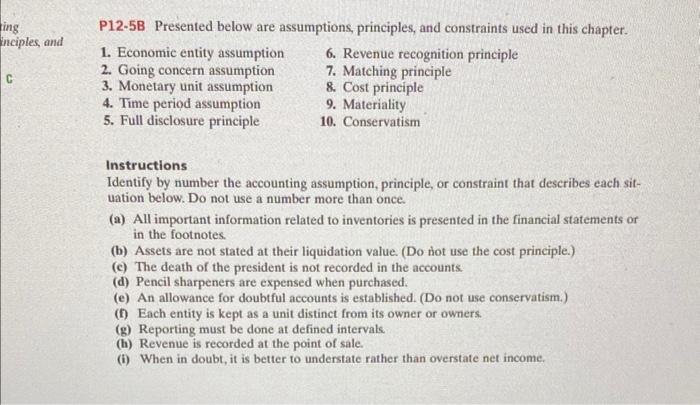
ing inciples, and P12-5B Presented below are assumptions, principles, and constraints used in this chapter. 1. Economic entity assumption 2. Going concern assumption 3. Monetary unit assumption 4. Time period assumption 5. Full disclosure principle 6. Revenue recognition principle 7. Matching principle 8. Cost principle 9. Materiality 10. Conservatism Instructions Identify by number the accounting assumption, principle, or constraint that describes each sit- uation below. Do not use a number more than once. (a) All important information related to inventories is presented in the financial statements or in the footnotes. (b) Assets are not stated at their liquidation value. (Do not use the cost principle.) (e) The death of the president is not recorded in the accounts. (d) Pencil sharpeners are expensed when purchased. (e) An allowance for doubtful accounts is established. (Do not use conservatism.) (f) Each entity is kept as a unit distinct from its owner or owners. (g) Reporting must be done at defined intervals. (h) Revenue is recorded at the point of sale. (i) When in doubt, it is better to understate rather than overstate net income.
Step by Step Solution
There are 3 Steps involved in it

Get step-by-step solutions from verified subject matter experts