







Question: input = (function, initial range, number of subranges to divide initial range into) output = (number of roots found, a vector of lower limits, a
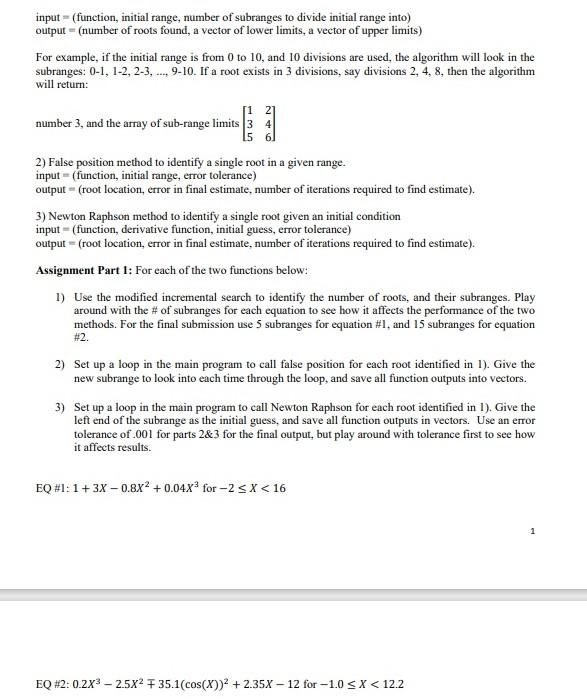
input = (function, initial range, number of subranges to divide initial range into) output = (number of roots found, a vector of lower limits, a vector of upper limits) For example, if the initial range is from 0 to 10, and 10 divisions are used the algorithm will look in the subranges: 0-1, 1-2, 2-3, ..., 9-10. If a root exists in 3 divisions, say divisions 2, 4, 8, then the algorithm will return: number 3, and the array of sub-range limits 3 4 2) False position method to identify a single root in a given range. input(function, initial range, error tolerance) output (root location, error in final estimate, number of iterations required to find estimate). 3) Newton Raphson method to identify a single root given an initial condition input = (function, derivative function, initial guess, error tolerance) output =(root location, error in final estimate, number of iterations required to find estimate). Assignment Part 1: For each of the two functions below: 1) Use the modified incremental search to identify the number of roots, and their subranges. Play around with the # of subranges for each equation to see how it affects the performance of the two methods. For the final submission use 5 subranges for equation #1, and 15 subranges for equation #2. 2) Set up a loop in the main program to call false position for each root identified in 1). Give the new subrange to look into each time through the loop, and save all function outputs into vectors. 3) Set up a loop in the main program to call Newton Raphson for each root identified in 1). Give the left end of the subrange as the initial guess, and save all function outputs in vectors. Use an error tolerance of .001 for parts 2&3 for the final output, but play around with tolerance first to see how it affects results. EQ #1: 1+3X 0.8x2 + 0.04x3 for-2
Step by Step Solution
There are 3 Steps involved in it

Get step-by-step solutions from verified subject matter experts
 Study Help