







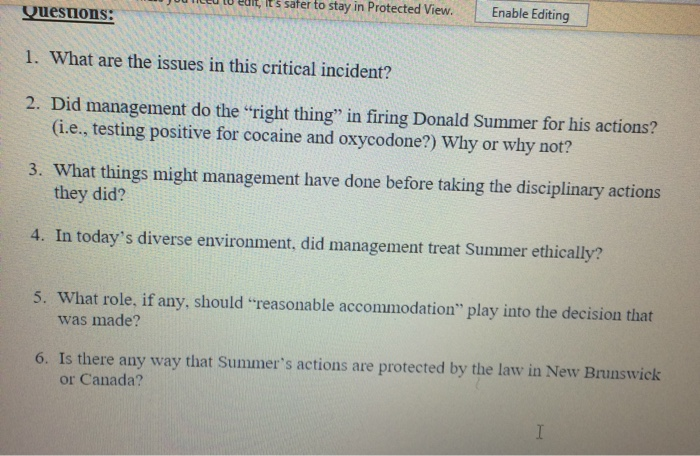
Question: Instructions: 1) Please read What to Do with a Druggie? Critical Incident 1-3 Case Study. See below Critical Incident Case Study. 2) Please answer the
Instructions:
1) Please read What to Do with a Druggie? Critical Incident 1-3 Case Study. See below Critical Incident Case Study.
2) Please answer the What to Do with a Druggy? Critical Incident Case Study Questions below.
3) Please refer to the assignment rubric saved on Brightspace as a guide to how your assignment will be evaluated.
What to Do with a Druggie? Critical Incident 1-3 Case Study
CASE STUDY
The Stage
As Mike Pearson drove from work to his grandsons tennis match, he contemplated the future. The economy showed no signs of recovery and his companys sales were down about 10 percent. Worse yet, the bottom line was less than 3 percent after taxes, the lowest level in the history of the company, Pearson Construction. His great-granddad had created the company 85 years ago and 18 years ago Mike succeeded his father as CEO. With more than 1,500 employees, he wondered whether he would have to make some personnel changes, and if so, how he would best approach that delicate task. Id better hurry or I will miss the start of the match. Im so glad Billy took up tennis while we were on vacation last summer. Hes doing a great job, and its so good for him to be out on the court.
Act One
Donald Summer began work as an electricians apprentice in 1988, and shortly after completing the program, he participated in a not-for-credit supervisory program offered by the company through the local community college. In 1999, Donald became a project supervisor, which was the perfect position for him. He spent most of his time out on the job, and he also acted as a strategic liaison between labor and management, who both respected his expertise and easy-going nature. His work performance was good and he received a number of PRIDE points, recognition given by the company based on employees demonstration of productivity, responsiveness, innovation, dedication, and enthusiasm (PRIDE) as reported by clients, other contractors, and fellow employees.
Donald was an avid tennis player since high school, and he often played on the weekends or after work with Pearsons purchasing manager, Carl Stoye. Once in a while he and Carl played doubles against Carls boss, Mike Pearson, and Mikes neighbor, George Coggins. Donald struggled for years to overcome the nagging pain of tennis elbow because he didnt want to quit playing. It seemed to be getting worse, so around 2010 he made a visit to his doctor, who prescribed oxycodone, a narcotic pain reliever, which seemed to take care of the chronic pain and helped him get his edge back on the court. Boy, he sure loved the game, and it gave him the opportunity to get out of the house and away from the quagmire of his home life. His wife constantly nagged at him about money, and his teenage boys seemed to be getting into trouble on what seemed like a weekly basis. Tennis, followed by a few gin and tonics at the club and maybe a line or two of coke with the club crew after Carl left, made him feel like he was on top of the world. If only he could stay there, or at work, where he was actually appreciated.
Donald loved his job, the money was great, and it kept him connected with the good life. He went to work every day and did his very best. No one at Pearson had any idea what he was going through or how he medicated and self-medicated his way through what seemed like a cold, muddy ditch of an existence at home. His wife knew, though. She found out everything one day while out shopping with one of the club wives. She stormed home to find Donald with gin and tonic in hand, arguing with the boys about the latest three-day suspension and how long it would be until his 14-year-old got his smartphone back. Donald, she hissed through her teeth, We need to talk. Can I see you in the den, please? As he sunk into his desk chair, she proceeded to describe what he already knew, the three-hour cooldowns at the club bar, the coke, the girlseverything. His shoulders slumped, he sighed, looked up at her and asked, Okay, what? What do you want me to do?
I have a mind to throw you out of this house right now. Maybe you could go live at the club. You seem to be right at home there. But, no, Im not going to raise these boys by myself. Theyre your responsibility. We are your responsibility. I bet if you left right now, youd spend all of our money on your boozing, your coke, your stupid tennis. No way. I wont even let that happen. Clean up your act, Donald. Quit it. All of it. Now. Or youre out of here, and Ill take you for every cent you have.
Well, that was pretty clear, Donald thought. So long, good life. He quit the club and complied with the demands. What else could he do?
In July 2013, Donald voluntarily entered an outpatient drug rehabilitation program. The program met on the weekends and did not interfere with his work schedule. He completed the program in October. His elbow pain was back and he couldnt stand it any longer, so he went to a different doctor about 30 miles away to get a new prescription for oxycodone, but for some reason the doctor would only suggest over-the-counter medication. One of the guys from the club texted him and invited him to a Halloween party for members and friends, and he was able to go because although he was no longer a member, he was invited. The coke came out around midnight after the cronies left, and he decided to head home at 2:00 a.m. with a few grams in his pocket, and 15 oxycodone pills someone offered to give him for his elbow. As he was leaving the party, one of the members gave him a guest pass to the tennis club, so he could go whenever he wanted and just pay court fees out of pocket, and buy drinks after, of course. In December, Donald and his wife filed Chapter 13 bankruptcy. Shortly thereafter, Pearson and other company employees became aware of Donalds financial problems when they read about his bankruptcy in the local paper. A week later, Mike Pearson became aware of Donalds participation in the rehab program during a discussion with a colleague. Mike and Pat Watts, Pearsons HR director, met with Donald to get his side of the story. They asked him to take a drug test. Donald suggested that he would test positive for drugs, but agreed to submit to the test. Pearsons employee handbook stated that anytime an employee was injured on the job he or she would submit to a drug and alcohol test. There was also a broad statement that company had the right to request alcohol and drug testing of suspected cause.
On April 5, 2014, Donald tests showed positive for cocaine and oxycodone. He was fired that day for violation of Pearsons drug policy. Donald believed that he could get clean and asked if in that case would they consider him for reemployment? Mike and the HR director basically said, We will have to see when that time comes.
Intermission
Mike and the Pat Watts struggled with the decision to terminate a long-term employee and pondered if they might have done something different.
Act 2
In late April, Donald entered an inpatient drug rehabilitation program. Upon entering the program, he tested positive for cocaine and oxycodone, along with THC (marijuana), which he had started smoking at night out in his workshop, which was the only place he could escape anymore. He couldnt afford to leave the house. He completed the program a month later, and the report issued by his rehab counselor described his recovery prognosis as guarded.
The day after he completed the program, Donald contacted Pat Watts, Pearsons HR director, and asked to return to work. In a meeting with Mike Pearson and Watts, Donald was told that the company was completing and thus ending a $130 million hospital project and with the current poor economy, they were forced to lay off over 100 employees. They told him that several supervisors would be laid off and others would have their hours reduced.
Donalds last words were, You lied to me. Im going to get a lawyer and sue you!
Mike and Pat wondered if they had made a mistake. He is over forty and a drug addict. Wonder what would be the basis for a law suit? Mike and Pat pondered their actions and wondered if they had done the right thing?.
Step by Step Solution
There are 3 Steps involved in it
1 Expert Approved Answer
Step: 1 Unlock

Question Has Been Solved by an Expert!
Get step-by-step solutions from verified subject matter experts
Step: 2 Unlock
Step: 3 Unlock
 Study Help