Question: Instructions for Road Machinery Manufacturing case study For this case I want you to assume the role as an advisor to Ray Wilkins. (In most
Instructions for Road Machinery Manufacturing case study
For this case I want you to assume the role as an advisor to Ray Wilkins. (In most cases you will assume the role of the actual individual, as opposed to an advisor.)
It is important that your recommendations/advice align with the circumstances of the case. (For instance, recommending the implementation of an ERP system would not be realistic for this case.)
You may choose to use templates with different designs. However, the contents and/or format/structure must be incorporated for all three cases. The grade breakdown is shown in the CaseGrading.docx file found in the Orientation/Administration folder in Slate.
As you would do if you were advising Ray Wilkins, you are to analyze the case from a holistic perspective (e.g. don't just focus on OM, or Leadership, or Financial Analysis).
For instance, for this case, at minimum you should consider assessing the following for each alternative you consider:
Advantages and Disadvantages
Impact on production, human resources and customers
Financial analysis
Which items on the Income Statement and Balance Sheet are likely to be impacted
How are they likely to be impacted (e.g. increase, decrease)?
How will key financial metrics likely be impacted?
Potential impacts when the business expands
How to deal with Robson's attitude
Finally, make sure you read the case critically, and not take all statements at face value. For instance, in this case I strongly suggest you analyze the true impact of the deposit required by QPS. You also need to take into account the relationship with Robson in your analysis.
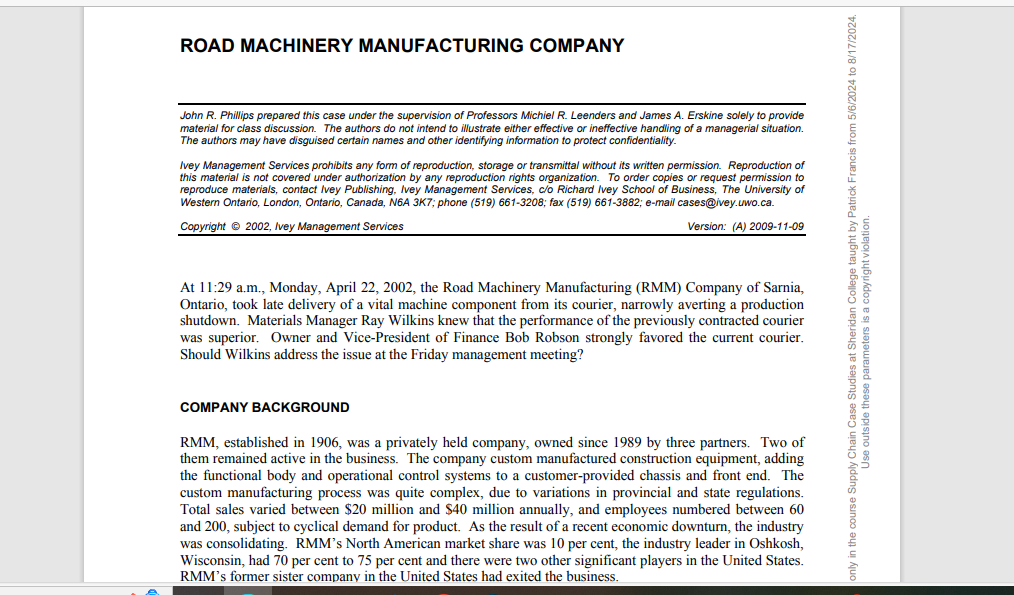
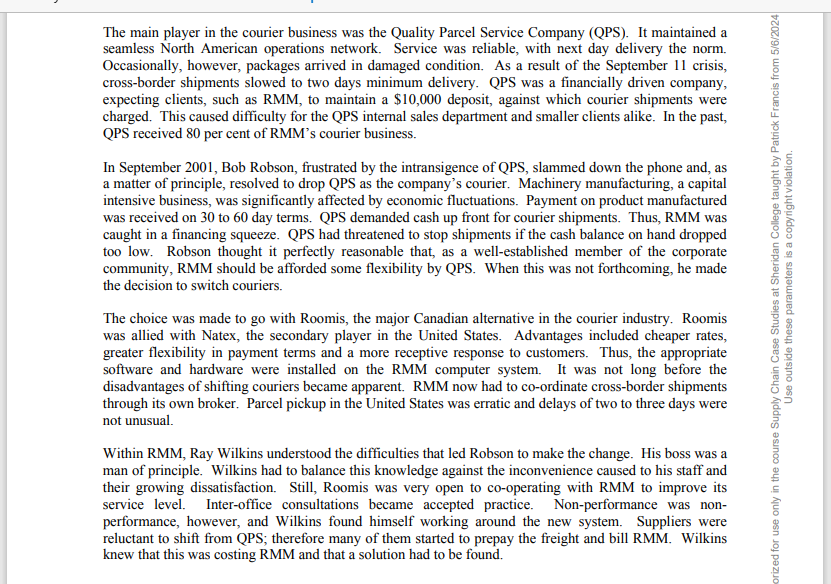
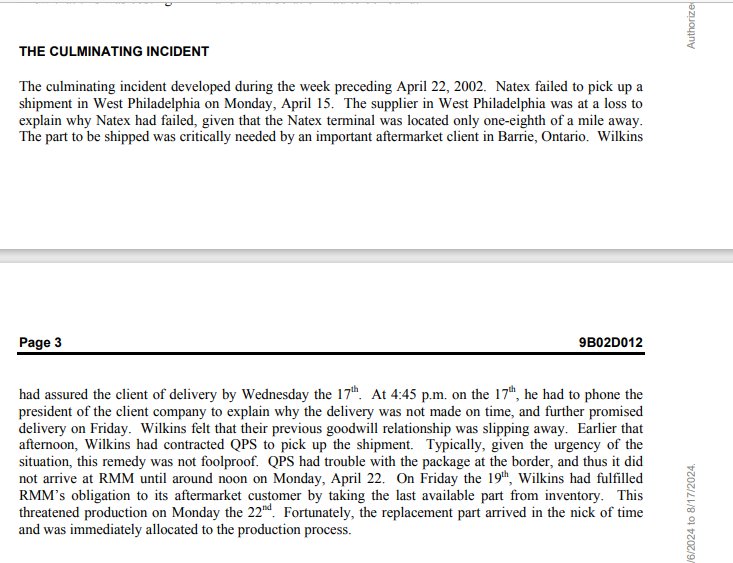
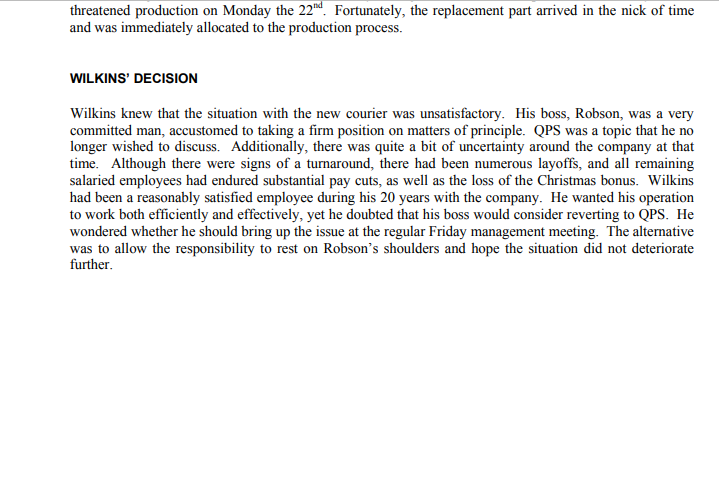
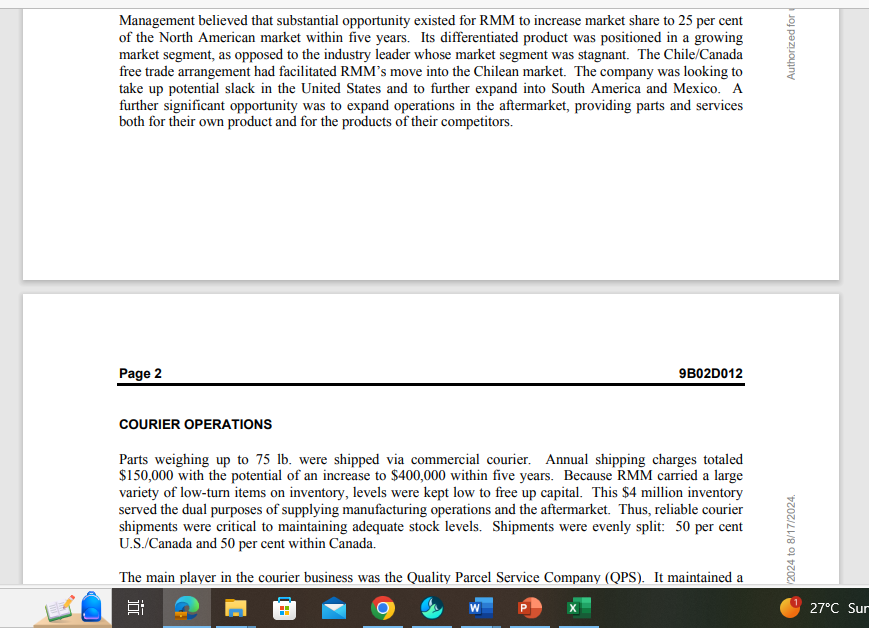
ROAD MACHINERY MANUFACTURING COMPANY John R. Phillips prepared this case under the supervision of Professors Michiel R. Leenders and James A. Erskine solely to provide material for class discussion. The authors do not intend to illustrate either effective or ineffective handling of a managerial situation. The authors may have disguised certain names and other identifying information to protect confidentiality. Ivey Management Services prohibits any form of reproduction, storage or transmittal without its written permission. Reproduction of this material is not covered under authorization by any reproduction rights organization. To order copies or request permission to reproduce materials, contact Ivey Publishing, Ivey Management Services, clo Richard Ivey School of Business, The University of Western Ontario, London, Ontario, Canada, NGA 3K7; phone (519) 661-3208; fax (519) 661-3882; e-mail cases@ivey.uwo.ca. Copyright @ 2002, Ivey Management Services Version: (A) 2009-11-09 At 11:29 a.m., Monday, April 22, 2002, the Road Machinery Manufacturing (RMM) Company of Sarnia, only in the course Supply Chain Case Studies at Sheridan College taught by Patrick Francis from 5/6/2024 to 8/17/2024. Ontario, took late delivery of a vital machine component from its courier, narrowly averting a production shutdown. Materials Manager Ray Wilkins knew that the performance of the previously contracted courier was superior. Owner and Vice-President of Finance Bob Robson strongly favored the current courier. Use outside these parameters is a copyright violation. Should Wilkins address the issue at the Friday management meeting? COMPANY BACKGROUND RMM, established in 1906, was a privately held company, owned since 1989 by three partners. Two of them remained active in the business. The company custom manufactured construction equipment, adding the functional body and operational control systems to a customer-provided chassis and front end. The custom manufacturing process was quite complex, due to variations in provincial and state regulations. Total sales varied between $20 million and $40 million annually, and employees numbered between 60 and 200, subject to cyclical demand for product. As the result of a recent economic downturn, the industry was consolidating. RMM's North American market share was 10 per cent, the industry leader in Oshkosh, Wisconsin, had 70 per cent to 75 per cent and there were two other significant players in the United States. RMM's former sister company in the United States had exited the business.The main player in the courier business was the Quality Parcel Service Company (QPS). It maintained a seamless North American operations network. Service was reliable, with next day delivery the norm. Occasionally, however, packages arrived in damaged condition. As a result of the September 11 crisis, cross-border shipments slowed to two days minimum delivery. QPS was a financially driven company, expecting clients, such as RMM, to maintain a $10,000 deposit, against which courier shipments were charged. This caused difficulty for the QPS internal sales department and smaller clients alike. In the past, QPS received 80 per cent of RMM s courier business. In September 2001, Bob Robson, frustrated by the intransigence of QPS, slammed down the phone and, as a matter of principle, resolved to drop QPS as the company's courier. Machinery manufacturing, a capital intensive business, was significantly affected by economic tluctuations. Payment on product manufactured was received on 30 to 60 day terms. QPS demanded cash up front for courier shipments. Thus, RMM was caught in a financing squeeze. (JPS had threatened to stop shipments if the cash balance on hand dropped too low. Robson thought it perfectly reasonable that, as a well-established member of the corporate community, RMM should be afforded some flexibility by QPS. When this was not forthcoming, he made the decision to switch couriers. The choice was made to go with Roomis, the major Canadian alternative in the courer industry. Roomis was allied with MNatex, the secondary plaver in the United States. Advantages included cheaper rates, greater flexibility in payment terms and a more receptive response to customers. Thus, the appropriate software and hardware were installed on the RMM computer system. It was not long before the disadvantages of shifting couriers became apparent. RMM now had to co-ordinate cross-border shipments through its own broker. Parcel pickup in the United States was erratic and delays of two to three days were not unusual. Within RMM, Ray Wilkins understood the difficulties that led Robson to make the change. His boss was a man of principle. Wilkins had to balance this knowledge against the inconvenience caused to his staff and their growing dissatisfaction. Still, Roomis was very open to co-operating with RMM to improve its service level. Inter-office consultations became accepted practice. Non-performance was non- performance, however, and Wilkins found himself working around the new system. Suppliers were reluctant to shift from QPS; therefore many of them started to prepay the freight and bill RMM. Wilkins knew that this was costing RMM and that a solution had to be found. from 5/6/2024 by Patrick Francis L & ol B [+ = = [ = 2 @ (o] = Authorize THE CULMINATING INCIDENT The culminating incident developed during the week preceding April 22, 2002. Natex failed to pick up a shipment in West Philadelphia on Monday, April 15. The supplier in West Philadelphia was at a loss to explain why Natex had failed, given that the Natex terminal was located only one-eighth of a mile away. The part to be shipped was critically needed by an important aftermarket client in Barrie, Ontario. Wilkins Page 3 9B02D012 had assured the client of delivery by Wednesday the 17". At 4:45 p.m. on the 17", he had to phone the president of the client company to explain why the delivery was not made on time, and further promised delivery on Friday. Wilkins felt that their previous goodwill relationship was slipping away. Earlier that afternoon, Wilkins had contracted QPS to pick up the shipment. Typically, given the urgency of the situation, this remedy was not foolproof. QPS had trouble with the package at the border, and thus it did not arrive at RMM until around noon on Monday, April 22. On Friday the 19", Wilkins had fulfilled RMM's obligation to its aftermarket customer by taking the last available part from inventory. This threatened production on Monday the 22". Fortunately, the replacement part arrived in the nick of time 16/2024 to 8/17/2024. and was immediately allocated to the production process.Authorize THE CULMINATING INCIDENT The culminating incident developed during the week preceding April 22, 2002. Natex failed to pick up a shipment in West Philadelphia on Monday, April 15. The supplier in West Philadelphia was at a loss to explain why Natex had failed, given that the Natex terminal was located only one-eighth of a mile away. The part to be shipped was critically needed by an important aftermarket client in Barrie, Ontario. Wilkins Page 3 9B02D012 had assured the client of delivery by Wednesday the 17". At 4:45 p.m. on the 17", he had to phone the president of the client company to explain why the delivery was not made on time, and further promised delivery on Friday. Wilkins felt that their previous goodwill relationship was slipping away. Earlier that afternoon, Wilkins had contracted QPS to pick up the shipment. Typically, given the urgency of the situation, this remedy was not foolproof. QPS had trouble with the package at the border, and thus it did not arrive at RMM until around noon on Monday, April 22. On Friday the 19", Wilkins had fulfilled RMM's obligation to its aftermarket customer by taking the last available part from inventory. This threatened production on Monday the 22". Fortunately, the replacement part arrived in the nick of time 16/2024 to 8/17/2024. and was immediately allocated to the production process.threatened production on Monday the 5l Fortunately, the replacement part arrived in the nick of time and was immediately allocated to the production process. WILKINS DECISION Wilkins knew that the situation with the new courier was unsatisfactory. His boss, Robson, was a very committed man, accustomed to taking a firm position on matters of principle. QPS was a topic that he no longer wished to discuss. Additionally, there was quite a bit of uncertainty around the company at that time. Although there were signs of a turnaround, there had been numerous layoffs, and all remaining salaried employees had endured substantial pay cuts, as well as the loss of the Christmas bonus. Wilkins had been a reasonably satistied employee during his 20 years with the company. He wanted his operation to work both efficiently and effectively, yet he doubted that his boss would consider reverting to QPS. He wondered whether he should bring up the i1ssue at the regular Friday management meeting. The alternative was to allow the responsibility to rest on Robson's shoulders and hope the situation did not deteriorate further. Management believed that substantial opportunity existed for RMM to increase market share to 25 per cent of the North American market within five years. Its differentiated product was positioned in a growing market segment, as opposed to the industry leader whose market segment was stagnant. The Chile/Canada free trade arrangement had facilitated RMM s move into the Chilean market. The company was looking to take up potential slack in the United States and to further expand mto South Amernca and Mexico. A further significant opportunity was to expand operations in the aftermarket, providing parts and services both for their own product and for the products of their competitors. Page 2 aB02D012 COURIER OPERATIONS Parts weighing up to 75 Ib. were shipped via commercial courier. Annual shipping charges totaled $150,000 with the potential of an increase to $400,000 within five years. Because RMM carried a large variety of low-turn items on inventory, levels were kept low to free up capital. This $4 million inventory served the dual purposes of supplying manufacturing operations and the aftermarket. Thus, reliable courier shipments were critical to maintaining adequate stock levels. Shipments were evenly split: 50 per cent [J.S./Canada and 50 per cent within Canada. The main plaver in the couner business was the Quality Parcel Service Company (QPS). [t maintained a
Step by Step Solution
There are 3 Steps involved in it
1 Expert Approved Answer
Step: 1 Unlock
Question Has Been Solved by an Expert!
Get step-by-step solutions from verified subject matter experts
Step: 2 Unlock
Step: 3 Unlock
Students Have Also Explored These Related General Management Questions!









 Study Help