







Question: Instructions For your discussion post, use Figure 15-1 from the textbook as your starting point to address the following: Can, and how does, the entrant
Instructions
For your discussion post, use Figure 15-1 from the textbook as your starting point to address the following:
- Can, and how does, the entrant succeed? Is the incumbent ever in control of this game?
- You may wish to review the old game known as Duopoly, as well as Antoine-Augustin Cournot, to help inform your post.
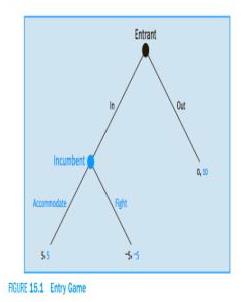
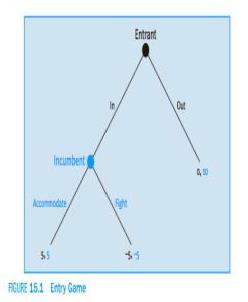
In yourManagerial Economicstextbook, we consider a sequential-move game in which an entrant is considering entering an industry in competition with an incumbent firm (see Figure 15-1). There are several possibilities of how this sequential game will be played. We want to use the Froeb rule of "look ahead and reason back."
15.1 Sequential-Move Games
In sequential-move games, players take turns, and each player observes what his or her rival did before having to move. To compute the likely outcome of a sequential game, we look ahead and reason back, or predict what will happen tomorrow in response to each of our possible actions today. By anticipating how the other player will react tomorrow, we can accurately forecast the con- sequences of her own moves.
We represent sequential games using the extensive or tree form of a game, familiar to anyone who has ever used a decision tree. Consider the simple two- move game illustrated in Figure 15.1. An entrant is deciding whether to enter an industry currently controlled by a single incumbent firm. Beginning on the bottom of the left branch of the tree, we see that entry can lead to two dif- ferent outcomes depending on how the incumbent reacts. The incumbent has two choices: accommodate entry or fight it. Accommodation
Figure 15.1
Entrant Incumbent FIGURE 15.1 Entry Game
Step by Step Solution
There are 3 Steps involved in it

Get step-by-step solutions from verified subject matter experts
 Study Help