



Question: INSTRUCTIONS In this assignment, you are asked to qualitatively analyze the vaccination decisions of two employers during the COVID - 1 9 pandemic, using your
INSTRUCTIONS
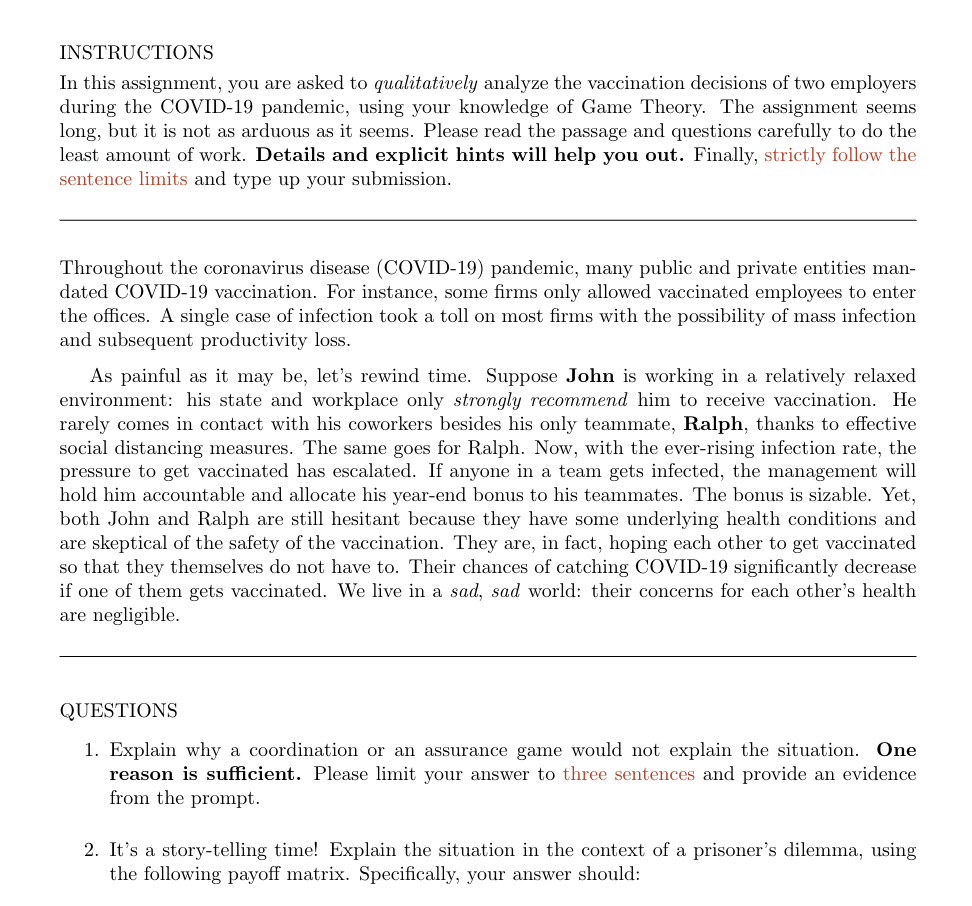
In this assignment, you are asked to qualitatively analyze the vaccination decisions of two employers during the COVID pandemic, using your knowledge of Game Theory. The assignment seems long, but it is not as arduous as it seems. Please read the passage and questions carefully to do the least amount of work. Details and explicit hints will help you out. Finally, strictly follow the sentence limits and type up your submission.
Throughout the coronavirus disease COVID pandemic, many public and private entities mandated COVID vaccination. For instance, some firms only allowed vaccinated employees to enter the offices. A single case of infection took a toll on most firms with the possibility of mass infection and subsequent productivity loss.
As painful as it may be let's rewind time. Suppose John is working in a relatively relaxed environment: his state and workplace only strongly recommend him to receive vaccination. He rarely comes in contact with his coworkers besides his only teammate, Ralph, thanks to effective social distancing measures. The same goes for Ralph. Now, with the everrising infection rate, the pressure to get vaccinated has escalated. If anyone in a team gets infected, the management will hold him accountable and allocate his yearend bonus to his teammates. The bonus is sizable. Yet, both John and Ralph are still hesitant because they have some underlying health conditions and are skeptical of the safety of the vaccination. They are, in fact, hoping each other to get vaccinated so that they themselves do not have to Their chances of catching COVID significantly decrease if one of them gets vaccinated. We live in a sad, sad world: their concerns for each other's health are negligible.
QUESTIONS
Explain why a coordination or an assurance game would not explain the situation. One reason is sufficient. Please limit your answer to three sentences and provide an evidence from the prompt.
It's a storytelling time! Explain the situation in the context of a prisoner's dilemma, using the following payoff matrix. Specifically, your answer should: a list three conditions that ensure this game to be a prisoner's dilemma,
b explain why each payoff is structured in the given manner, and
c make a conjecture on where the coefficients are coming from.
Note that you only need to explain a single player's payoff because this is a symmetric game. Please limit your answer to ten sentences. Hint : Three conditions are needed to ensure the two characteristics of a prisoner's dilemma. Do not need to simplify them.Hint : Why is the coefficient of d is in the payoff of an individual who accepts rejects the vaccine? What does this say about John and Ralph's belief in its effectiveness?
b is the usual yearend bonus for each employee, d is the monetary value of emotional and physical discomfort a COVID patient with health issues would experience, and s is the monetary value of emotional and physical discomfort one experiences from vaccine side effects. All three components are in present values.
The firm has been giving out paid vacation days to improve vaccination access and, eventually increase the vaccination rates. John's day off is this Friday. He will have to revisit his vaccination decision. While Ralph knows this, it is very unlikely that John will share his decision when he returns on Monday because he is a very private person. Ralph will make his vaccination decision before he gets his paid vacation day the week after. Is the vaccination outcome from this situation different from the Nash equilibrium from Question Explain your answer in two sentences maximum.
With enough social pressure, both John and Ralph eventually got vaccinated. They are now asked to get annual booster shots. Suppose we are in a sad, sad world, where the COVID pandemic never ends. To maximize their returns every period, they decided to adopt the Grim Trigger strategy that could ensure mutual, annual vaccination.
a In two sentences, describe what happens if John does not receive a booster shot one year.
b The Federal Reserve Bank lowered the interest rate to support firms and households as the economy slows down. Suppose John and Ralph save all their yearend bonuses in their savings account. Is mutual, annual vaccination more or less likely to happen? Limit your explanation to four sentences.
Step by Step Solution
There are 3 Steps involved in it
1 Expert Approved Answer
Step: 1 Unlock

Question Has Been Solved by an Expert!
Get step-by-step solutions from verified subject matter experts
Step: 2 Unlock
Step: 3 Unlock