







Question: INSTRUCTIONS. Include all intermediate steps in your calculations and ensure that your final answers are clearly presented. Problem # 1 . ( 8 0 points
INSTRUCTIONS. Include all intermediate steps in your calculations and ensure that your final answers are clearly
presented.
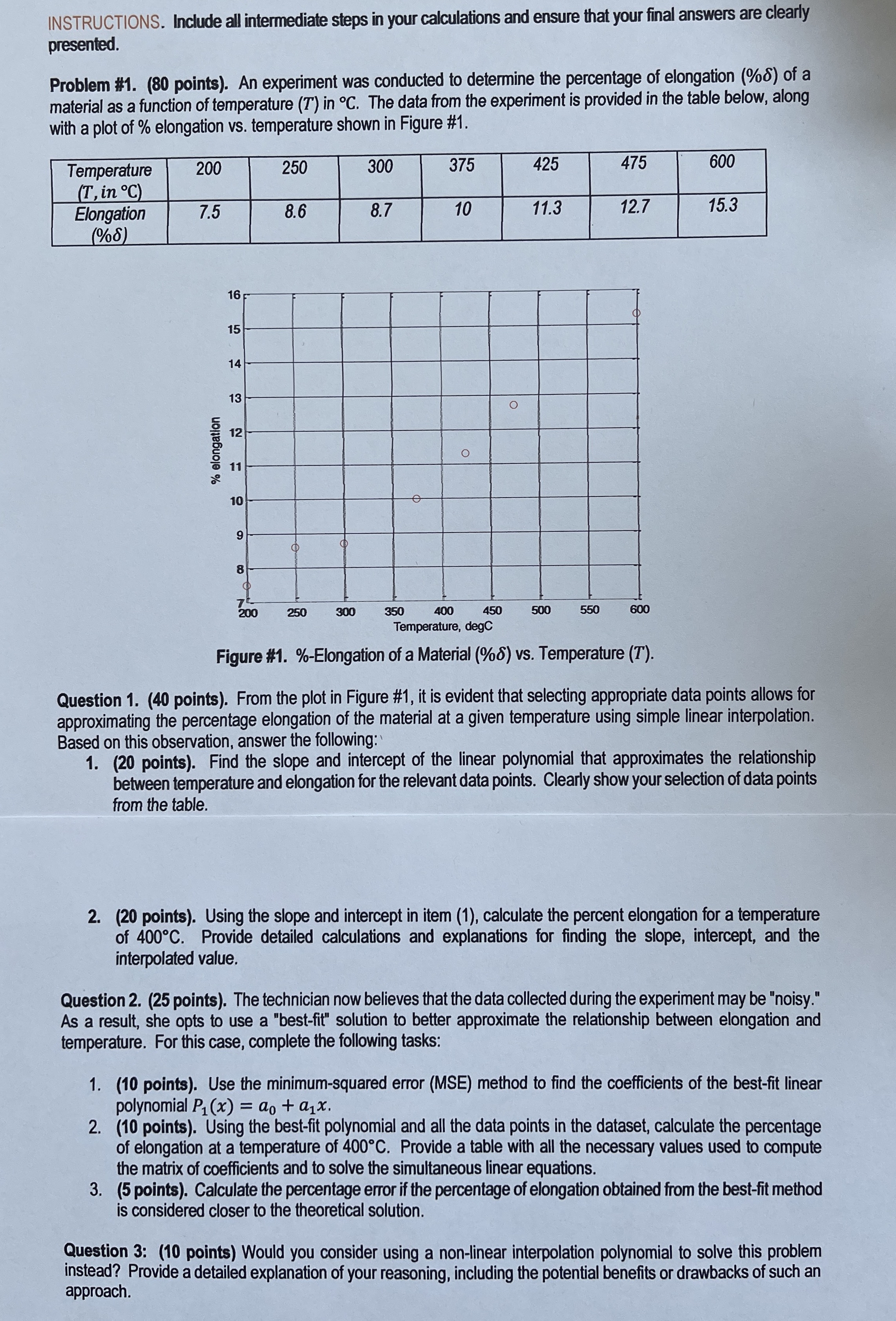
Problem # points An experiment was conducted to determine the percentage of elongation of a
material as a function of temperature in The data from the experiment is provided in the table below, along
with a plot of elongation vs temperature shown in Figure #
Figure #Elongation of a Material vs Temperature
Question points From the plot in Figure # it is evident that selecting appropriate data points allows for
approximating the percentage elongation of the material at a given temperature using simple linear interpolation.
Based on this observation, answer the following:
points Find the slope and intercept of the linear polynomial that approximates the relationship
between temperature and elongation for the relevant data points. Clearly show your selection of data points
from the table.
points Using the slope and intercept in item calculate the percent elongation for a temperature
of Provide detailed calculations and explanations for finding the slope, intercept, and the
interpolated value.
Question points The technician now believes that the data collected during the experiment may be "noisy."
As a result, she opts to use a "bestfit" solution to better approximate the relationship between elongation and
temperature. For this case, complete the following tasks:
points Use the minimumsquared error MSE method to find the coefficients of the bestfit linear
polynomial
points Using the bestfit polynomial and all the data points in the dataset, calculate the percentage
of elongation at a temperature of Provide a table with all the necessary values used to compute
the matrix of coefficients and to solve the simultaneous linear equations.
points Calculate the percentage error if the percentage of elongation obtained from the bestfit method
is considered closer to the theoretical solution.
Question : points Would you consider using a nonlinear interpolation polynomial to solve this problem
instead? Provide a detailed explanation of your reasoning, including the potential benefits or drawbacks of such an
approach.
Step by Step Solution
There are 3 Steps involved in it
1 Expert Approved Answer
Step: 1 Unlock

Question Has Been Solved by an Expert!
Get step-by-step solutions from verified subject matter experts
Step: 2 Unlock
Step: 3 Unlock
 Study Help