







Question: Instructions on for the assignment on page #3 Case: Rebooting a Fundraising Event during a Global Pandemic On March 16th 2020 Mayor London Breed announced
Instructions on for the assignment on page #3
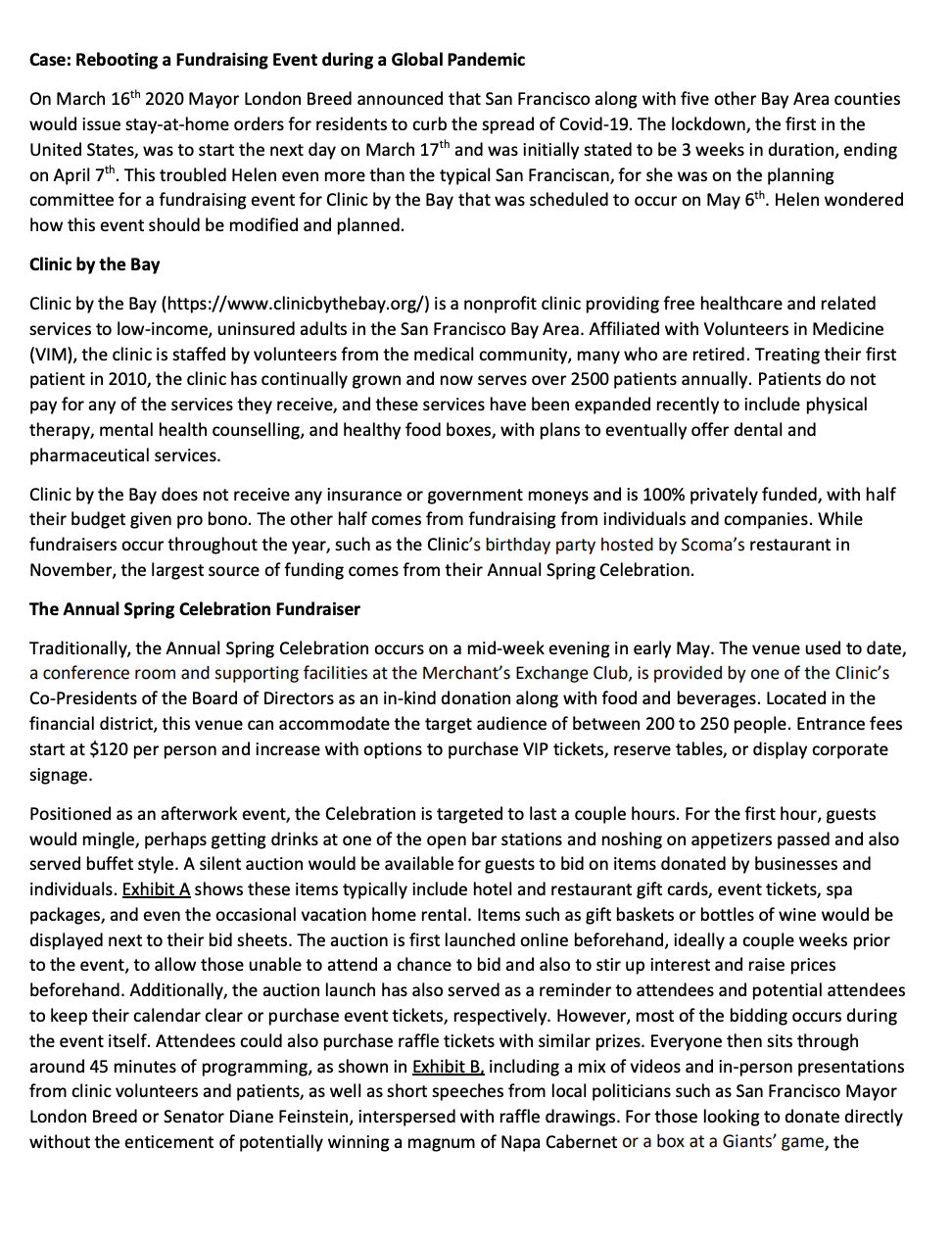
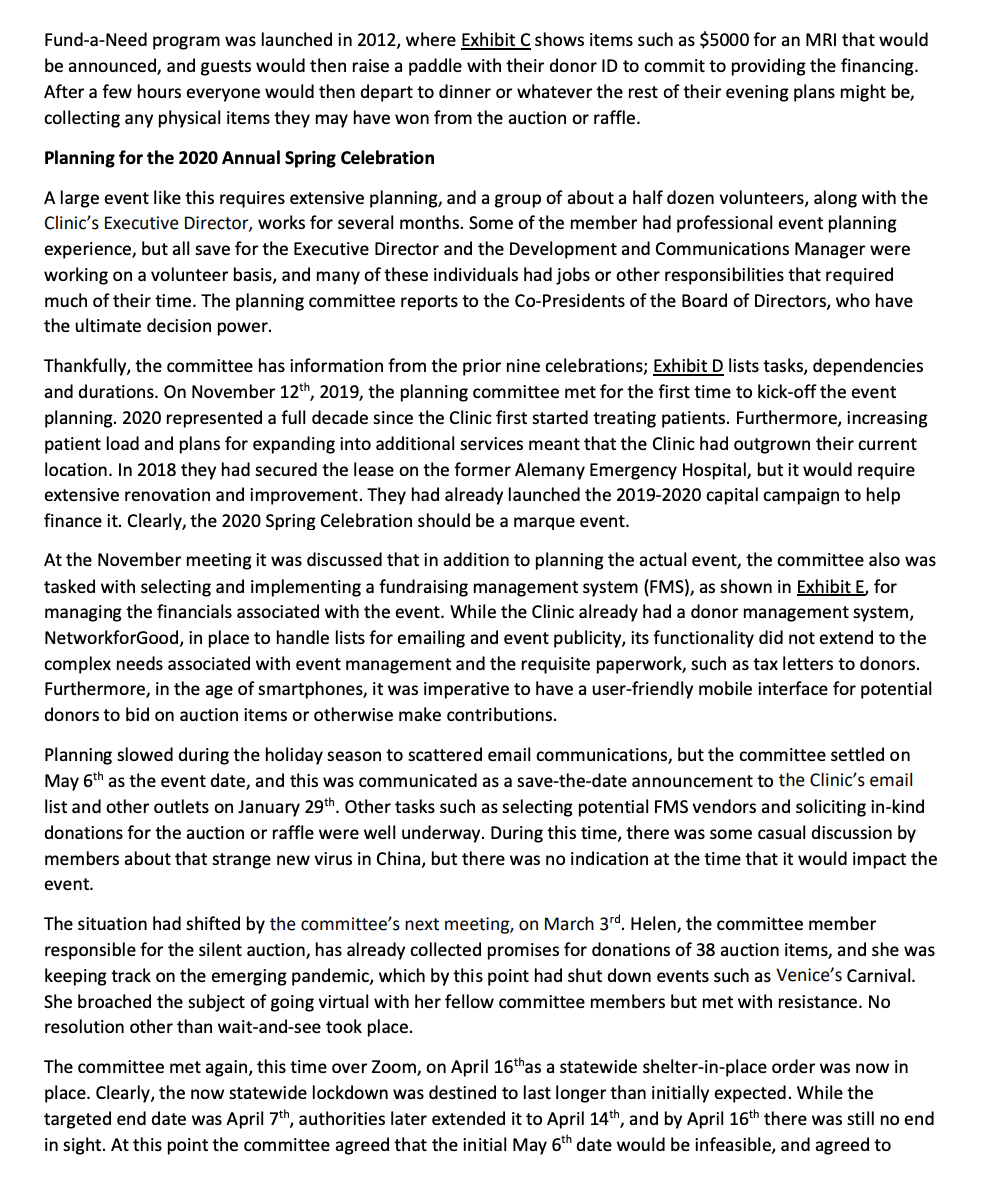
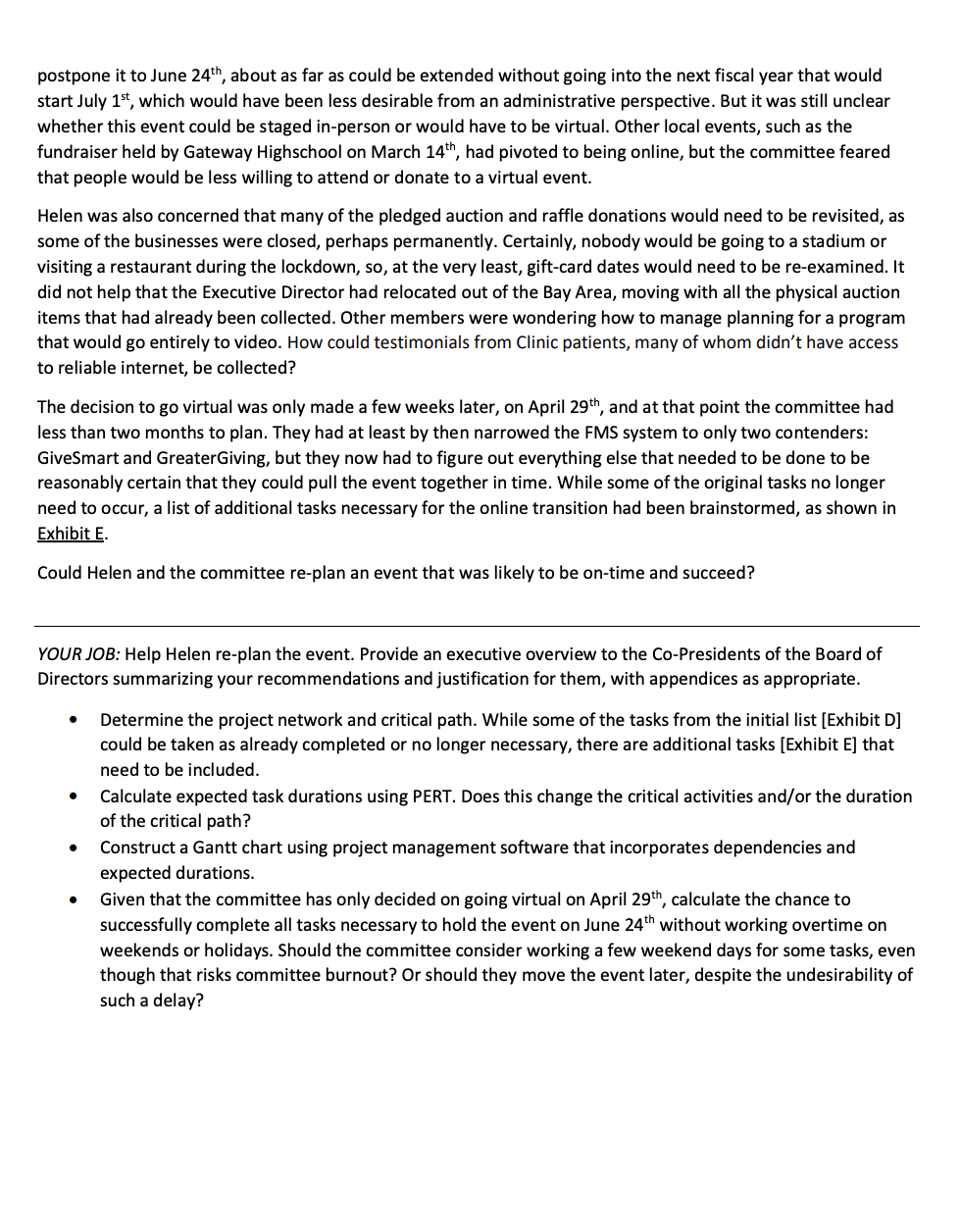
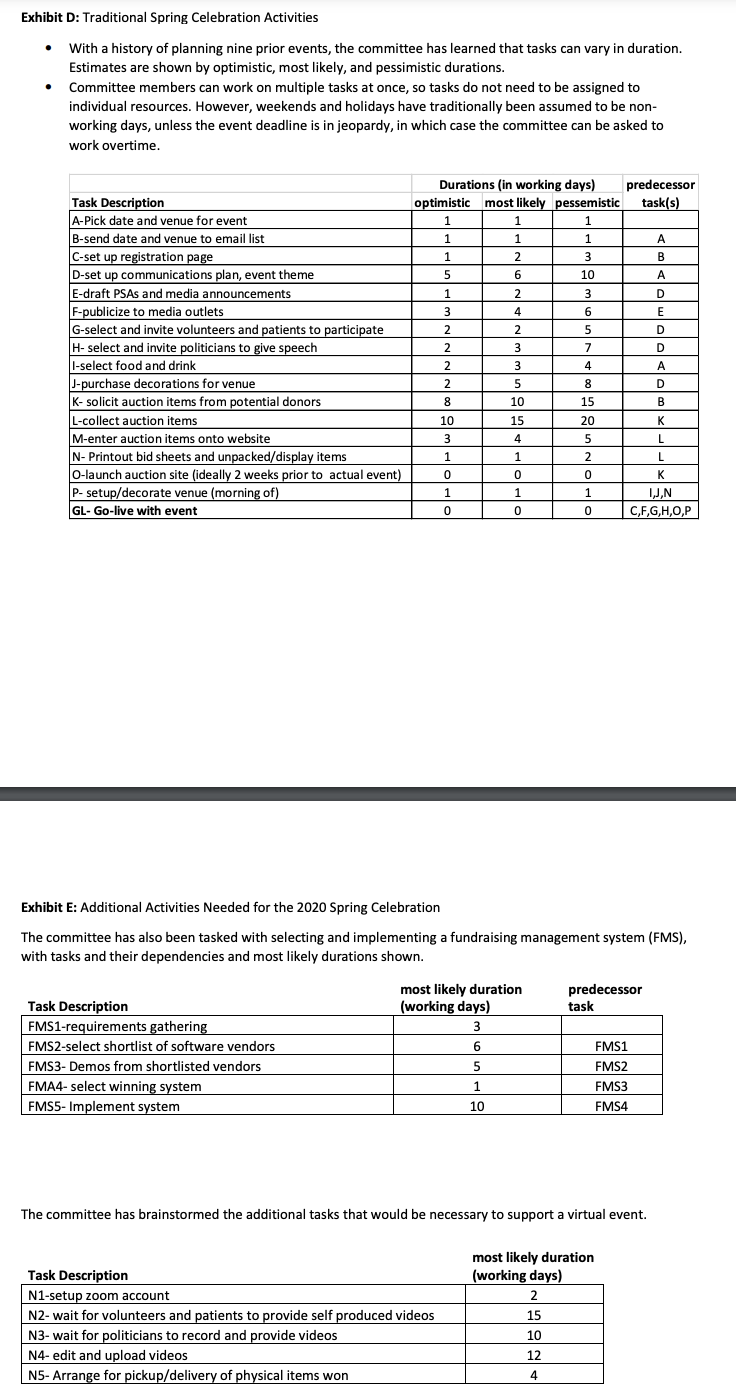
Case: Rebooting a Fundraising Event during a Global Pandemic On March 16th 2020 Mayor London Breed announced that San Francisco along with five other Bay Area counties would issue stay-at-home orders for residents to curb the spread of Covid-19. The lockdown, the first in the United States, was to start the next day on March 17th and was initially stated to be 3 weeks in duration, ending on April 7th. This troubled Helen even more than the typical San Franciscan, for she was on the planning committee for a fundraising event for Clinic by the Bay that was scheduled to occur on May 6th. Helen wondered how this event should be modified and planned. Clinic by the Bay Clinic by the Bay (https://www.clinicbythebay.org/) is a nonprofit clinic providing free healthcare and related services to low-income, uninsured adults in the San Francisco Bay Area. Affiliated with Volunteers in Medicine (VIM), the clinic is staffed by volunteers from the medical community, many who are retired. Treating their first patient in 2010, the clinic has continually grown and now serves over 2500 patients annually. Patients do not pay for any of the services they receive, and these services have been expanded recently to include physical therapy, mental health counselling, and healthy food boxes, with plans to eventually offer dental and pharmaceutical services. Clinic by the Bay does not receive any insurance or government moneys and is 100% privately funded, with half their budget given pro bono. The other half comes from fundraising from individuals and companies. While fundraisers occur throughout the year, such as the Clinic's birthday party hosted by Scoma's restaurant in November, the largest source of funding comes from their Annual Spring Celebration. The Annual Spring Celebration Fundraiser Traditionally, the Annual Spring Celebration occurs on a mid-week evening in early May. The venue used to date, a conference room and supporting facilities at the Merchant's Exchange Club, is provided by one of the Clinic's Co-Presidents of the Board of Directors as an in-kind donation along with food and beverages. Located in the financial district, this venue can accommodate the target audience of between 200 to 250 people. Entrance fees start at $120 per person and increase with options to purchase VIP tickets, reserve tables, or display corporate signage. Positioned as an afterwork event, the Celebration is targeted to last a couple hours. For the first hour, guests would mingle, perhaps getting drinks at one of the open bar stations and noshing on appetizers passed and also served buffet style. A silent auction would be available for guests to bid on items donated by businesses and individuals. Exhibit A shows these items typically include hotel and restaurant gift cards, event tickets, spa packages, and even the occasional vacation home rental. Items such as gift baskets or bottles of wine would be displayed next to their bid sheets. The auction is first launched online beforehand, ideally a couple weeks prior to the event, to allow those unable to attend a chance to bid and also to stir up interest and raise prices beforehand. Additionally, the auction launch has also served as a reminder to attendees and potential attendees to keep their calendar clear or purchase event tickets, respectively. However, most of the bidding occurs during the event itself. Attendees could also purchase raffle tickets with similar prizes. Everyone then sits through around 45 minutes of programming, as shown in Exhibit B, including a mix of videos and in-person presentations from clinic volunteers and patients, as well as short speeches from local politicians such as San Francisco Mayor London Breed or Senator Diane Feinstein, interspersed with raffle drawings. For those looking to donate directly without the enticement of potentially winning a magnum of Napa Cabernet or a box at a Giants' game, the Fund-a-Need program was launched in 2012, where Exhibit C shows items such as $5000 for an MRI that would be announced, and guests would then raise a paddle with their donor ID to commit to providing the financing. After a few hours everyone would then depart to dinner or whatever the rest of their evening plans might be, collecting any physical items they may have won from the auction or raffle. Planning for the 2020 Annual Spring Celebration A large event like this requires extensive planning, and a group of about a half dozen volunteers, along with the Clinic's Executive Director, works for several months. Some of the member had professional event planning experience, but all save for the Executive Director and the Development and Communications Manager were working on a volunteer basis, and many of these individuals had jobs or other responsibilities that required much of their time. The planning committee reports to the Co-Presidents of the Board of Directors, who have the ultimate decision power. Thankfully, the committee has information from the prior nine celebrations; Exhibit D lists tasks, dependencies and durations. On November 12th, 2019, the planning committee met for the first time to kick-off the event planning. 2020 represented a full decade since the Clinic first started treating patients. Furthermore, increasing patient load and plans for expanding into additional services meant that the Clinic had outgrown their current location. In 2018 they had secured the lease on the former Alemany Emergency Hospital, but it would require extensive renovation and improvement. They had already launched the 2019-2020 capital campaign to help finance it. Clearly, the 2020 Spring Celebration should be a marque event. At the November meeting it was discussed that in addition to planning the actual event, the committee also was tasked with selecting and implementing a fundraising management system (FMS), as shown in Exhibit E, for managing the financials associated with the event. While the Clinic already had a donor management system, NetworkforGood, in place to handle lists for emailing and event publicity, its functionality did not extend to the complex needs associated with event management and the requisite paperwork, such as tax letters to donors. Furthermore, in the age of smartphones, it was imperative to have a user-friendly mobile interface for potential donors to bid on auction items or otherwise make contributions. Planning slowed during the holiday season to scattered email communications, but the committee settled on May 6th as the event date, and this was communicated as a save-the-date announcement to the Clinic's email list and other outlets on January 29th. Other tasks such as selecting potential FMS vendors and soliciting in-kind donations for the auction or raffle were well underway. During this time, there was some casual discussion by members about that strange new virus in China, but there was no indication at the time that it would impact the event. The situation had shifted by the committee's next meeting, on March 3rd. Helen, the committee member responsible for the silent auction, has already collected promises for donations of 38 auction items, and she was keeping track on the emerging pandemic, which by this point had shut down events such as Venice's Carnival. She broached the subject of going virtual with her fellow committee members but met with resistance. No resolution other than wait-and-see took place. The committee met again, this time over Zoom, on April 16thas a statewide shelter-in-place order was now in place. Clearly, the now statewide lockdown was destined to last longer than initially expected. While the targeted end date was April 7th, authorities later extended it to April 14th, and by April 16th there was still no end in sight. At this point the committee agreed that the initial May 6th date would be infeasible, and agreed to postpone it to June 24th, about as far as could be extended without going into the next fiscal year that would start July 1st, which would have been less desirable from an administrative perspective. But it was still unclear whether this event could be staged in-person or would have to be virtual. Other local events, such as the fundraiser held by Gateway Highschool on March 14th, had pivoted to being online, but the committee feared that people would be less willing to attend or donate to a virtual event. Helen was also concerned that many of the pledged auction and raffle donations would need to be revisited, as some of the businesses were closed, perhaps permanently. Certainly, nobody would be going to a stadium or visiting a restaurant during the lockdown, so, at the very least, gift-card dates would need to be re-examined. It did not help that the Executive Director had relocated out of the Bay Area, moving with all the physical auction items that had already been collected. Other members were wondering how to manage planning for a program that would go entirely to video. How could testimonials from Clinic patients, many of whom didn't have access to reliable internet, be collected? The decision to go virtual was only made a few weeks later, on April 29th, and at that point the committee had less than two months to plan. They had at least by then narrowed the FMS system to only two contenders: GiveSmart and Greater Giving, but they now had to figure out everything else that needed to be done to be reasonably certain that they could pull the event together in time. While some of the original tasks no longer need to occur, a list of additional tasks necessary for the online transition had been brainstormed, as shown in Exhibit E. Could Helen and the committee re-plan an event that was likely to be on-time and succeed? YOUR JOB: Help Helen re-plan the event. Provide an executive overview to the Co-Presidents of the Board of Directors summarizing your recommendations and justification for them, with appendices as appropriate. . . Determine the project network and critical path. While some of the tasks from the initial list (Exhibit D] could be taken as already completed or no longer necessary, there are additional tasks [Exhibit E] that need to be included. Calculate expected task durations using PERT. Does this change the critical activities and/or the duration of the critical path? Construct a Gantt chart using project management software that incorporates dependencies and expected durations. Given that the committee has only decided on going virtual on April 29th, calculate the chance to successfully complete all tasks necessary to hold the event on June 24th without working overtime on weekends or holidays. Should the committee consider working a few weekend days for some tasks, even though that risks committee burnout? Or should they move the event later, despite the undesirability of such a delay? . Exhibit D: Traditional Spring Celebration Activities With a history of planning nine prior events, the committee has learned that tasks can vary in duration. Estimates are shown by optimistic, most likely, and pessimistic durations. Committee members can work on multiple tasks at once, so tasks do not need to be assigned to individual resources. However, weekends and holidays have traditionally been assumed to be non- working days, unless the event deadline is in jeopardy, in which case the committee can be asked to work overtime. . Durations (in working days) predecessor optimistic most likely pessemistic task(s) 1 1 1 1 1 1 1 1 A 1 1 2 2 3 B B 5 6 10 A 1 2 3 D 3 4 6 E 2 2 5 D 2 Task Description A-Pick date and venue for event - B-send date and venue to email list C-set up registration page D-set up communications plan, event theme E-draft PSAs and media announcements F-publicize to media outlets G-select and invite volunteers and patients to participate H-select and invite politicians to give speech l-select food and drink J-purchase decorations for venue K- solicit auction items from potential donors L-collect auction items M-enter auction items onto website N- Printout bid sheets and unpacked/display items O-launch auction site (ideally 2 weeks prior to actual event) P-setup/decorate venue (morning of) GL-Go-live with event 3 3 7 7 4 D A D D 5 10 8 15 2 2 2 8 10 3 3 1 1 0 B 15 20 4 1 5 2 0 L L K 1JN C,F,G,H,O,P 0 1 0 1 1 0 0 Exhibit E: Additional Activities Needed for the 2020 Spring Celebration The committee has also been tasked with selecting and implementing a fundraising management system (FMS), with tasks and their dependencies and most likely durations shown. predecessor task Task Description FMS1-requirements gathering FMS2-select shortlist of software vendors FMS3-Demos from shortlisted vendors FMA4-select winning system FMS5- Implement system most likely duration (working days) 3 6 5 1 10 FMS1 FMS2 FMS3 FMS4 The committee has brainstormed the additional tasks that would be necessary to support a virtual event. Task Description N1-setup zoom account N2- wait for volunteers and patients to provide self produced videos N3- wait for politicians to record and provide videos N4- edit and upload videos N5- Arrange for pickup/delivery of physical items won most likely duration (working days) 2 15 10 12 4 4 Case: Rebooting a Fundraising Event during a Global Pandemic On March 16th 2020 Mayor London Breed announced that San Francisco along with five other Bay Area counties would issue stay-at-home orders for residents to curb the spread of Covid-19. The lockdown, the first in the United States, was to start the next day on March 17th and was initially stated to be 3 weeks in duration, ending on April 7th. This troubled Helen even more than the typical San Franciscan, for she was on the planning committee for a fundraising event for Clinic by the Bay that was scheduled to occur on May 6th. Helen wondered how this event should be modified and planned. Clinic by the Bay Clinic by the Bay (https://www.clinicbythebay.org/) is a nonprofit clinic providing free healthcare and related services to low-income, uninsured adults in the San Francisco Bay Area. Affiliated with Volunteers in Medicine (VIM), the clinic is staffed by volunteers from the medical community, many who are retired. Treating their first patient in 2010, the clinic has continually grown and now serves over 2500 patients annually. Patients do not pay for any of the services they receive, and these services have been expanded recently to include physical therapy, mental health counselling, and healthy food boxes, with plans to eventually offer dental and pharmaceutical services. Clinic by the Bay does not receive any insurance or government moneys and is 100% privately funded, with half their budget given pro bono. The other half comes from fundraising from individuals and companies. While fundraisers occur throughout the year, such as the Clinic's birthday party hosted by Scoma's restaurant in November, the largest source of funding comes from their Annual Spring Celebration. The Annual Spring Celebration Fundraiser Traditionally, the Annual Spring Celebration occurs on a mid-week evening in early May. The venue used to date, a conference room and supporting facilities at the Merchant's Exchange Club, is provided by one of the Clinic's Co-Presidents of the Board of Directors as an in-kind donation along with food and beverages. Located in the financial district, this venue can accommodate the target audience of between 200 to 250 people. Entrance fees start at $120 per person and increase with options to purchase VIP tickets, reserve tables, or display corporate signage. Positioned as an afterwork event, the Celebration is targeted to last a couple hours. For the first hour, guests would mingle, perhaps getting drinks at one of the open bar stations and noshing on appetizers passed and also served buffet style. A silent auction would be available for guests to bid on items donated by businesses and individuals. Exhibit A shows these items typically include hotel and restaurant gift cards, event tickets, spa packages, and even the occasional vacation home rental. Items such as gift baskets or bottles of wine would be displayed next to their bid sheets. The auction is first launched online beforehand, ideally a couple weeks prior to the event, to allow those unable to attend a chance to bid and also to stir up interest and raise prices beforehand. Additionally, the auction launch has also served as a reminder to attendees and potential attendees to keep their calendar clear or purchase event tickets, respectively. However, most of the bidding occurs during the event itself. Attendees could also purchase raffle tickets with similar prizes. Everyone then sits through around 45 minutes of programming, as shown in Exhibit B, including a mix of videos and in-person presentations from clinic volunteers and patients, as well as short speeches from local politicians such as San Francisco Mayor London Breed or Senator Diane Feinstein, interspersed with raffle drawings. For those looking to donate directly without the enticement of potentially winning a magnum of Napa Cabernet or a box at a Giants' game, the Fund-a-Need program was launched in 2012, where Exhibit C shows items such as $5000 for an MRI that would be announced, and guests would then raise a paddle with their donor ID to commit to providing the financing. After a few hours everyone would then depart to dinner or whatever the rest of their evening plans might be, collecting any physical items they may have won from the auction or raffle. Planning for the 2020 Annual Spring Celebration A large event like this requires extensive planning, and a group of about a half dozen volunteers, along with the Clinic's Executive Director, works for several months. Some of the member had professional event planning experience, but all save for the Executive Director and the Development and Communications Manager were working on a volunteer basis, and many of these individuals had jobs or other responsibilities that required much of their time. The planning committee reports to the Co-Presidents of the Board of Directors, who have the ultimate decision power. Thankfully, the committee has information from the prior nine celebrations; Exhibit D lists tasks, dependencies and durations. On November 12th, 2019, the planning committee met for the first time to kick-off the event planning. 2020 represented a full decade since the Clinic first started treating patients. Furthermore, increasing patient load and plans for expanding into additional services meant that the Clinic had outgrown their current location. In 2018 they had secured the lease on the former Alemany Emergency Hospital, but it would require extensive renovation and improvement. They had already launched the 2019-2020 capital campaign to help finance it. Clearly, the 2020 Spring Celebration should be a marque event. At the November meeting it was discussed that in addition to planning the actual event, the committee also was tasked with selecting and implementing a fundraising management system (FMS), as shown in Exhibit E, for managing the financials associated with the event. While the Clinic already had a donor management system, NetworkforGood, in place to handle lists for emailing and event publicity, its functionality did not extend to the complex needs associated with event management and the requisite paperwork, such as tax letters to donors. Furthermore, in the age of smartphones, it was imperative to have a user-friendly mobile interface for potential donors to bid on auction items or otherwise make contributions. Planning slowed during the holiday season to scattered email communications, but the committee settled on May 6th as the event date, and this was communicated as a save-the-date announcement to the Clinic's email list and other outlets on January 29th. Other tasks such as selecting potential FMS vendors and soliciting in-kind donations for the auction or raffle were well underway. During this time, there was some casual discussion by members about that strange new virus in China, but there was no indication at the time that it would impact the event. The situation had shifted by the committee's next meeting, on March 3rd. Helen, the committee member responsible for the silent auction, has already collected promises for donations of 38 auction items, and she was keeping track on the emerging pandemic, which by this point had shut down events such as Venice's Carnival. She broached the subject of going virtual with her fellow committee members but met with resistance. No resolution other than wait-and-see took place. The committee met again, this time over Zoom, on April 16thas a statewide shelter-in-place order was now in place. Clearly, the now statewide lockdown was destined to last longer than initially expected. While the targeted end date was April 7th, authorities later extended it to April 14th, and by April 16th there was still no end in sight. At this point the committee agreed that the initial May 6th date would be infeasible, and agreed to postpone it to June 24th, about as far as could be extended without going into the next fiscal year that would start July 1st, which would have been less desirable from an administrative perspective. But it was still unclear whether this event could be staged in-person or would have to be virtual. Other local events, such as the fundraiser held by Gateway Highschool on March 14th, had pivoted to being online, but the committee feared that people would be less willing to attend or donate to a virtual event. Helen was also concerned that many of the pledged auction and raffle donations would need to be revisited, as some of the businesses were closed, perhaps permanently. Certainly, nobody would be going to a stadium or visiting a restaurant during the lockdown, so, at the very least, gift-card dates would need to be re-examined. It did not help that the Executive Director had relocated out of the Bay Area, moving with all the physical auction items that had already been collected. Other members were wondering how to manage planning for a program that would go entirely to video. How could testimonials from Clinic patients, many of whom didn't have access to reliable internet, be collected? The decision to go virtual was only made a few weeks later, on April 29th, and at that point the committee had less than two months to plan. They had at least by then narrowed the FMS system to only two contenders: GiveSmart and Greater Giving, but they now had to figure out everything else that needed to be done to be reasonably certain that they could pull the event together in time. While some of the original tasks no longer need to occur, a list of additional tasks necessary for the online transition had been brainstormed, as shown in Exhibit E. Could Helen and the committee re-plan an event that was likely to be on-time and succeed? YOUR JOB: Help Helen re-plan the event. Provide an executive overview to the Co-Presidents of the Board of Directors summarizing your recommendations and justification for them, with appendices as appropriate. . . Determine the project network and critical path. While some of the tasks from the initial list (Exhibit D] could be taken as already completed or no longer necessary, there are additional tasks [Exhibit E] that need to be included. Calculate expected task durations using PERT. Does this change the critical activities and/or the duration of the critical path? Construct a Gantt chart using project management software that incorporates dependencies and expected durations. Given that the committee has only decided on going virtual on April 29th, calculate the chance to successfully complete all tasks necessary to hold the event on June 24th without working overtime on weekends or holidays. Should the committee consider working a few weekend days for some tasks, even though that risks committee burnout? Or should they move the event later, despite the undesirability of such a delay? . Exhibit D: Traditional Spring Celebration Activities With a history of planning nine prior events, the committee has learned that tasks can vary in duration. Estimates are shown by optimistic, most likely, and pessimistic durations. Committee members can work on multiple tasks at once, so tasks do not need to be assigned to individual resources. However, weekends and holidays have traditionally been assumed to be non- working days, unless the event deadline is in jeopardy, in which case the committee can be asked to work overtime. . Durations (in working days) predecessor optimistic most likely pessemistic task(s) 1 1 1 1 1 1 1 1 A 1 1 2 2 3 B B 5 6 10 A 1 2 3 D 3 4 6 E 2 2 5 D 2 Task Description A-Pick date and venue for event - B-send date and venue to email list C-set up registration page D-set up communications plan, event theme E-draft PSAs and media announcements F-publicize to media outlets G-select and invite volunteers and patients to participate H-select and invite politicians to give speech l-select food and drink J-purchase decorations for venue K- solicit auction items from potential donors L-collect auction items M-enter auction items onto website N- Printout bid sheets and unpacked/display items O-launch auction site (ideally 2 weeks prior to actual event) P-setup/decorate venue (morning of) GL-Go-live with event 3 3 7 7 4 D A D D 5 10 8 15 2 2 2 8 10 3 3 1 1 0 B 15 20 4 1 5 2 0 L L K 1JN C,F,G,H,O,P 0 1 0 1 1 0 0 Exhibit E: Additional Activities Needed for the 2020 Spring Celebration The committee has also been tasked with selecting and implementing a fundraising management system (FMS), with tasks and their dependencies and most likely durations shown. predecessor task Task Description FMS1-requirements gathering FMS2-select shortlist of software vendors FMS3-Demos from shortlisted vendors FMA4-select winning system FMS5- Implement system most likely duration (working days) 3 6 5 1 10 FMS1 FMS2 FMS3 FMS4 The committee has brainstormed the additional tasks that would be necessary to support a virtual event. Task Description N1-setup zoom account N2- wait for volunteers and patients to provide self produced videos N3- wait for politicians to record and provide videos N4- edit and upload videos N5- Arrange for pickup/delivery of physical items won most likely duration (working days) 2 15 10 12 4 4Step by Step Solution
There are 3 Steps involved in it
1 Expert Approved Answer
Step: 1 Unlock

Question Has Been Solved by an Expert!
Get step-by-step solutions from verified subject matter experts
Step: 2 Unlock
Step: 3 Unlock
 Study Help