







Question: Instructions: Part I: Exploring entrance length Construct a 2 D COMSOL model of pressure - driven flow through a channel according to the instructions given
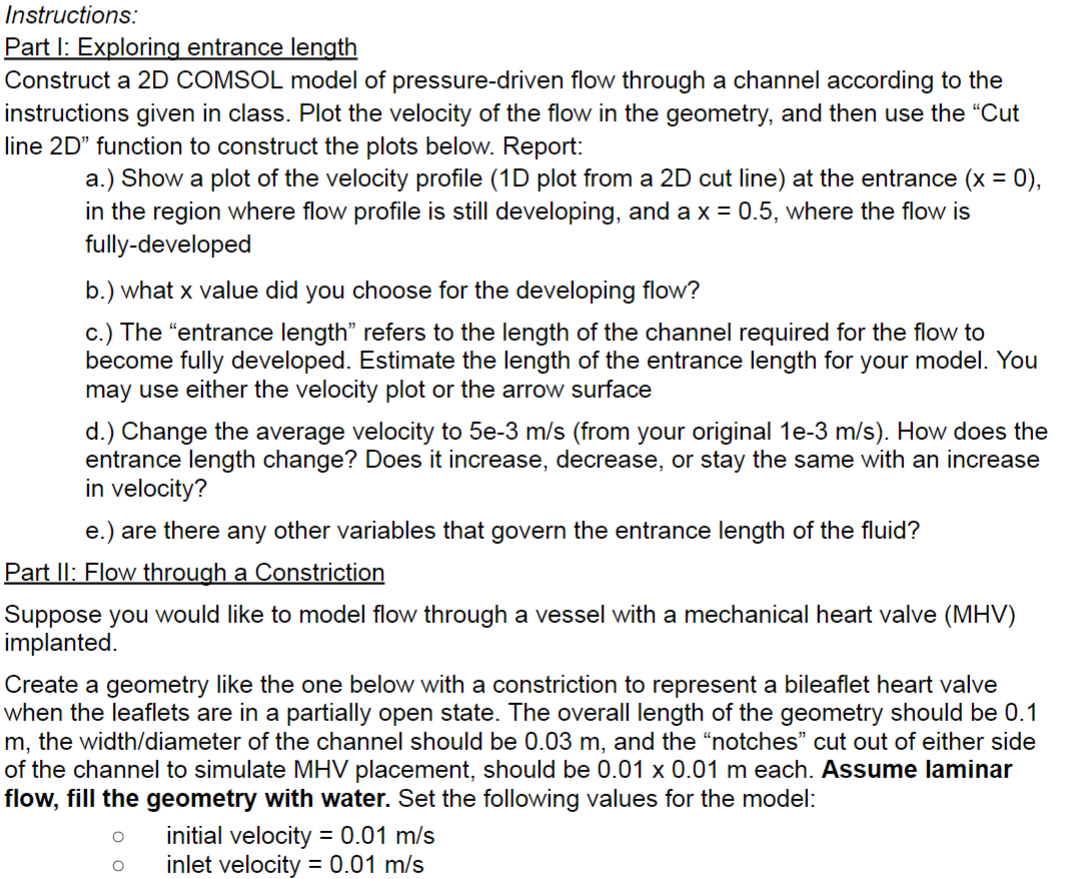
Instructions:
Part I: Exploring entrance length
Construct a D COMSOL model of pressuredriven flow through a channel according to the instructions given in class. Plot the velocity of the flow in the geometry, and then use the "Cut line D function to construct the plots below. Report:
a Show a plot of the velocity profile D plot from a D cut line at the entrance x in the region where flow profile is still developing, and a x where the flow is fullydeveloped
b what x value did you choose for the developing flow?
c The "entrance length" refers to the length of the channel required for the flow to become fully developed. Estimate the length of the entrance length for your model. You may use either the velocity plot or the arrow surface
d Change the average velocity to mathrmemathrm~mmathrmsfrom your original mathrmemathrm~mmathrms How does the entrance length change? Does it increase, decrease, or stay the same with an increase in velocity?
e are there any other variables that govern the entrance length of the fluid?
Part II: Flow through a Constriction
Suppose you would like to model flow through a vessel with a mechanical heart valve MHV implanted.
Create a geometry like the one below with a constriction to represent a bileaflet heart valve when the leaflets are in a partially open state. The overall length of the geometry should be m the widthdiameter of the channel should be m and the "notches" cut out of either side of the channel to simulate MHV placement, should be times mathrm~m each. Assume laminar flow, fill the geometry with water. Set the following values for the model:
initial velocity ms
inlet velocity ms
outlet pressure mathrm~Pa
Solve the problem and plot the velocity magnitude. Report:
Provide a plot of the velocity magnitude in your geometry
Provide a line plot of velocity across the channel before and after the constriction ie a plot of velocity magnitude as a function of "arc length", or position across the channel
Briefly describe why this problem is difficult to solve analytically ie with pencil and paper from the mathrmNmathrmS equations. Which terms cannot be eliminated from those equations for this problem?
Assuming that the geometry is filled with water, at what velocity would you expect to start seeing turbulence? Where in this geometry would you expect turbulence to first develop?
Step by Step Solution
There are 3 Steps involved in it
1 Expert Approved Answer
Step: 1 Unlock

Question Has Been Solved by an Expert!
Get step-by-step solutions from verified subject matter experts
Step: 2 Unlock
Step: 3 Unlock
 Study Help