



Question: Instructions: Recall the Superhero study from your prior Crash Course Quizzes (#2, #3 and #4). The study focused on looking at how persistent boys are
Instructions: Recall the Superhero study from your prior Crash Course Quizzes (#2, #3 and #4). The study focused on looking at how persistent boys are at completing a boring task when they are dressed in either street clothes or a Superhero costume (like Spiderman, Batman, or Superman).
For Crash Course #5, imagine that you focus on the two conditions where the children are either dressed in Superhero clothes or they are dressed in Street clothes (for this crash course, ignore the third Choice condition. The children do not have a choice in this current study). Your prior crash course quizzes showed that the boys tended to worker harder themselves when they were dressed in Superhero clothing than when the boys were dressed in their street clothes. Now you want to expand this design to see if the same finding holds for girls. You thus recruit both boys and girls for a study where they perform the boring computer class in their Street clothes or they are told to wear Superhero clothes (Children in this Superhero condition do have a wide variety of choices that cover all gender-based Superhero roles, like Superman/woman, Batman/woman, Spiderman/woman, etc. They are just told to choose the costume they want to wear).
In our new factorial study, participants receive one of four surveys that focus on a combination of the participant Gender (Boys v. Girls) and Clothing (Superhero clothes v. Street clothes): 1). Superhero + Boy, 2). Superhero + Girl, 3). Street Clothes + Boy, or 4) Street Clothes + Girl. The children then perform the boring computer task and are timed for length of persistence using a scale ranging from 0 minutes to 10 minutes maximum.
You have several predictions that focus on two main effects and one interaction.
For the main effect of Clothing, you predict that the children will be more persistent (or work longer) when dressed as a Superhero than when dressed in street clothes. For the main effect of Gender, you predict girls will be more persistent than boys. Finally, you expect an interaction of Clothing and Gender such that boys dressed in street clothes will be less persistent than all other conditions. That is, boys dressed in costume or girls either dressed in costume or dressed in street clothes will not differ from each other, but all will work more persistently than boys dressed in street clothes. In other words, girls work longer regardless of how they are dressed, but boys only work longer when dressed as a Superhero.
1). What are the independent and dependent variables in this study? Choose the best option from those listed below.
A. There is one independent variable: the Clothing condition (Superhero clothes v. Street clothes). There are two dependent variables. First, there is the participant gender (Boys v. Girls). Second, there is there is the childrens persistence on the computer task (0 minutes to 10 minutes).
B. There are two independent variables. First, there is the Clothing condition (Superhero clothes v. Street clothes). Second, there is the Gender condition (Boys v. Girls). There is one dependent variable: Persistence on the computer task (20 minutes to 30 minutes).
C. There are two independent variables. First, there is the Clothing condition (Superhero clothes v. Street clothes). Second, there is the Gender condition (Boys v. Girls). There are two dependent variables: First, there is there is the childrens persistence on the computer task (0 minutes to 10 minutes). Second, there is the childrens ratings of Superhero costumes (0 = I would like to wear a costume to 10 = I would not like to wear a costume).
D. There are two independent variables. First, there is the Clothing condition (Superhero clothes v. Street clothes). Second, there is the Gender condition (Boys v. Girls). There is one dependent variable: Persistence on the computer task (0 minutes to 10 minutes).
E. There are four independent variables. First, there is the Superhero clothes condition Second, there is the Street clothes condition. Third, there is the condition with boys. Fourth, there is the condition with girls. There is one dependent variable: Persistence on the computer task (0 minutes to 10 minutes).
You run a Factorial AVOVA on this data set and get the following SPSS output. Using this output, interpret the information.
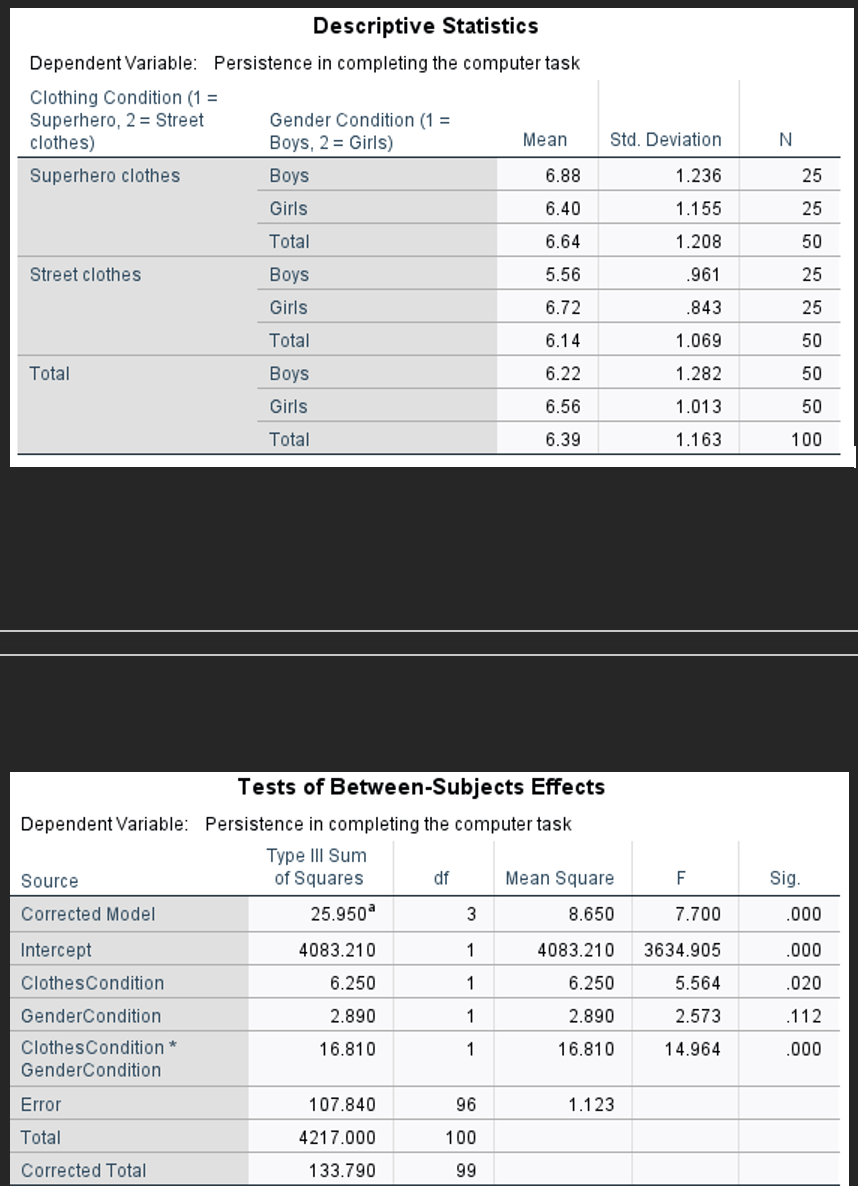
2). Choose the correct interpretation of the Tests of Between Subjects Effects table:
A. There are two significant main effects and one significant interaction
B. There is one significant main effect, one non-significant main effect, and one non- significant interaction
C. There is one significant main effect, one non-significant main effect, and one significant interaction
D. There are no significant main effects and one significant interaction
E. There are two significant main effects and one non-significant interaction
3). Which of the following is the accurate APA format for writing out the Superhero clothing condition main effect (Superhero clothes v. Street clothes) and the dependent variable Persistence in completing the computer task?
A. We ran a univariate ANOVA with Clothes condition (Superhero clothes v. Street clothes) and Gender condition (Boys v. Girls) as our two independent variables and the childrens persistence in completing the computer task as the dependent variable. There was no significant main effect for the Clothing condition, F(1, 96) = 5.56, p = .020. The children persisted at the computer task equally whether dressed in Superhero clothes (M = 6.64, SD = 1.21) or Street clothes (M = 6.14, SD = 1.07). This shows that dressing up in Superhero clothes has no impact on how persistent children are when working on a boring computer task.
B. We ran a univariate ANOVA with Clothes condition (Superhero clothes v. Street clothes) and Gender condition (Boys v. Girls) as our two independent variables and the childrens persistence in completing the computer task as the dependent variable. There was no significant main effect for the Clothing condition, F(1, 100) = 5.56, p = .020. The children persisted at the computer task equally whether dressed in Superhero clothes (M = 6.64, SD = 1.21) or Street clothes (M = 6.14, SD = 1.07). This shows that dressing up in Superhero clothes has no impact on how persistent children are when working on a boring computer task.
C. We ran a univariate ANOVA with Clothes condition (Superhero clothes v. Street clothes) and Gender condition (Boys v. Girls) as our two independent variables and the childrens persistence in completing the computer task as the dependent variable. There was a significant main effect for the Clothing condition, F(1, 96) = 6.25, p = .020. The children worked longer in the Street clothes condition (M = 6.64, SD = 1.21) than in the Superhero clothes condition (M = 6.14, SD = 1.07). This shows that children persist at a task longer when in their street clothes than when dressed in Superhero clothes.
D. We ran a univariate ANOVA with Clothes condition (Superhero clothes v. Street clothes) and Gender condition (Boys v. Girls) as our two independent variables and the childrens persistence in completing the computer task as the dependent variable. There was a significant main effect for the Clothing condition, F(1, 100) = 5.56, p = .020. The children worked longer in the Superhero clothes condition (M = 6.64, SD = 1.21) than in the Street clothes condition (M = 6.14, SD = 1.07). This shows that children persist at a task longer when in Superhero clothing than when dressed in Street clothes.
E. We ran a univariate ANOVA with Clothes condition (Superhero clothes v. Street clothes) and Gender condition (Boys v. Girls) as our two independent variables and the childrens persistence in completing the computer task as the dependent variable. There was a significant main effect for the Clothes condition, F(1, 96) = 5.56, p = .020. The children worked longer in the Superhero clothes condition (M = 6.64, SD = 1.21) than in the Street clothes condition (M = 6.14, SD = 1.07). This shows that children persist at a task longer when dressed in Superhero clothes than when dressed in street clothes.
4). Which of the following is the correct write-up for the interaction and (if significant) follow-up simple effects tests?
A. The interaction of Clothes condition by Gender condition was not significant, F(1, 96) = 14.96, p = .000. Since this is not significant, there was no need to run simple effects follow-up tests.
B. The interaction of Clothes condition by Gender condition was not significant, F(1, 100) = 14.96, p = .17. Since this is not significant, there was no need to run simple effects follow-up tests.
C. The interaction of Clothes condition by Gender condition was significant, F(1, 96) = 14.96, p
D. The interaction of Clothes condition by Gender condition was significant, F(1, 100) = 16.81, p
E. The interaction of Clothes condition by Gender condition was significant, F(1, 96) = 14.96, p
5). Below is a set of two SPSS simple effects tests using the split file function. Note that this only looks at two of the simple effects tests rather than all four. The first simple effects test looks at the Superhero clothes condition while the second simple effects test looks at the Street clothes condition. Both simple effects tests attempt to see if boys and girls differ from each other when wearing similar clothes.
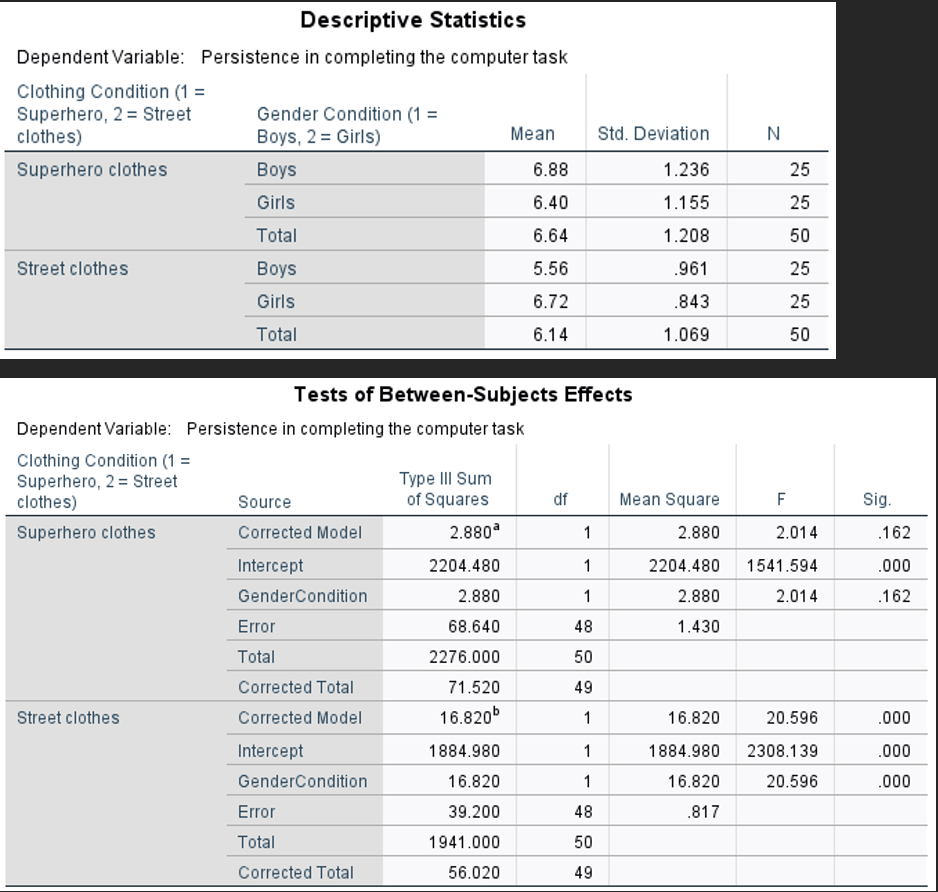
After looking at the charts above, I interpret it this way:
Following the significant original interaction, the first follow-up simple effects tests showed a significant difference for Gender in the Superhero clothes condition, F(1, 48) = 2.01, p M = 6.40, SD = 1.56) were less persistent in working on the computer task than boys dressed in Superhero clothes (M = 6.88, SD = 1.26). The second simple effects tests similarly showed a significant difference for Gender in the Street clothes condition, F(1, 48) = 20.60, p M = 6.72, SD = 0.84) were more persistent in working on the computer task than boys dressed in Street clothes (M = 5.56, SD = 0.96).
Is this a correct interpretation of those simple effects tests? Why or why not?
A. Yes, it is a correct interpretation in its entirety. Girls were significantly less persistent than boys in working on the computer task in the Superhero clothes condition, but boys were significantly less persistent in working on the computer task in the Street clothes condition.
B. It is only partially correct, as only one simple effects test was significant. While it is true that girls were significantly more persistent than boys in working on the computer task in the Street clothes condition, there was no difference in persistence between boys and girls in the Superhero condition.
C. It is only partially correct, as neither simple effect test was significant. Girls and boys did not differ in their persistence regardless of whether they were dressed in Superhero clothes or Street clothes.
D. It is entirely incorrect, as the simple effects test for the Superhero clothes condition was significant while the simple effects test for the Street clothes condition was not significant.
E. It is incorrect to run simple effects tests at all. Since the original interaction was not significant, simple effects are not required for the interaction of Clothing condition X Gender condition.
Descriptive Statistics Dependent Variable: Persistence in completing the computer task Clothing Condition (1= Superhero, 2 = Street clothes) Superhero clothes Street clothes Total Source Corrected Model Intercept Clothes Condition Tests of Between-Subjects Effects Dependent Variable: Persistence in completing the computer task Type III Sum of Squares GenderCondition Clothes Condition * GenderCondition Gender Condition (1= Boys, 2= Girls) Boys Girls Total Boys Girls Total Boys Girls Total Error Total Corrected Total 25.950 4083.210 6.250 2.890 16.810 107.840 4217.000 133.790 df 3 1 1 1 1 Mean 96 100 99 6.88 6.40 6.64 5.56 6.72 6.14 6.22 6.56 6.39 Std. Deviation 1.236 1.155 1.208 .961 .843 1.069 1.282 1.013 1.163 Mean Square 8.650 4083.210 6.250 2.890 16.810 1.123 F 7.700 3634.905 5.564 2.573 14.964 N 25 25 50 25 25 50 50 50 100 Sig. .000 .000 .020 .112 .000 Descriptive Statistics Dependent Variable: Persistence in completing the computer task Clothing Condition (1= Superhero, 2 Street clothes) Superhero clothes Street clothes Gender Condition (1 = Boys, 2 = Girls) Boys Girls Total Street clothes Boys Girls Total Dependent Variable: Persistence in completing the computer task Clothing Condition (1 = Superhero, 2= Street clothes) Superhero clothes Source Corrected Model Intercept GenderCondition Error Total Tests of Between-Subjects Effects Corrected Total Corrected Model Intercept GenderCondition Error Total Corrected Total Mean Type III Sum of Squares 2.880 2204.480 2.880 68.640 2276.000 71.520 16.820b 1884.980 16.820 39.200 1941.000 56.020 6.88 6.40 6.64 5.56 6.72 6.14 df 1 1 1 48 50 49 1 Std. Deviation 1.236 1.155 1.208 .961 .843 1.069 1 1 48 50 49 Mean Square 2.880 2204.480 2.880 1.430 N 25 25 50 25 25 50 F 2.014 1541.594 2.014 16.820 20.596 1884.980 2308.139 16.820 20.596 .817 Sig. .162 .000 .162 .000 .000 .000
Step by Step Solution
There are 3 Steps involved in it

Get step-by-step solutions from verified subject matter experts