





Question: Instructions Rules Use either indirect proof or conditional proof (or both) and the eighteen rules of inference to derive the conclusions of the symbolized argument
Instructions Rules Use either indirect proof orInstructions Rules Use either indirect proof orInstructions Rules Use either indirect proof orInstructions Rules Use either indirect proof orInstructions Rules Use either indirect proof or

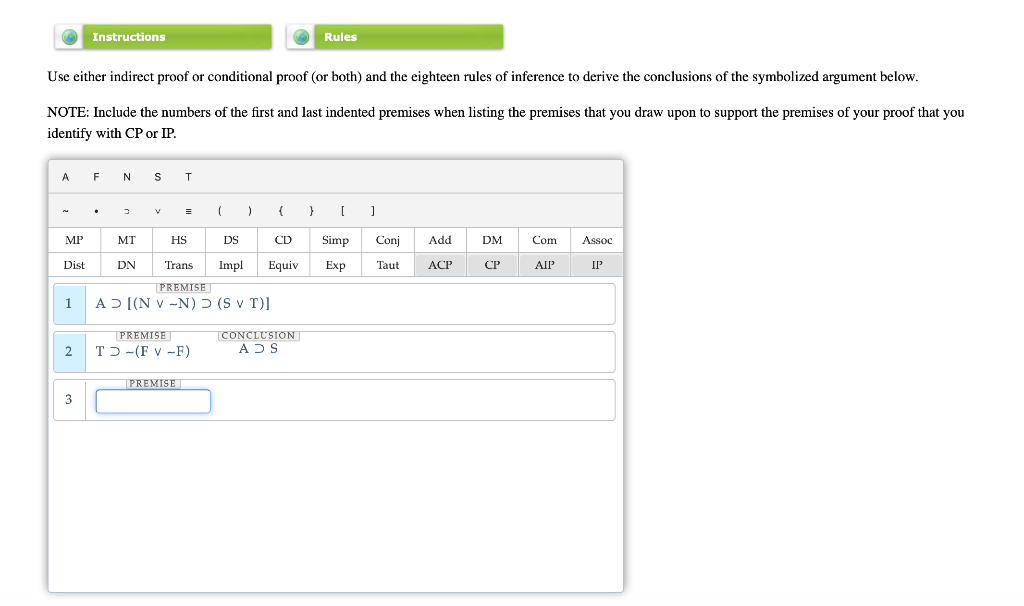
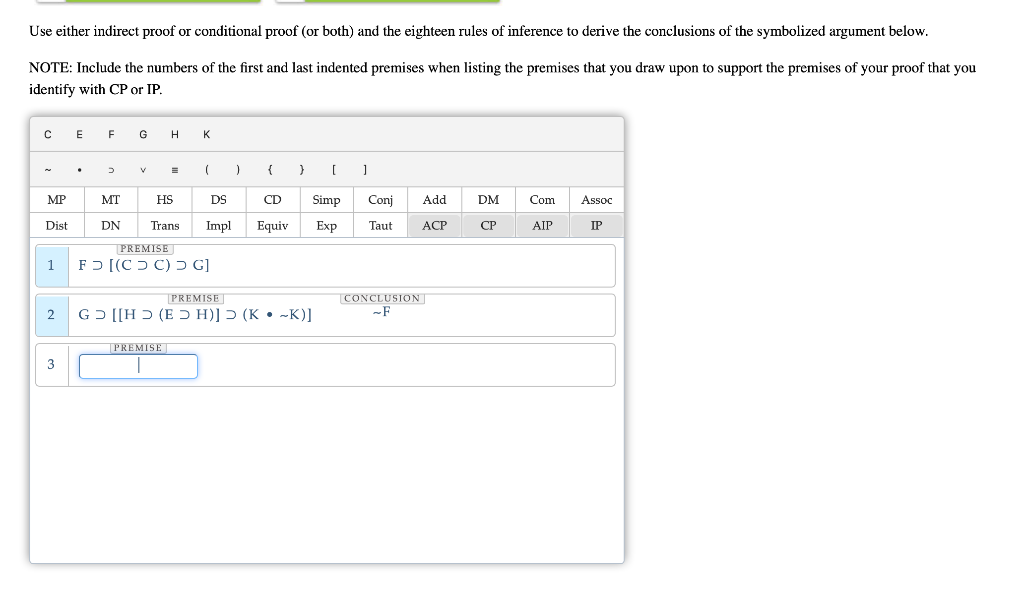
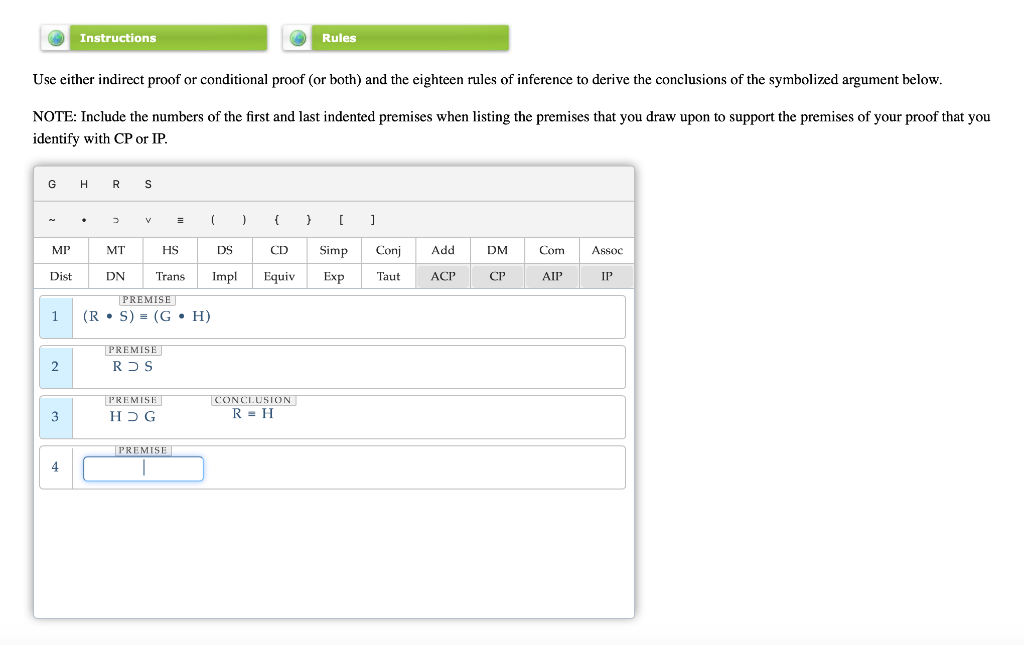
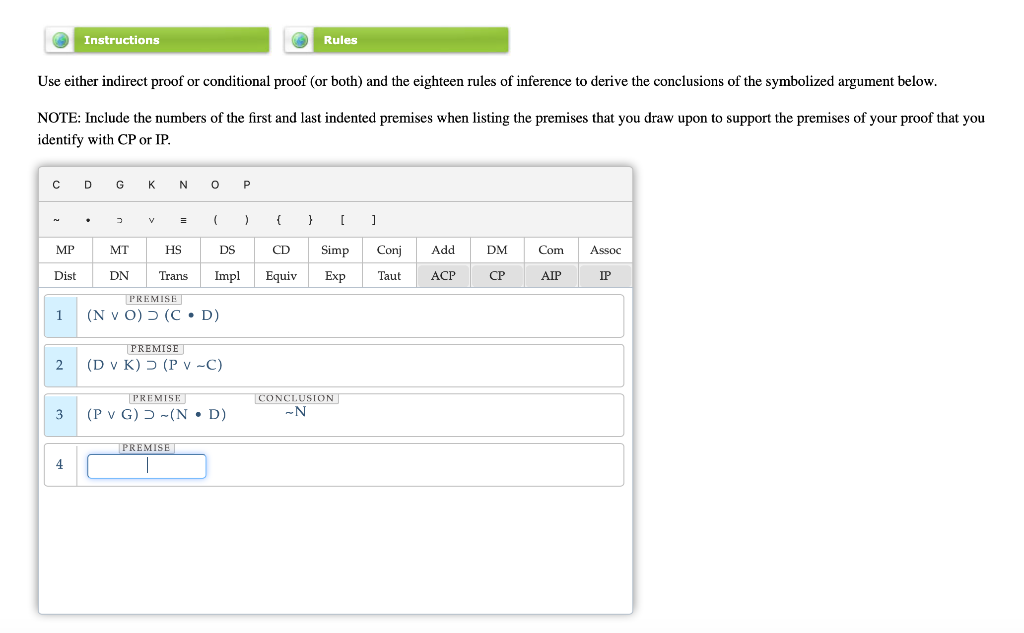
Instructions Rules Use either indirect proof or conditional proof (or both) and the eighteen rules of inference to derive the conclusions of the symbolized argument below. NOTE: Include the numbers of the first and last indented premises when listing the premises that you draw upon to support the premises of your proof that you identify with CP or IP. A F N S T > { } ] MP Conj Add DM Com Assoc Simp Exp Dist Taut ACP MT HS DS CD DN Trans Imp! Equiv PREMISE A((N V-N) (SVT) CP AIP IP 1 PREMISE T-(F V-F) CONCLUSION AS 2 PREMISE 3 Use either indirect proof or conditional proof (or both) and the eighteen rules of inference to derive the conclusions of the symbolized argument below. NOTE: Include the numbers of the first and last indented premises when listing the premises that you draw upon to support the premises of your proof that you identify with CP or IP. E F G H ) { } [ MP MT HS DS CD Simp Conj Add DM Com Assoc Dist Equiv Exp Taut ACP CP AIP IP DN Trans Impl PREMISE F [(CDC) G] 1 PREMISE G[[H ( EH)] = (K-K)] CONCLUSION -F 2 PREMISE 3 Instructions Rules Use either indirect proof or conditional proof (or both) and the eighteen rules of inference to derive the conclusions of the symbolized argument below. NOTE: Include the numbers of the first and last indented premises when listing the premises that you draw upon to support the premises of your proof that you identify with CP or IP. K L M N P Q R S > } [ ] MP MT HS DS CD Simp Conj Add DM Com Assoc Dist Exp Taut ACP AIP IP DN Trans Impl Equiv PREMISE K[(MVN) (P) 1 PREMISE LI(QVR) (S-N)) CONCLUSION ( KL)-N 2 PREMISE 3 Instructions Rules Use either indirect proof or conditional proof (or both) and the eighteen rules of inference to derive the conclusions of the symbolized argument below. NOTE: Include the numbers of the first and last indented premises when listing the premises that you draw upon to support the premises of your proof that you identify with CP or IP. G H R S v ) { } [ ] MP MT HS DS CD Conj Add DM Com Assoc Simp Exp Dist Equiv Taut ACP CP AIP IP DN Trans Imp! PREMISE ( RS) = ( GH) 1 PREMISE RS 2 PREMISE HG CONCLUSION R=H 3 PREMISE 4 Instructions Rules Use either indirect proof or conditional proof (or both) and the eighteen rules of inference to derive the conclusions of the symbolized argument below. NOTE: Include the numbers of the first and last indented premises when listing the premises that you draw upon to support the premises of your proof that you identify with CP or IP. D G K N 0 P ( ( ) { } [ ] MP MT HS DS CD Simp Conj Add DM Com Assoc IP Dist DN Trans Impl Equiv Exp Taut ACP CP AIP PREMISE 1 (NVO) ( CD) PREMISE (D VK) (PV-C) 2 PREMISE (PVG)-(N. D) CONCLUSION -N 3 PREMISE 4 Instructions Rules Use either indirect proof or conditional proof (or both) and the eighteen rules of inference to derive the conclusions of the symbolized argument below. NOTE: Include the numbers of the first and last indented premises when listing the premises that you draw upon to support the premises of your proof that you identify with CP or IP. A F N S T > { } ] MP Conj Add DM Com Assoc Simp Exp Dist Taut ACP MT HS DS CD DN Trans Imp! Equiv PREMISE A((N V-N) (SVT) CP AIP IP 1 PREMISE T-(F V-F) CONCLUSION AS 2 PREMISE 3 Use either indirect proof or conditional proof (or both) and the eighteen rules of inference to derive the conclusions of the symbolized argument below. NOTE: Include the numbers of the first and last indented premises when listing the premises that you draw upon to support the premises of your proof that you identify with CP or IP. E F G H ) { } [ MP MT HS DS CD Simp Conj Add DM Com Assoc Dist Equiv Exp Taut ACP CP AIP IP DN Trans Impl PREMISE F [(CDC) G] 1 PREMISE G[[H ( EH)] = (K-K)] CONCLUSION -F 2 PREMISE 3 Instructions Rules Use either indirect proof or conditional proof (or both) and the eighteen rules of inference to derive the conclusions of the symbolized argument below. NOTE: Include the numbers of the first and last indented premises when listing the premises that you draw upon to support the premises of your proof that you identify with CP or IP. K L M N P Q R S > } [ ] MP MT HS DS CD Simp Conj Add DM Com Assoc Dist Exp Taut ACP AIP IP DN Trans Impl Equiv PREMISE K[(MVN) (P) 1 PREMISE LI(QVR) (S-N)) CONCLUSION ( KL)-N 2 PREMISE 3 Instructions Rules Use either indirect proof or conditional proof (or both) and the eighteen rules of inference to derive the conclusions of the symbolized argument below. NOTE: Include the numbers of the first and last indented premises when listing the premises that you draw upon to support the premises of your proof that you identify with CP or IP. G H R S v ) { } [ ] MP MT HS DS CD Conj Add DM Com Assoc Simp Exp Dist Equiv Taut ACP CP AIP IP DN Trans Imp! PREMISE ( RS) = ( GH) 1 PREMISE RS 2 PREMISE HG CONCLUSION R=H 3 PREMISE 4 Instructions Rules Use either indirect proof or conditional proof (or both) and the eighteen rules of inference to derive the conclusions of the symbolized argument below. NOTE: Include the numbers of the first and last indented premises when listing the premises that you draw upon to support the premises of your proof that you identify with CP or IP. D G K N 0 P ( ( ) { } [ ] MP MT HS DS CD Simp Conj Add DM Com Assoc IP Dist DN Trans Impl Equiv Exp Taut ACP CP AIP PREMISE 1 (NVO) ( CD) PREMISE (D VK) (PV-C) 2 PREMISE (PVG)-(N. D) CONCLUSION -N 3 PREMISE 4
Step by Step Solution

There are 3 Steps involved in it

1 Expert Approved Answer
Step: 1 Unlock blur-text-image

Question Has Been Solved by an Expert!

Get step-by-step solutions from verified subject matter experts

Step: 2 Unlock
Step: 3 Unlock

Students Have Also Explored These Related General Management Questions!