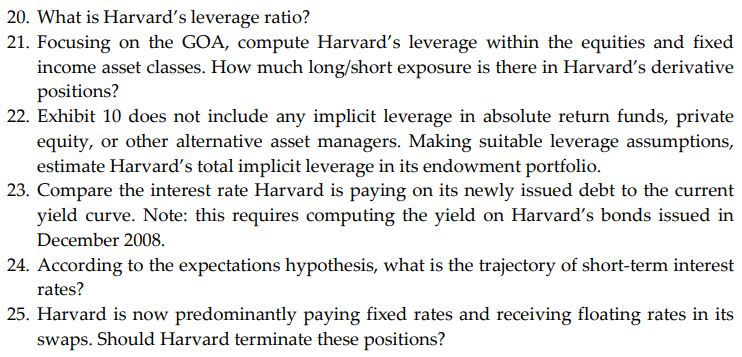
Question: Instructions: Select one question from the list below to answer. Make a slide summarizing your answer to the chosen question. Additionally, do a conclusion slide
Instructions:
Select one question from the list below to answer.
Make a slide summarizing your answer to the chosen question.
Additionally, do a conclusion slide that encapsulates the main points of the case.
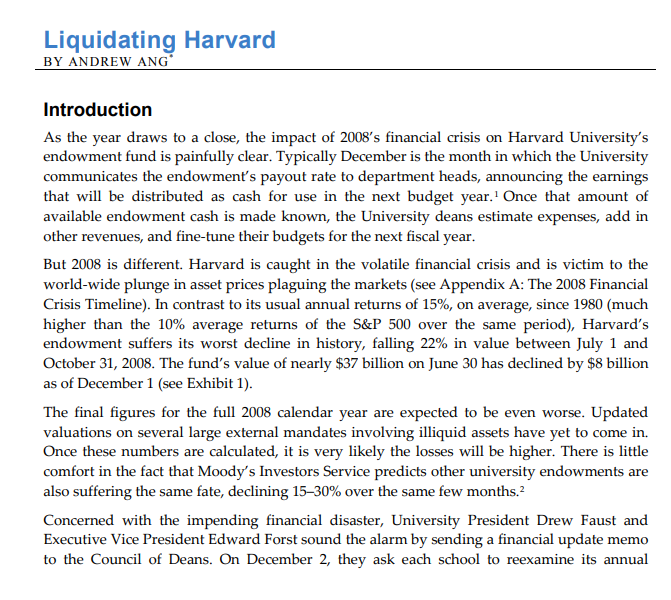
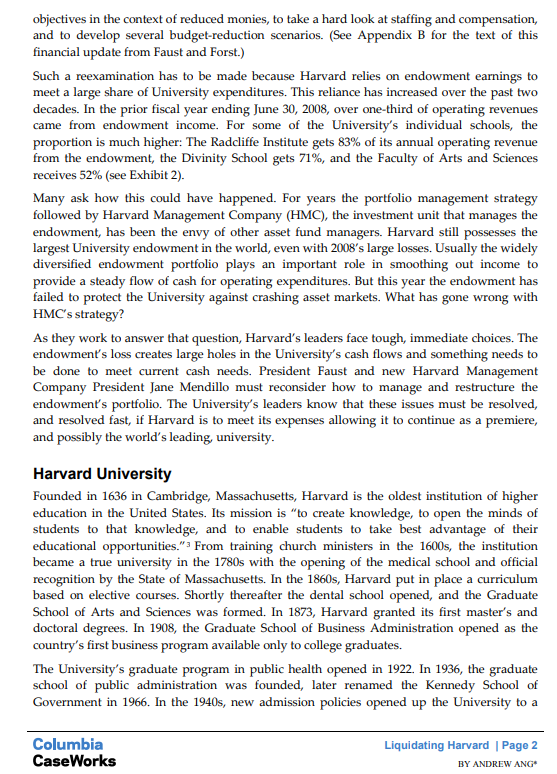
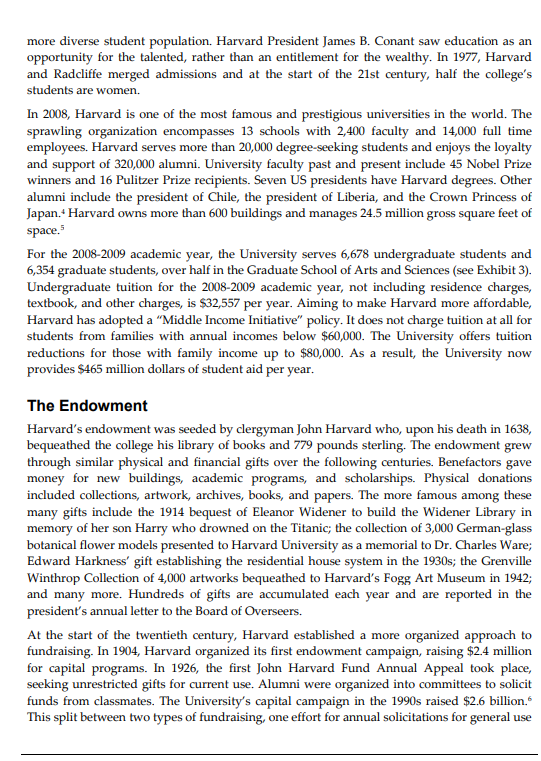
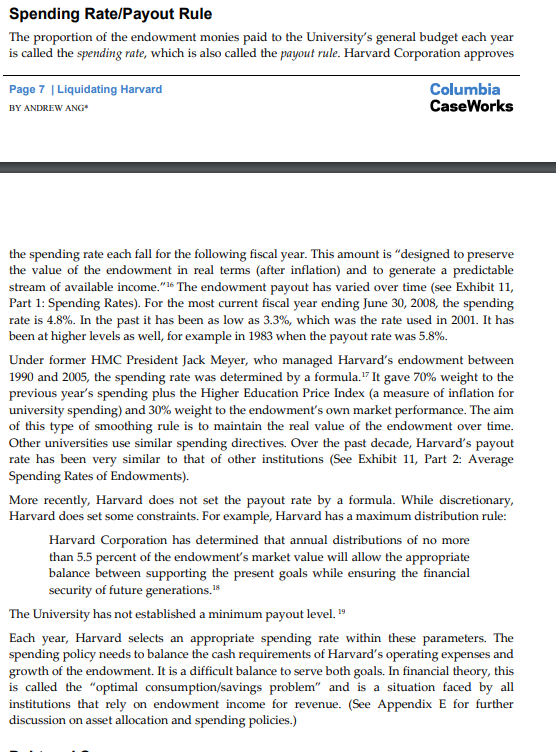
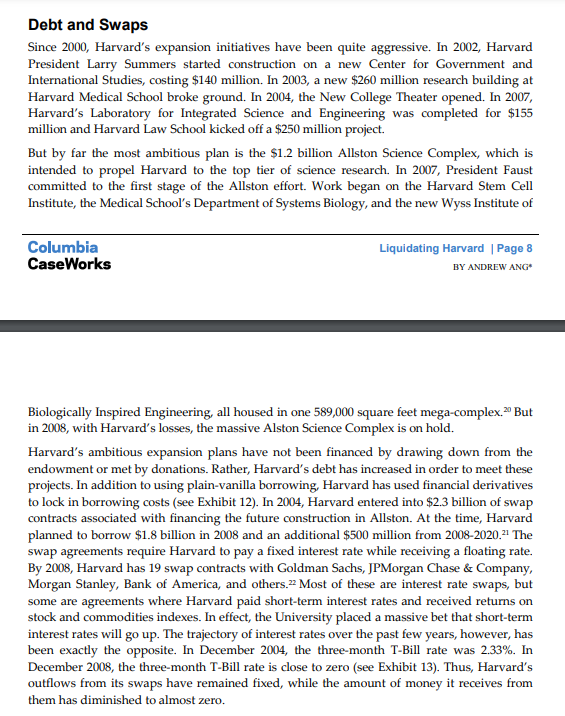
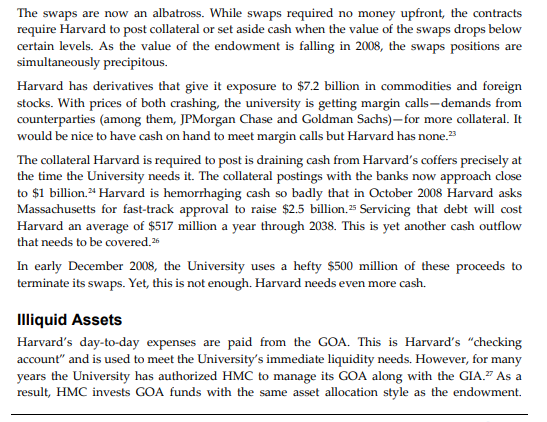
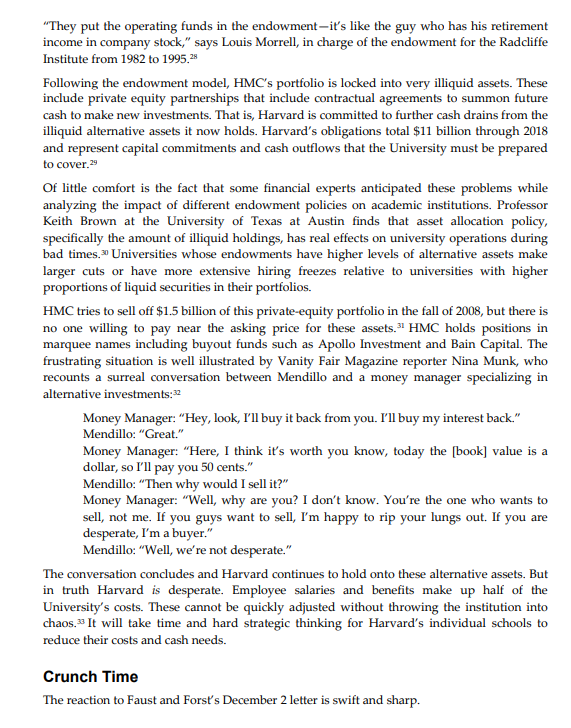
20. 21. 22, 23. 24, 25. What is Harvard's leverage ratio? Focusing on the GOA, compute Harvard's leverage within the equities and fixed income asset classes. How much long/short exposure is there in Harvard's derivative positions? Exhibit 10 does not include any implicit leverage in absolute return funds, private equity, or other alternative asset managers. Making suitable leverage assumptions, estimate Harvard's total implicit leverage in its endowment portfolio. Compare the interest rate Harvard is paying on its newly issued debt to the current yield curve. Note: this requires computing the yield on Harvard's bonds issued in December 2008. According to the expectations hypothesis, what is the trajectory of short-term interest rates? Harvard is now predominantly paying fixed rates and receiving floating rates in its swaps. Should Harvard terminate these positions? Liquidating Harvard BY ANDREW ANG" Introduction As the year draws to a close, the impact of 2008's financial crisis on Harvard University's endowment fund is painfully clear. Typically December is the month in which the University communicates the endowment's payout rate to department heads, announcing the earnings that will be distributed as cash for use in the next budget year.! Once that amount of available endowment cash is made known, the University deans estimate expenses, add in other revenues, and fine-tune their budgets for the next fiscal year. But 2008 is different. Harvard is caught in the volatile financial crisis and is victim to the world-wide plunge in asset prices plaguing the markets (see Appendix A: The 2008 Financial Crisis Timeline). In contrast to its usual annual returns of 15%, on average, since 1980 (much higher than the 10% average returns of the 5&P 500 over the same period), Harvard's endowment suffers its worst decline in history, falling 22% in value between July 1 and October 31, 2008. The fund's value of nearly $37 billion on June 30 has declined by $8 billion as of December 1 (see Exhibit 1). The final figures for the full 2008 calendar year are expected to be even worse. Updated valuations on several large external mandates involving illiquid assets have yet to come in. Once these numbers are calculated, it is very likely the losses will be higher. There is little comfort in the fact that Moody's Investors Service predicts other university endowments are also suffering the same fate, declining 15-30% over the same few months.? Concerned with the impending financial disaster, University President Drew Faust and Executive Vice President Edward Forst sound the alarm by sending a financial update memo to the Council of Deans. On December 2, they ask each school to reexamine its annual objectives in the context of reduced monies, to take a hard look at staffing and compensation, and to develop several budget-reduction scenarios. (See Appendix B for the text of this financial update from Faust and Forst.) Such a reexamination has to be made because Harvard relies on endowment earnings to meet a large share of University expenditures. This reliance has increased over the past two decades. In the prior fiscal year ending June 30, 2008, over one-third of operating revenues came from endowment income. For some of the University's individual schools, the proportion is much higher: The Radcliffe Institute gets 83% of its annual operating revenue from the endowment, the Divinity School gets 71%, and the Faculty of Arts and Sciences receives 52% (see Exhibit 2). Many ask how this could have happened. For years the portfolioc management strategy followed by Harvard Management Company (HMC), the investment unit that manages the endowment, has been the envy of other asset fund managers. Harvard still possesses the largest University endowment in the world, even with 2008's large losses. Usually the widely diversified endowment portfolio plays an important role in smoothing out income to provide a steady flow of cash for operating expenditures. But this year the endowment has failed to protect the University against crashing asset markets. What has gone wrong with HMC s strategy? As they work to answer that question, Harvard's leaders face tough, immediate choices. The endowment's loss creates large holes in the University's cash flows and something needs to be done to meet current cash needs. President Faust and new Harvard Management Company President Jane Mendillo must reconsider how to manage and restructure the endowment's portfolio. The University's leaders know that these issues must be resolved, and resolved fast, if Harvard is to meet its expenses allowing it to continue as a premiere, and possibly the world's leading, university. Harvard University Founded in 1636 in Cambridge, Massachusetts, Harvard is the oldest institution of higher education in the United States. Its mission is \"to create knowledge, to open the minds of students to that knowledge, and to enable students to take best advantage of their educational opportunities.\"? From training church ministers in the 1600s, the institution became a true university in the 1780s with the opening of the medical school and official recognition by the State of Massachusetts. In the 1860s, Harvard put in place a curriculum based on elective courses. Shortly thereafter the dental school opened, and the Graduate School of Arts and Sciences was formed. In 1873, Harvard granted its first master's and doctoral degrees. In 1908, the Graduate 5chool of Business Administration opened as the country's first business program available only to college graduates. The University's graduate program in public health opened in 1922 In 1936, the graduate school of public administration was founded, later renamed the Kennedy School of Government in 1966. In the 1940s, new admission policies opened up the University to a Columbia Liguidating Harvard | Page 2 CaseWorks BY ANDREW ANCG* more diverse student population. Harvard President James B. Conant saw education as an opportunity for the talented, rather than an entitlement for the wealthy. In 1977, Harvard and Radcliffe merged admissions and at the start of the 21st century, half the college's students are women. In 2008, Harvard is one of the most famous and prestigious universities in the world. The sprawling organization encompasses 13 schools with 2,400 faculty and 14,000 full time employees. Harvard serves more than 20,000 degree-seeking students and enjoys the loyalty and support of 320,000 alumni. University faculty past and present include 45 Nobel Prize winners and 16 Pulitzer Prize recipients. Seven US presidents have Harvard degrees. Other alumni include the president of Chile, the president of Liberia, and the Crown Princess of Japan* Harvard owns more than 600 buildings and manages 24.5 million gross square feet of space.\" For the 2008-2009 academic year, the University serves 6,678 undergraduate students and 6,354 graduate students, over half in the Graduate School of Arts and Sciences (see Exhibit 3). Undergraduate tuition for the 2008-200% academic year, not including residence charges, textbook, and other charges, is $32,557 per year. Aiming to make Harvard more affordable, Harvard has adopted a \"Middle Income Initiative\" policy. It does not charge tuition at all for students from families with annual incomes below $60,000. The University offers tuition reductions for those with family income up to $80,000. As a result, the University now provides $465 million dollars of student aid per year. The Endowment Harvard's endowment was seeded by clergyman John Harvard who, upon his death in 1638, bequeathed the college his library of books and 779 pounds sterling. The endowment grew through similar physical and financial gifts over the following centuries. Benefactors gave money for new buildings, academic programs, and scholarships. Physical donations included collections, artwork, archives, books, and papers. The more famous among these many gifts include the 1914 bequest of Eleanor Widener to build the Widener Library in memory of her son Harry who drowned on the Titanic; the collection of 3,000 German-glass botanical flower models presented to Harvard University as a memorial to Dr. Charles Ware; Edward Harkness' gift establishing the residential house system in the 1930s; the Grenville Winthrop Collection of 4,000 artworks bequeathed to Harvard's Fogg Art Museum in 1942; and many more. Hundreds of gifts are accumulated each year and are reported in the president's annual letter to the Board of Overseers. At the start of the twentieth century, Harvard established a more organized approach to fundraising. In 1904, Harvard organized its first endowment campaign, raising $2.4 million for capital programs. In 1926, the first John Harvard Fund Annual Appeal took place, seeking unrestricted gifts for current use. Alumni were organized into committees to solicit funds from classmates. The University's capital campaign in the 199(0s raised $2.6 billion.* This split between two types of fundraising, one effort for annual solicitations for general use funds and the other for special endowment campaigns to support capital projects, continues to this day. In terms of managing this wealth, Harvard originally charged the treasurer of the University with responsibility for its management. The treasurer used a wide variety of outside advisors, banks, and investment houses to manage the endowment. In 1974 this approach changed when Harvard Management Company (HMC) was formed as "an independent, private management company devoling its entire attention to Harvard."\" HMC hired a dozen investment specialists and moved the University's investment management function in-house. Today HMC reports directly to the treasurer and the Harvard Corporation Board of Overseers. (See Appendix C for a history of HMC.) The large endowment at Harvard provides several advantages. First, the endowment allows Harvard a greater amount of independence. Money from other sources, such as government grants or private foundations, can dry up or may arrive with strict conditions on how funds can be spent. Spending rules for these types of funds can change over time, for example, as legislation regarding stem cell research has changed in Congress. By building up endowment income, Harvard keeps a modicum of autonomy. Second, the endowment provides a usually predictable stream of money for operating budgets. Other sources of revenue, for example, grants or licensing arrangements, are dependent on multiple forces such as government legislation, availability of external sources of funds, rovalty arrangements, retail sales, and so on. The income generated by the endowment is more under Harvard's control. University financial planners have historically been able to use endowment income to partially meet the University's future operating EXPEnses. The third advantage af an endowment is that it allows future generations to gshare in tcn:la:,r's. riches. As Harvard points out: Although their specific uses vary, endowment funds have a common purpose: to support activities not just for one year, or even one generation, but in perpetuity. Harvard University follows investment and distribution policies that aim to sustain the value of the endowment in real dollar terms for future generations while providing a steady stream of income support for current operations. A fourth advantage is that a large endowment contributes to the Urd\ ersit:.r's prestige. In terms of endowment size, Harvard has long been at the top of the list. An elite university's endowment represents a symbol of status and prestige, similar to the university's libraries, art museums, architecture, faculty, and the prominence of its alumni.... Endowments are like a cowboy's belt buckle: the bigger the buckle, the more impressive the cowboy.* However, some experts take a skeptical view of these justifications for large endowments. In a 1998 New York Times interview,\" Henry Hansmann, professor of law at Yale University, describes large private universities as \"institutions whose business is to run large pools of investment assets. . .. They run educational institutions on the side, that can expand and contract to act as buffers for investment pools.\" In a damning critique he goes further and suggests that many endowments are managed to maximize growth first, \"viewing the educational operations as a constraint to unfettered financial asset accumulation.\" He contends that all university stakeholdersadministrators and faculty, current students, alumni, and donorsseek large endowments for their own selfish motives (see Appendix D The Purpose of Endowments). Whatever reason may justify Harvard's large endowment, the endowment's importance to Harvard operations is undisputed, as a detailed examination of the University's finances illustrates. Finances If Harvard University were listed as a stock, it would be an 5&I 500 company. The balance sheet for the fiscal year ending June 30, 2008, shows a net asset position of $43.5 billion dollars (see Exhibit 4). This puts the institution on par with listed large cap companies. For example, the market capitalization for Bristol-Myers Squibb Company is $40.6 billion, for United Parcel Service is $42.2 billion, and for Altria Group is $43.1 billion as of the same June 30, 2008, date. The $36.9 billion Harvard endowment consists of over 11,000 separate funds, used for many different purposes including new buildings, named professor chairs, endowed scholarship funds, research centers, and more. These endowment funds are not subject to permanent restrictions by donors, but decisions to spend principal require the approval of the Harvard Corporation. As of June 30, 2008, 16.6% of the endowment funds are totally unrestricted, 709% are temporarily restricted, and the remainder is subject to permanent restrictions. Despite Harvard's large physical expansions to its new science campus in neighboring Allston and to the new joint research centers in Hong Kong, Paris, Buenos Aires, and Tokyo, Harvard's fixed assets of $4.9 billion as of June 30, 2008, represent less than 10% of its total investment portfolio. All but a small fraction of the endowment is invested in the General Investment Account (GIA). The endowment funds are pooled and the various schools, centers, and other dedicated trusts holding endowment funds receive units in the pooled general investments. These operate like a mutual fund account and their values fluctuate monthly. The participating funds of all of Harvard's schools, centers, and trusts have the same pro-rated asset returms and distributions as the GLA. Harvard's other main investment account, which is %06 billion as of June 30, 2008, is the General Operating Account (GOA). The GOA represents working capital of Harvard University and consists of current funds, assets, and liabilities related to student and faculty loans and facilities. Money in the GOA is used to manage, control, and execute all University financial transactions except those transactions associated with the GLA. Harvard's operating expenses for the last fiscal year total $3.5 billion (see Exhibits 5 and 6). The cash necessary to meet these expenses came from student tuition, government grants, gifts, and endowment income. For the last fiscal year, these sources were insufficient and the University raised $0.7 billion in cash through financing activities (see Exhibit 7). As of June 2008, Harvard has $41 billion of current issued debt. At the moment, this sum is still much smaller than the value of the endowment. Policy Portfolio HMC's philosophy in managing assets is anchored in a model based on broad financial diversification - one that spreads monies over different asset classes, geographies, and return strategies. This investment philosophy was originally developed by the American economist Harry Markowitz in 1952 and subsequently recognized by his 1990 Nobel Prize. I Markowitz's thesis is that a portfolio holding many different assets can obtain a higher risk- return tradeoff than a portfolio holding only one or two types of assets. The economic intuition behind this holds that, when assets are non-perfectly correlated, there is scope for some assets to do well and offset the losses from other assets which simultaneously perform badly. As a result, an investor who is holding many different assets can diversify away risk, producing a superior risk-return ratio. A more recent incarnation of the diversification model is called the endowment model, which advocates large holdings of alternative asset classes, most of which are illiquid. " This approach is described in David F. Swensen's book, Pioneering Portfolio Management, published in 2000." Swensen, the chief investment officer at Yale University, argues that in highly liquid markets, such as fixed income, the potential for making positive returns is limited due to competition. Consequently in those markets there is little scope for fundamental research to yield excess returns. By contrast, other markets, such as real assets, venture capital, and private equity, have large potential payoffs for those investors who have superior research and management skills. According to Swensen, the gains in illiquid markets are not competed away because most managers have limited investment horizons. Perpetually lived institutions such as college endowments can afford to play in these markets because their horizons are longer than those of their "competitors" for investment management services. Swensen notes that the cross- sectional dispersion in manager performance for illiquid markets is much higher than for public markets. For example, fixed income managers track their benchmarks very closely, usually by no more than a few basis points, while hedge fund managers' track records vary widely. Swensen thus recommends that long-term institutional investors with sufficient resources who can carefully select expert managers in alternative, illiquid assets can achieve superior risk-adjusted returns. Harvard explicitly follows the endowment model and, in doing so, creates a yardstick for its own performance called the policy portfolio. This cornerstone of HMC's investment philosophy is "the long-term asset mix most likely to meet the University's return goals with Columbia Liquidating Harvard | Page 6 CaseWorks BY ANDREW ANGthe appropriate level of risk. It serves as the benchmark against which the actual portfolio is measured.\" " The policy portfolio differs from a traditional stock/bond portfolio by including large allocations to alternative and illiquid assets such as private equity, real estate, and absolute return strategies. HMC announces the annual policy portfolio benchmark one year in advance (see Exhibit 5). HMC's policy portfolio for the 2008-2009 fiscal year is to hold 11% in traditional domestic equities and 4% in domestic bonds. Foreign equities and emerging markets constitute 22%. The policy portfolio is heavily skewed towards illiquid assets: private equities are 13%, timber is %%, and real estate comprises 9% respectively. There is a large 18% allocation to hedge funds. In addition, the policy portiolio is slightly levered, holding a -3% cash position. Harvard's tilt towards illiquid and alternative assets is much more aggressive than the average endowment (see Exhibit ). The policy portfolio benchmark is regularly reviewed. For example, in July 1999, a new asset class, inflation-indexed bonds, was established. In 2005, the policy allocation to inflation- indexed bonds was 5%. It was reduced to (% in 2006. Strategic changes to the policy portfolio are a function of the Board's investment outlook, HMC's experience, and the changing circumstances of Harvard's actual portfolio. The policy portfolio benchmarks for liquid assets are well-recognized broad indices, such as the S5&P 500, the 5&FP 400, and the Russell 2000 for domestic equities.'* However, for illiquid assets, the benchmarks are jointly set by HMC management and the Board and are proprietary. The policy portfolio is not the acfual porifolic held by HMC. The actual asset mix differs from that of the policy portiolio because asset values fluctuate daily with the markets. Thus the actual portfolio uses the policy portfolio as a benchmark (see Exhibit 10). The differences between the actual and policy portfolio constitute tactical asset allocation decisions, as the 2008 HMC annual report to the Harvard community explains: If domestic equities are perceived to be overvalued, the actual portfolio may hold only 9% in domestic equities compared with the 11% weight set in the Policy Portfolio. If these tactical asset allocation decisions are correct, on balance, the actual portfolio will tend to outperform the policy portfolio. HMC can also outperform the policy portfolio by superior performance of its actual portfolios within each asset class. This third component is called security selection and is the purview of active management. Harvard uses both internal and external managers in a hybrid model to select securities. Active management is often implemented by taking active long-short positions. In contrast to the small amount of leverage in the policy portfolio, with a 3% cash position, the actual portfolio has a liability-to-asset ratio of 24% on June 30, 2009, Certain asset classes within the portfolio are highly levered due to active management. Spending Rate/Payout Rule The proportion of the endowment monies paid to the University's general budget each year is called the spending rale, which is also called the payout rule. Harvard Corporation approves Page 7 | Liguidating Harvard Columbia BY ANDREW ANG* Eaunrks the spending rate each fall for the following fiscal year. This amount is \"designed to preserve the value of the endowment in real terms (after inflation) and to generate a predictable stream of available income.\"" The endowment payout has varied over time (see Exhibit 11, Part 1: Spending Kates). For the most current fiscal year ending June 30, 2008, the spending rate is 4.8%. In the past it has been as low as 3.3%, which was the rate used in 2001. It has been at higher levels as well, for example in 1983 when the payout rate was 5.8%. Under former HMC President Jack Meyer, who managed Harvard's endowment between 1990 and 2005, the spending rate was determined by a formula.\" It gave 70% weight to the previous vear''s spending plus the Higher Education Price Index (a measure of inflation for university spending) and 30% weight to the endowment's own market performance. The aim of this type of smoothing rule is to maintain the real value of the endowment over time. Other universities use similar spending directives. Over the past decade, Harvard's pavout rate has been very similar to that of other institutions (See Exhibit 11, Part 2: Average Spending Rates of Endowments). More recently, Harvard does not set the payout rate by a formula. While discretionary, Harvard does set some constraints. For example, Harvard has a maximum distribution rule: Harvard Corporation has determined that annual distributions of no more than 5.5 percent of the endowment's market value will allow the appropriate balance between supporting the present goals while ensuring the financial security of fulure generations. The Universit}r has not established a minimum payout level. Each vear, Harvard selects an appropriate spending rate within these parameters. The spending policy needs to balance the cash requirements of Harvard's operating expenses and growth of the endowment. It is a difficult balance to serve both goals. In financial theory, this is called the \"optimal consumption/savings problem\" and is a situation faced by all institutions that rely on endowment income for revenue. (See Appendix E for further discussion on asset allocation and spending policies.) Debt and Swaps Since 2000, Harvard's expansion initiatives have been quite aggressive. In 2002, Harvard President Larry Summers started construction on a new Center for Government and International Studies, costing $140 million. In 2003, a new $260 million research building at Harvard Medical School broke ground. In 2004, the New College Theater opened. In 2007, Harvard's Laboratory for Integrated Science and Engineering was completed for $155 million and Harvard Law School kicked off a $250 million project. But by far the most ambitious plan is the $1.2 billion Allston Science Complex, which is intended to propel Harvard to the top tier of science research. In 2007, President Faust committed to the first stage of the Allston effort. Work began on the Harvard Stem Cell Institute, the Medical School's Department of Systems Biology, and the new Wyss Institute of Columbia Liquidating Harvard | Page 8 CaseWorks BY ANDREW ANG* Biologically Inspired Engineering, all housed in one 589,000 square feet mega-complex. " But in 2008, with Harvard's losses, the massive Alston Science Complex is on hold. Harvard's ambitious expansion plans have not been financed by drawing down from the endowment or met by donations. Rather, Harvard's debt has increased in order to meet these projects. In addition to using plain-vanilla borrowing, Harvard has used financial derivatives to lock in borrowing costs (see Exhibit 12). In 2004, Harvard entered into $2.3 billion of swap contracts associated with financing the future construction in Allston. At the time, Harvard planned to borrow $1.8 billion in 2008 and an additional $500 million from 2008-2020." The swap agreements require Harvard to pay a fixed interest rate while receiving a floating rate. By 2008, Harvard has 19 swap contracts with Goldman Sachs, JPMorgan Chase & Company, Morgan Stanley, Bank of America, and others." Most of these are interest rate swaps, but some are agreements where Harvard paid short-term interest rates and received returns on stock and commodities indexes. In effect, the University placed a massive bet that short-term interest rates will go up. The trajectory of interest rates over the past few years, however, has been exactly the opposite. In December 2004, the three-month T-Bill rate was 2.33%. In December 2008, the three-month T-Bill rate is close to zero (see Exhibit 13). Thus, Harvard's outflows from its swaps have remained fixed, while the amount of money it receives from them has diminished to almost zero.The swaps are now an albatross. While swaps required no money upfront, the contracts require Harvard to post collateral or set aside cash when the value of the swaps drops below certain levels. As the value of the endowment is falling in 2008, the swaps positions are simultaneously precipitous. Harvard has derivatives that give it exposure to $7.2 billion in commodities and foreign stocks. With prices of both crashing, the university is getting margin callsdemands from counterparties (among them, [PMorgan Chase and Goldman Sachs)for more collateral. It would be nice to have cash on hand to meet margin calls but Harvard has none > The collateral Harvard is required to post is draining cash from Harvard's coffers precisely at the time the University needs it. The collateral postings with the banks now approach close to $1 billion.** Harvard is hemorrhaging cash so badly that in October 2008 Harvard asks Massachusetts for fast-track approval to raise $2.5 billion.* Servicing that debt will cost Harvard an average of $517 million a year through 2038. This is vet another cash outflow that needs to be covered. In early December 2008, the University uses a hefty 3500 million of these proceeds to terminate its swaps. Yet, this is not enough. Harvard needs even more cash. llliquid Assets Harvard's day-to-day expenses are paid from the GOA. This is Harvard's \"checking account\" and is used to meet the University's immediate liquidity needs. However, for many vears the University has authorized HMC to manage its GOA along with the GIA As a result, HMC invests GOA funds with the same asset allocation style as the endowment. \"They put the operating funds in the endowmentit's like the guy who has his retirement income in company stock,\" says Louis Morrell, in charge of the endowment for the Radcliffe Institute from 1982 to 1995 Following the endowment model, HMC's portfolio is locked into very illiquid assets. These include private equity partnerships that include contractual agreements to summon future cash to make new investments. That is, Harvard is committed to further cash drains from the illiquid alternative assets it now holds. Harvard's obligations total $11 billion through 2018 and represent capital commitments and cash outflows that the University must be prepared to cover. Of litle comfort is the fact that some financial experts anticipated these problems while analyzing the impact of different endowment policies on academic institutions. Professor Keith Brown at the University of Texas at Austin finds that asset allocation policy, specifically the amount of illiquid holdings, has real effects on university operations during bad times.* Universities whose endowments have higher levels of alternative assets make larger cuts or have more extensive hiring freezes relative to universities with higher proportions of liquid securities in their portfolios. HMC tries to sell off $1.5 billion of this private-equity portfolio in the fall of 2008, but there is no one willing to pay near the asking price for these assets. HMC holds positions in marquee names including buyout funds such as Apollo Investment and Bain Capital. The frustrating situation is well illustrated by Vanity Fair Magazine reporter Nina Munk, who recounts a surreal conversation between Mendillo and a money manager specializing in alternative investments: = Money Manager: \"Hey, look, I'll buy it back from you. I'll buy my interest back."\" Mendillo: \"Great.\" Money Manager: \"Here, | think it's worth you know, today the [book] value is a dollar, so I'll pay you 50 cents.\" Mendillo: \"Then why would I sell it?\" Money Manager: \"Well, why are you? I don't know. You're the one who wants to sell, not me. If you guys want to sell, I'm happy to rip your lungs out. If you are desperate, I'm a buyer.\" Mendillo: \"Well, we're not desperate.\" The conversation concludes and Harvard continues to hold onto these alternative assets. But in truth Harvard is desperate. Employee salaries and benefits make up half of the University's costs. These cannot be quickly adjusted without throwing the institution into chaos. It will take time and hard strategic thinking for Harvard's individual schools to reduce their costs and cash needs. Crunch Time The reaction to Faust and Forst's December 2 letter is swift and sl'mrp. \"Apparently nobody in our financial office has read the story in Genesis about Joseph interpreting Pharach's dream. . . . You know, during the seven good years you save for the seven lean vears,\" comments Professor Alan M. Dershowitz, professor of law at Harvard Law School Harvard University leaders and Mendillo at HMC need to take immediate action. They must first decide how to keep the University liquid and in operation. The options are limited and painful: they can force the deans to slash budgets, halt hiring, and freeze projects; the development office can launch emergency fundraising; the financial aid department can roll back the Middle Income Initiative or scale back financial aid offers; HMC can issue even more new debt during this dreadful bond market; or key Harvard assets can be sold, perhaps at fire sale prices. Each of these options lead to even more difficult decisions: Which projects should be delayed and which projects cancelled? If assets are liquidated, which ones should be sold? And for how much? Is there a limit to the losses that Harvard is willing to sustain? Then, once the cash flow is stabilized, more strategic issues will need to be resolved as well: Most importantly, how should Harvard's endowment be managed going forward? Is the endowment model with illiquid, alternative assets still appropriate for Harvard's GOA and GIA? Most fundamentally in the spirit of Henry Hansmann, what is the purpose of Harvard's endowment wealth? Jane Mendillo needs to decide whether to keep the current portfolio strategy. While the endowment model of investing has been guiding Harvard since 1990, the events of 2008 show that the current model is not fail-safe. Many Harvard stakeholdersstudents, faculty, and trusteesare calling for HMC not to repeat the disaster of 2008. Faust, Forst, and Mendillo weigh the options and prepare to act
Step by Step Solution
There are 3 Steps involved in it
1 Expert Approved Answer
Step: 1 Unlock
Question Has Been Solved by an Expert!
Get step-by-step solutions from verified subject matter experts
Step: 2 Unlock
Step: 3 Unlock
Students Have Also Explored These Related Finance Questions!









 Study Help