







Question: Inter Process communication (IPC) technique supports a thread in one process to share some information with threads in other processes. This can be implemented through
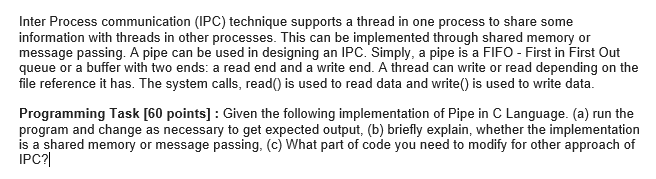


Inter Process communication (IPC) technique supports a thread in one process to share some information with threads in other processes. This can be implemented through shared memory or message passing. A pipe can be used in designing an IPC. Simply, a pipe is a FIFO First in First Out queue or a buffer with two ends: a read end and a write end. A thread can write or read depending on the file reference it has. The system calls, read) is used to read data and write0 is used to write data Programming Task [60 points]: Given the following implementation of Pipe in C Language. (a) run the program and change as necessary to get expected output, (b) briefly explain, whether the implementation is a shared memory or message passing, (c) What part of code you need to modify for other approach of IPC? include
Step by Step Solution
There are 3 Steps involved in it

Get step-by-step solutions from verified subject matter experts
 Study Help