







Question: Interference occurs when two or more waves are at the same location at the same time. For example the wind may create tiny ripples on
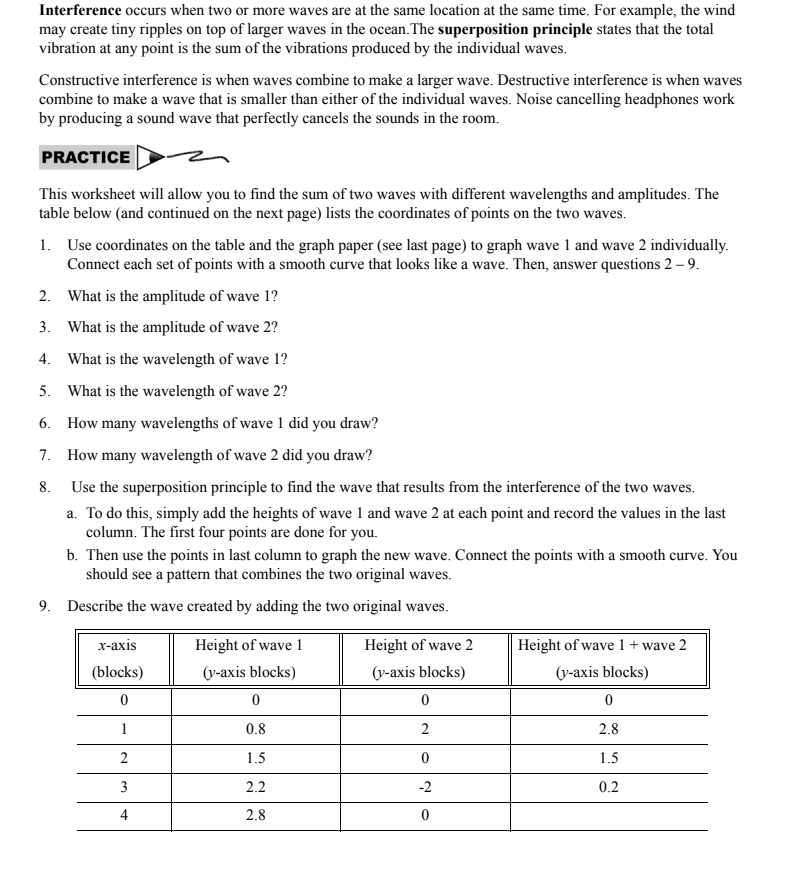
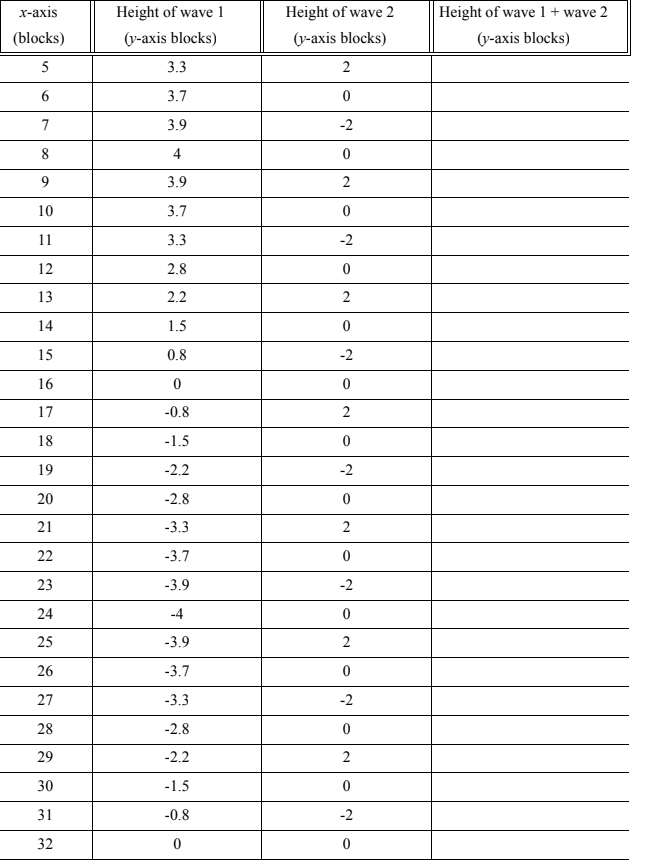
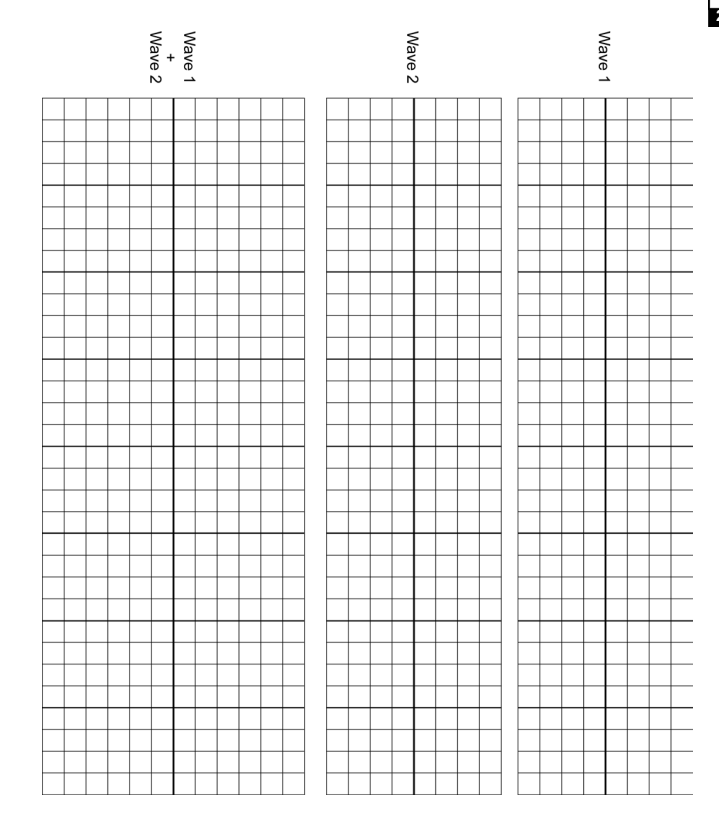
Interference occurs when two or more waves are at the same location at the same time. For example the wind may create tiny ripples on top of larger waves in the ocean.'Ihe superposition principle states that the total vibration at any point is the sum of the vibrations produced by the individual waves. lConstructive interference is when waves combine to make a larger wave. Destructive interference is when waves combine to make a wave that is smaller than either of the individual waves. Noise cancelling headphones work by producing a sound wave that perfectly cancels the sounds in the room. more [:p-wz-c This worksheet will allow you to nd the sum of two waves with different wavelengths and amplitudes. The table below (and continued on the neat page) lists the coordinates of points on the two waves. 1. Use coordinates on the table and the graph paper {see last page) to graph wave 1 and wave 2 individually. Connect each set of points with a smooth curve that looks like a wave. Then, answer questions 2 9. 2 What is the amplitude of wave 1? 3. What is the amplitude of wave 2? 4 What is the wavelength of wave 1'? 5 What is the wavelength of wave 2'? 6. How many wavelengths of wave 1 did you draw? 1' How many wavelength of wave 2 did you draw? 3. Use the superposition principle to nd the wave that results from the interference of the two waves. a. To do this1 simply add the heights of wave 1 and wave 2 at each point and record the values in the last column. The first four points are done for you. h. Then use the points in last column to graph the new wave. Connect the points with a smooth curve. You should see a pattern that combines the two original waves. 9. Describe the wave created by adding the two original waves. Height of wave 1 Height of wave 2 Height of wave 1 + wave 2 (yaxis blocks] [yraxis blocks} (y-i blocks) x-axis Height of wave 1 Height of wave 2 Height of wave 1 + wave 2 (blocks) (v-axis blocks) (v-axis blocks) ()-axis blocks) 5 3.3 2 6 3.7 0 3.9 -2 8 4 O 9 3.9 N 10 3.7 O 11 3.3 12 2.8 0 13 2.2 14 1.5 15 0.8 -2 16 0 17 -0.8 2 18 -1.5 19 -2.2 -2 20 -2.8 21 -3.3 22 -3.7 23 -3.9 24 -4 O 25 -3.9 N 26 -3.7 O 27 -3.3 -2 28 -2.8 0 29 -2.2 N 30 -1.5 O 31 -0.8 32 0 0\f
Step by Step Solution
There are 3 Steps involved in it

Get step-by-step solutions from verified subject matter experts
 Study Help