



Question: Intermolecular Forces (IMFs) and Noncovalent Interactions When neighboring molecules or ions (or remote parts of the same molecule or ion) interact with one another, they
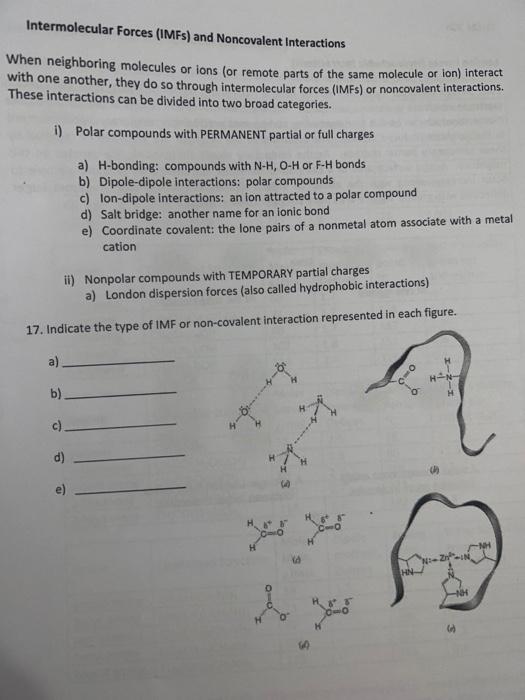
Intermolecular Forces (IMFs) and Noncovalent Interactions When neighboring molecules or ions (or remote parts of the same molecule or ion) interact with one another, they do so through intermolecular forces (IMFs) or noncovalent interactions. These interactions can be divided into two broad categories. i) Polar compounds with PERMANENT partial or full charges a) H-bonding: compounds with NH,OH or FH bonds b) Dipole-dipole interactions: polar compounds c) Ion-dipole interactions: an ion attracted to a polar compound d) Salt bridge: another name for an ionic bond e) Coordinate covalent: the lone pairs of a nonmetal atom associate with a metal cation ii) Nonpolar compounds with TEMPORARY partial charges a) London dispersion forces (also called hydrophobic interactions)
Step by Step Solution
There are 3 Steps involved in it

Get step-by-step solutions from verified subject matter experts