Question: Introduction Summary Evaluation Response Conclusion Be sure to explain the reasons for your opinions. Whenever possible, provide examples from the article to support your conclusions.
-
Introduction
-
Summary
-
Evaluation
-
Response
-
Conclusion
-
Be sure to explain the reasons for your opinions.
-
Whenever possible, provide examples from the article to support your conclusions.
-
If you find fault in an area of the article, consider an alternative approach that would
improve the methods.
FYI: Definitions of critique include:
-
A critical review or commentary
-
A detailed analysis and assessment of something
-
A method of disciplined, systematic analysis of a written or oral discourse
-
Involves identifying both strengths and faults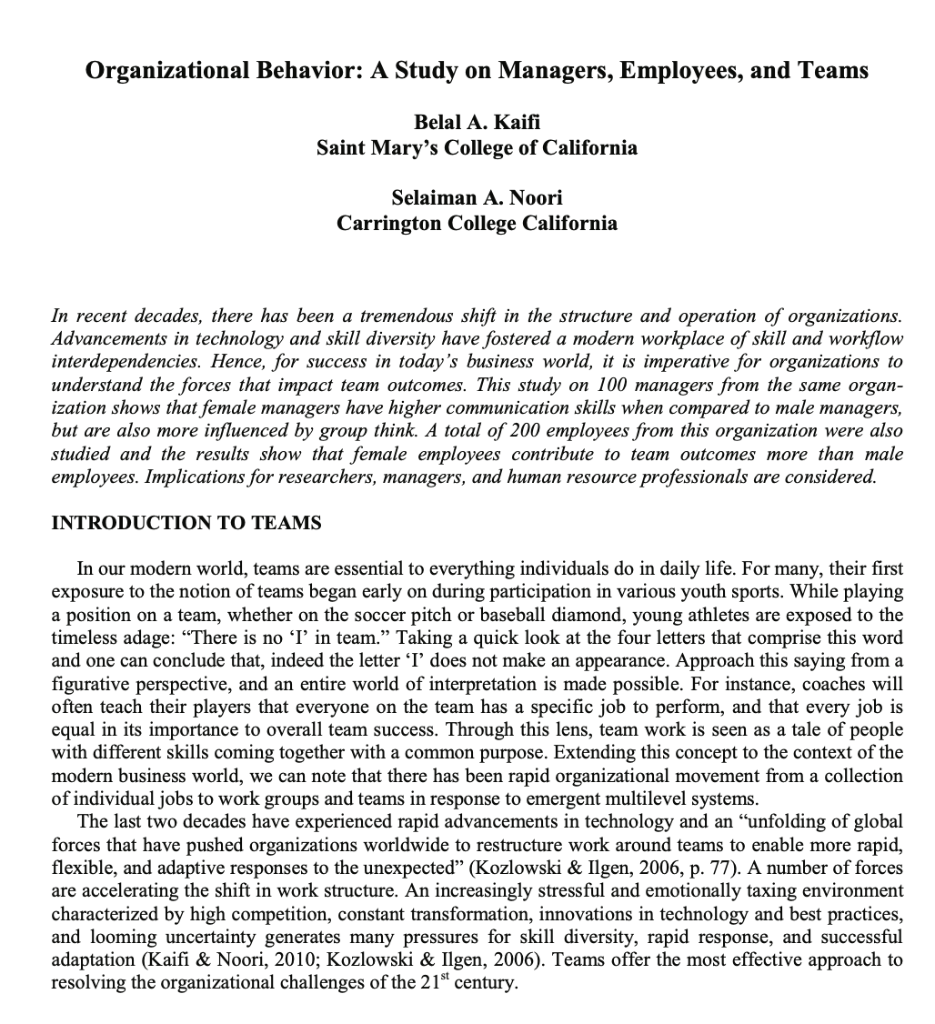
Organizational Behavior: A Study on Managers, Employees, and Teams Belal A. Kaifi Saint Mary's College of California Selaiman A. Noori Carrington College California In recent decades, there has been a tremendous shift in the structure and operation of organizations. Advancements in technology and skill diversity have fostered a modern workplace of skill and workflow interdependencies. Hence, for success in today's business world, it is imperative for organizations to understand the forces that impact team outcomes. This study on 100 managers from the same organ- ization shows that female managers have higher communication skills when compared to male managers, but are also more influenced by group think. A total of 200 employees from this organization were also studied and the results show that female employees contribute to team outcomes more than male employees. Implications for researchers, managers, and human resource professionals are considered. INTRODUCTION TO TEAMS In our modern world, teams are essential to everything individuals do in daily life. For many, their first exposure to the notion of teams began early on during participation in various youth sports. While playing a position on a team, whether on the soccer pitch or baseball diamond, young athletes are exposed to the timeless adage: There is no T' in team. Taking a quick look at the four letters that comprise this word and one can conclude that, indeed the letter l' does not make an appearance. Approach this saying from a figurative perspective, and an entire world of interpretation is made possible. For instance, coaches will often teach their players that everyone on the team has a specific job to perform, and that every job is equal in its importance to overall team success. Through this lens, team work is seen as a tale of people with different skills coming together with a common purpose. Extending this concept to the context of the modern business world, we can note that there has been rapid organizational movement from a collection of individual jobs to work groups and teams in response to emergent multilevel systems. The last two decades have experienced rapid advancements in technology and an unfolding of global forces that have pushed organizations worldwide to restructure work around teams to enable more rapid, flexible, and adaptive responses to the unexpected (Kozlowski & Ilgen, 2006, p. 77). A number of forces are accelerating the shift in work structure. An increasingly stressful and emotionally taxing environment characterized by high competition, constant transformation, innovations in technology and best practices, and looming uncertainty generates many pressures for skill diversity, rapid response, and successful adaptation (Kaifi & Noori, 2010; Kozlowski & Ilgen, 2006). Teams offer the most effective approach to resolving the organizational challenges of the 219 century. Organizational Behavior: A Study on Managers, Employees, and Teams Belal A. Kaifi Saint Mary's College of California Selaiman A. Noori Carrington College California In recent decades, there has been a tremendous shift in the structure and operation of organizations. Advancements in technology and skill diversity have fostered a modern workplace of skill and workflow interdependencies. Hence, for success in today's business world, it is imperative for organizations to understand the forces that impact team outcomes. This study on 100 managers from the same organ- ization shows that female managers have higher communication skills when compared to male managers, but are also more influenced by group think. A total of 200 employees from this organization were also studied and the results show that female employees contribute to team outcomes more than male employees. Implications for researchers, managers, and human resource professionals are considered. INTRODUCTION TO TEAMS In our modern world, teams are essential to everything individuals do in daily life. For many, their first exposure to the notion of teams began early on during participation in various youth sports. While playing a position on a team, whether on the soccer pitch or baseball diamond, young athletes are exposed to the timeless adage: There is no T' in team. Taking a quick look at the four letters that comprise this word and one can conclude that, indeed the letter l' does not make an appearance. Approach this saying from a figurative perspective, and an entire world of interpretation is made possible. For instance, coaches will often teach their players that everyone on the team has a specific job to perform, and that every job is equal in its importance to overall team success. Through this lens, team work is seen as a tale of people with different skills coming together with a common purpose. Extending this concept to the context of the modern business world, we can note that there has been rapid organizational movement from a collection of individual jobs to work groups and teams in response to emergent multilevel systems. The last two decades have experienced rapid advancements in technology and an unfolding of global forces that have pushed organizations worldwide to restructure work around teams to enable more rapid, flexible, and adaptive responses to the unexpected (Kozlowski & Ilgen, 2006, p. 77). A number of forces are accelerating the shift in work structure. An increasingly stressful and emotionally taxing environment characterized by high competition, constant transformation, innovations in technology and best practices, and looming uncertainty generates many pressures for skill diversity, rapid response, and successful adaptation (Kaifi & Noori, 2010; Kozlowski & Ilgen, 2006). Teams offer the most effective approach to resolving the organizational challenges of the 219 century









 Study Help