



Question: Introduction The Mega Logistics logistics center has been operating on the Polish market for 4 years. The Mega Logistics company was established and still operates
Introduction
The Mega Logistics logistics center has been operating on the Polish market for years. The Mega Logistics company was established and still operates as a civil partnership. Two coowners do not have large funds, which prevents the company from developing quickly and conquering the market. Nevertheless, the company is perfectly placed on the market as a logistics operator for specific clients. Numerous business contacts, punctuality and good quality of services provided mean that the company can operate on the market. Currently, its main clients are retail chains. The company's main asset is a m transshipment and storage hall. Establishing cooperation with permanent business partners gave the center the opportunity to provide funds for the company's operations. According to the owners, the company's financial situation looks good. There were no problems with solvency, and the profit satisfied the owners. One day, Mr Piotr, the new financial director, looked at the company's financial report, in particular the costs incurred.
Table Quarterly costs by place of origin and type of costs
tableResourcesCostAdministrative staff, EuroManual workers, EuroForklifts EuroIT equipment, EuroWarehouse workers, EuroWarehouse EuroDrivers EuroDelivery vehicles, EuroTotalCustomer profitability calculation activitybased costing
Customer profitability calculation activitybased costing
Based on conversations with his employees, the manager determined what activities were performed in the company in order to deliver the product to the customer. Everything seemed trivially simple and Mr Piotr was surprised that he had not noticed it earlier, or rather, he had noticed it but probably did not attach due importance to it The list of identified activities is presented in Table
Table Activities carried out in the company
activity
Receiving goods
Notifying the reception
Storing goods
Handling and manipulation
Pickup
Issuing invoices
Transport planning
Transport to the customer
Mr Piotr, after consulting with the chief accountant, began collecting data that could be used to create an activitybased costing. He began by taking a closer look at the activities carried out that were necessary for the company to function. He noticed that the data presented in them was highly aggregated, which made it impossible to determine where they were generated. In connection with this, Mr Piotr decided to organize a series of meetings with employees responsible for individual areas in order to be able to more precisely determine where individual costs were generated.
The first cost category that Mr Piotr drew attention to was the acceptance into the warehouse. The information obtained showed that the acceptance process into the warehouse involves manual workers working in shifts in the first shift and in the second shift They are responsible for unloading and checking each shipment and transferring the goods to the warehouse, in which they are assisted by one warehouse worker whose task is to supervise and keep records. Acceptance takes place on an area of m and the workers are equipped with two computer stations for their work.
The next step was to organize a meeting with the employee responsible for storage. The main share of costs is the cost of storage and warehouse management. The goods are stored on an area of m and employees are responsible for the goods located there, who, in order to automate and simplify work, have one computer station at the entrance to the warehouse, to support goods registration. Transport within the warehouse hall is carried out using shortdistance transport vehicles in the form of forklifts. The number of kilometers for shortdistance transport was calculated from the data obtained from the reports for the last quarter km
The third distinguished process is the process of picking and sending stored goods for shipping. The picking process is handled by five warehouse workers. Additionally, these workers are supported by office workers. On average, office workers spend working hours per quarter on preparing documents related to picking, hours on invoicing, hours on handling receipts, hours on warehouse administration and hours on preparing transport documentation. The picking process takes place on an area of m
The last activity carried out within the company is the execution of shipping and transport to the customer. For this purpose, the company employs drivers whose. Data from tachographs for the last quarter presented the approximate number of kilometers covered km
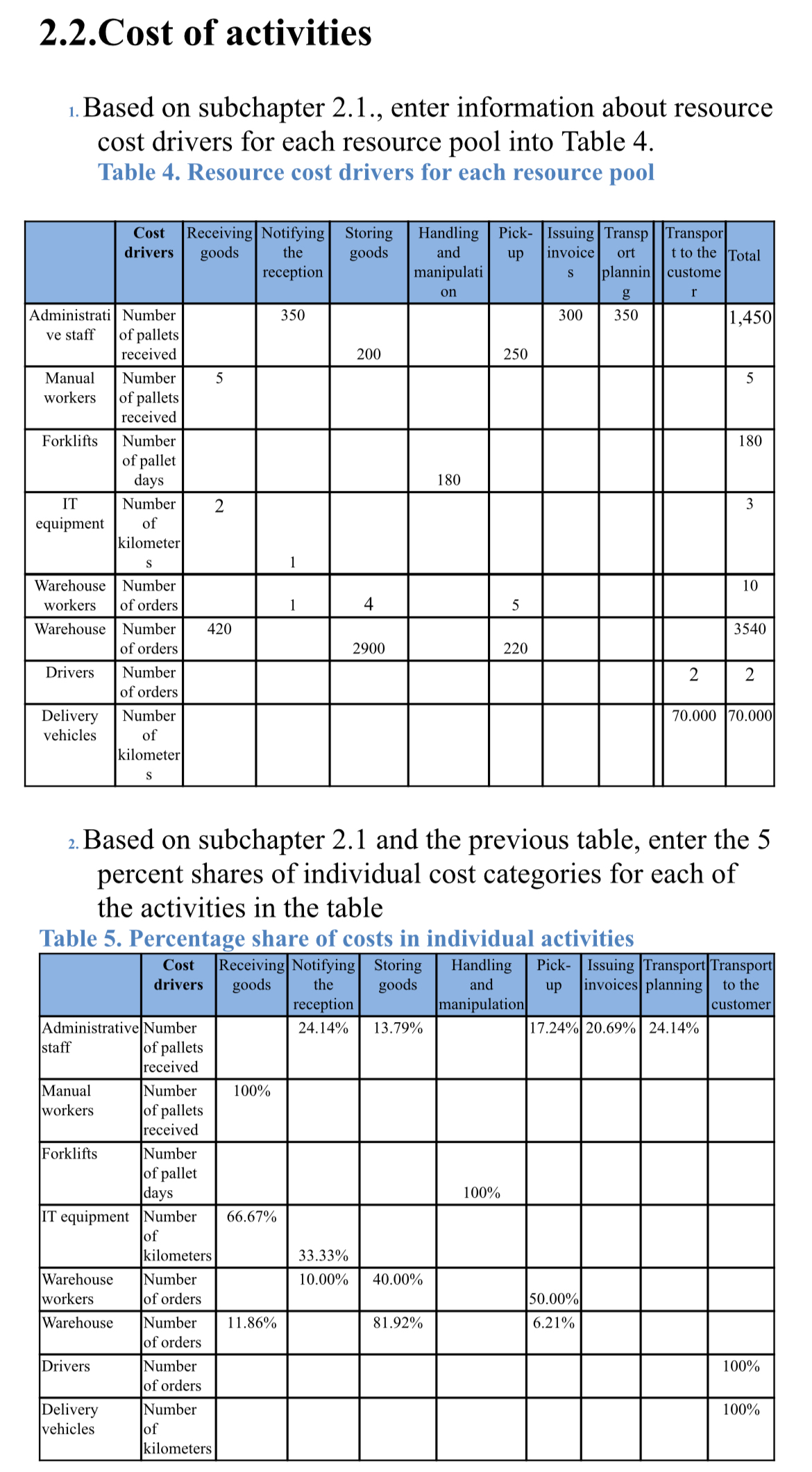
The next stage in the process of collecting data necessary to perform the activitybased costing was to identify the cost drivers of the activities. Mr Piotr came up with the idea that it would be best to organize a meeting of people responsi.
Step by Step Solution
There are 3 Steps involved in it
1 Expert Approved Answer
Step: 1 Unlock

Question Has Been Solved by an Expert!
Get step-by-step solutions from verified subject matter experts
Step: 2 Unlock
Step: 3 Unlock