Question: INTRODUCTION: This is an individual assignment. Students need to write one Case Study Analysis, which includes the following: CASE STUDY ANALYSIS COMPONENTS: 1. Logically answering
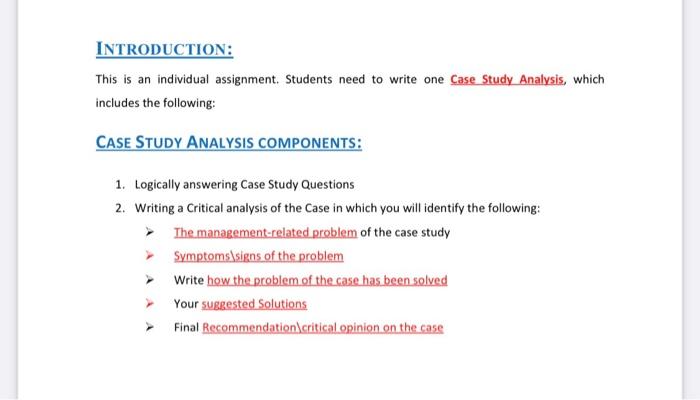
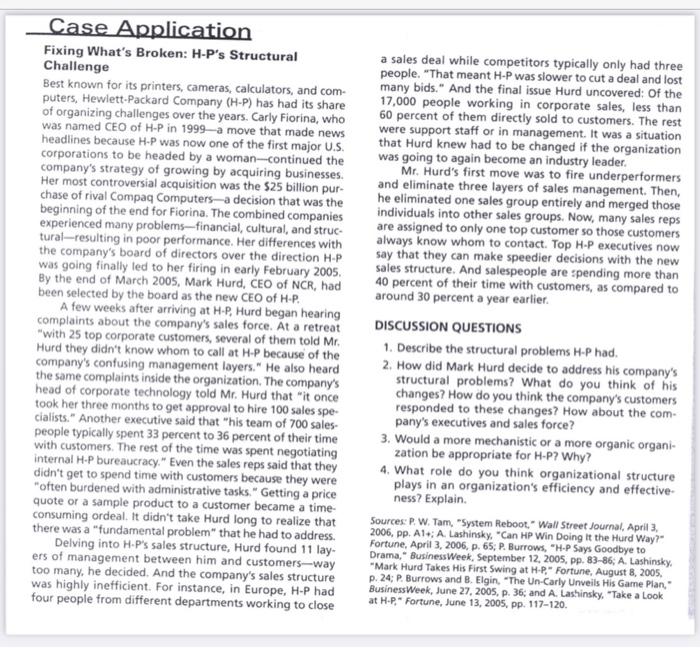
INTRODUCTION: This is an individual assignment. Students need to write one Case Study Analysis, which includes the following: CASE STUDY ANALYSIS COMPONENTS: 1. Logically answering Case Study Questions 2. Writing a Critical analysis of the Case in which you will identify the following: The management-related problem of the case study Symptoms\signs of the problem Write how the problem of the case has been solved Your suggested Solutions > Final Recommendation critical opinion on the case Case Application Fixing What's Broken: H-P's Structural Challenge Best known for its printers, cameras, calculators, and com- puters, Hewlett-Packard Company (H-P) has had its share of organizing challenges over the years. Carly Fiorina, who was named CEO of H-P in 1999-a move that made news headlines because H-P was now one of the first major U.S. corporations to be headed by a woman-continued the company's strategy of growing by acquiring businesses. Her most controversial acquisition was the $25 billion pur- chase of rival Compaq Computers-a decision that was the beginning of the end for Fiorina. The combined companies experienced many problems-financial, cultural, and struc- tural-resulting in poor performance. Her differences with the company's board of directors over the direction H-P was going finally led to her firing in early February 2005 By the end of March 2005, Mark Hurd, CEO of NCR, had been selected by the board as the new CEO of H.P. A few weeks after arriving at H-P, Hurd began hearing complaints about the company's sales force. At a retreat "With 25 top corporate customers, several of them told Mr. Hurd they didn't know whom to call at HP because of the company's confusing management layers." He also heard the same complaints inside the organization. The company's head of corporate technology told Mr. Hurd that "it once took her three months to get approval to hire 100 sales spe cialists." Another executive said that his team of 700 sales- people typically spent 33 percent to 36 percent of their time with customers. The rest of the time was spent negotiating internal HP bureaucracy." Even the sales reps said that they didn't get to spend time with customers because they were often burdened with administrative tasks. Getting a price quote or a sample product to a customer became a time consuming ordeal. It didn't take Hurd long to realize that there was a "fundamental problem" that he had to address. Delving into H.P's sales structure, Hurd found 11 lay- ers of management between him and customers--way too many, he decided. And the company's sales structure was highly inefficient. For instance, in Europe, H-P had four people from different departments working to close a sales deal while competitors typically only had three people. "That meant H-P was slower to cut a deal and lost many bids." And the final issue Hurd uncovered: Of the 17,000 people working in corporate sales, less than 60 percent of them directly sold to customers. The rest were support staff or in management. It was a situation that Hurd knew had to be changed if the organization was going to again become an industry leader. Mr. Hurd's first move was to fire underperformers and eliminate three layers of sales management. Then, he eliminated one sales group entirely and merged those individuals into other sales groups. Now, many sales reps are assigned to only one top customer so those customers always know whom to contact. Top HP executives now say that they can make speedier decisions with the new sales structure. And salespeople are spending more than 40 percent of their time with customers, as compared to around 30 percent a year earlier. DISCUSSION QUESTIONS 1. Describe the structural problems H-P had. 2. How did Mark Hurd decide to address his company's structural problems? What do you think of his changes? How do you think the company's customers responded to these changes? How about the com- pany's executives and sales force? 3. Would a more mechanistic or a more organic organi zation be appropriate for H-P? Why? 4. What role do you think organizational structure plays in an organization's efficiency and effective- ness? Explain. Sources: P. W. Tam, "System Reboot." Wall Street Journal, April 3, 2006, pp. Al; A. Lashinsky, "Can HP Win Doing it the Hurd Way?" Fortune, April 3, 2006, p. 65; P. Burrows, "H-P Says Goodbye to Drama,* Business Week, September 12, 2005, pp. 83-86; A Lashinsky, "Mark Hurd Takes His First Swing at HP" Fortune, August 8, 2005, p. 24; P. Burrows and B. Elgin "The Un-Carly Unveils His Game Plan," Business Week, June 27, 2005, p. 36 and A. Lashinsky, "Take a look at H.P." Fortune, June 13, 2005, pp. 117-120









 Study Help