







Question: inventory data for Jeters Company are presented in E6-7 Instructions (a) Calculate the cost of the ending inventory and the cost of goods sold for
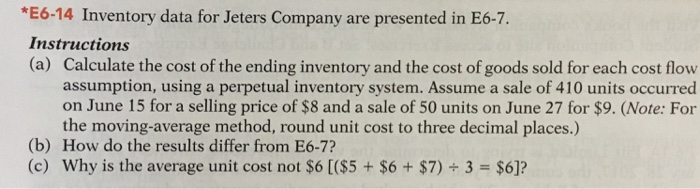
Instructions (a) Calculate the cost of the ending inventory and the cost of goods sold for each cost flow assumption, using a perpetual inventory system. Assume a sale of 410 units occurred on June 15 for a selling price of $8 and a sale of 50 units on June 27 for $9. (Note: For the moving-average method, round unit cost to three decimal places.) (b) How do the results differ from E6-7? (c) Why is the average unit cost not $6 [($5 +$6 $7)3 $6]? Instructions (a) Calculate the cost of the ending inventory and the cost of goods sold for each cost flow assumption, using a perpetual inventory system. Assume a sale of 410 units occurred on June 15 for a selling price of $8 and a sale of 50 units on June 27 for $9. (Note: For the moving-average method, round unit cost to three decimal places.) (b) How do the results differ from E6-7? (c) Why is the average unit cost not $6 [($5 +$6 $7)3 $6]
Step by Step Solution
There are 3 Steps involved in it

Get step-by-step solutions from verified subject matter experts
 Study Help