Question: involves knowingly and willingly ignoring the tax law. Choose the correct answer. O A. Tax planning OB. Tax abuse C. Tax evasion e D. Tax
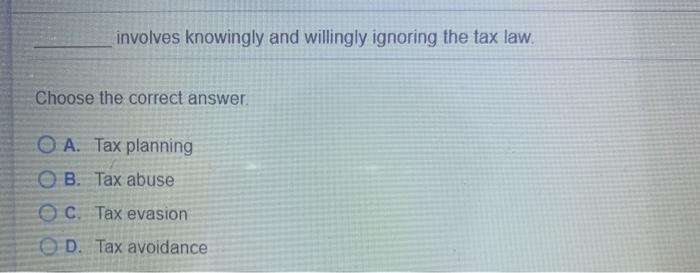
involves knowingly and willingly ignoring the tax
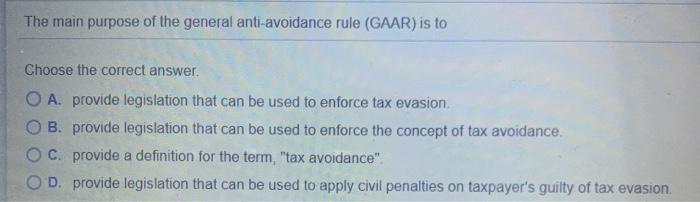
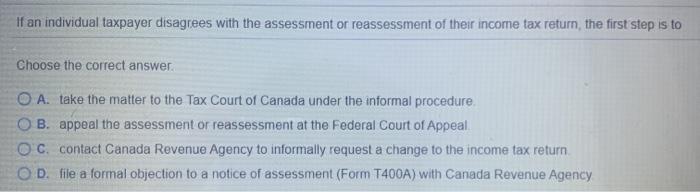
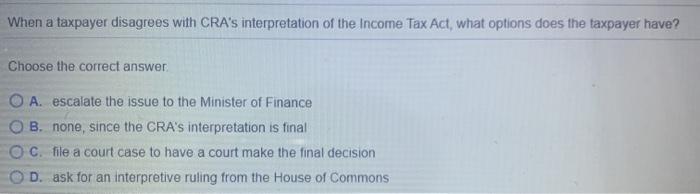
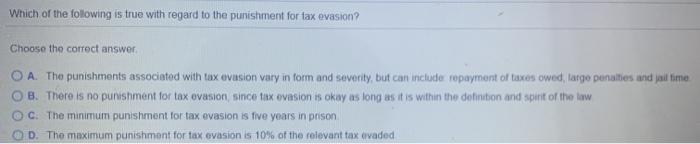
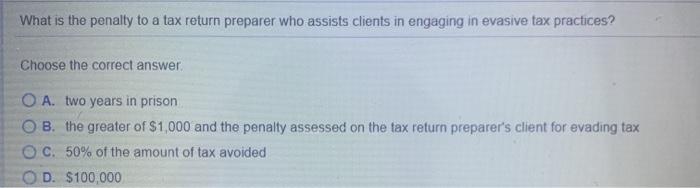
involves knowingly and willingly ignoring the tax law. Choose the correct answer. O A. Tax planning OB. Tax abuse C. Tax evasion e D. Tax avoidance Which of the following is true with regard to the punishment for tax evasion? Choose the correct answer O A. The punishments associated with tax evasion vary in form and severity, but can include repayment of taxes owed, largo penalties and jail time O B. There is no punishment for tax evasion since tax evasion is okay as long as it is within the definition and spirit of the low OC. The minimum punishment for tax evasion is five years in prison D. The maximum punishment for tax evasion is 10% of the relevant tax evaded What is the penalty to a tax return preparer who assists clients in engaging in evasive tax practices? Choose the correct answer O A. two years in prison B. the greater of $1,000 and the penalty assessed on the tax return preparer's client for evading tax C. 50% of the amount of tax avoided D. $100,000 The main purpose of the general anti-avoidance rule (GAAR) is to Choose the correct answer O A. provide legislation that can be used to enforce tax evasion O B. provide legislation that can be used to enforce the concept of tax avoidance. OC. provide a definition for the term "tax avoidance" OD. provide legislation that can be used to apply civil penalties on taxpayer's guilty of tax evasion If an individual taxpayer disagrees with the assessment or reassessment of their income tax return, the first step is to Choose the correct answer O A. take the matter to the Tax Court of Canada under the informal procedure O B. appeal the assessment or reassessment at the Federal Court of Appeal OC. contact Canada Revenue Agency to informally request a change to the income tax return OD. file a formal objection to a notice of assessment (Form T400A) with Canada Revenue Agency When a taxpayer disagrees with CRA's interpretation of the Income Tax Act, what options does the taxpayer have? Choose the correct answer O A escalate the issue to the Minister of Finance OB. none, since the CRA's interpretation is final OC file a court case to have a court make the final decision D. ask for an interpretive ruling from the House of Commons
Step by Step Solution

There are 3 Steps involved in it

1 Expert Approved Answer
Step: 1 Unlock blur-text-image

Question Has Been Solved by an Expert!

Get step-by-step solutions from verified subject matter experts

Step: 2 Unlock
Step: 3 Unlock

Students Have Also Explored These Related General Management Questions!