





Question: Ionic compounds tend to be more soluble in water than covalent compounds, which means that ionic compounds can be separated from certain covalent compounds by

Ionic compounds tend to be more soluble in water than covalent compounds, which means that ionic compounds can be separated from certain covalent compounds by dissolving them in water. Ionic compounds can be identified by the fact that their chemical formulas tend to start with a metal. Which of the following is an ionic compound? a. CS2 b. MgCl2 c. CCl4 d. SiO2
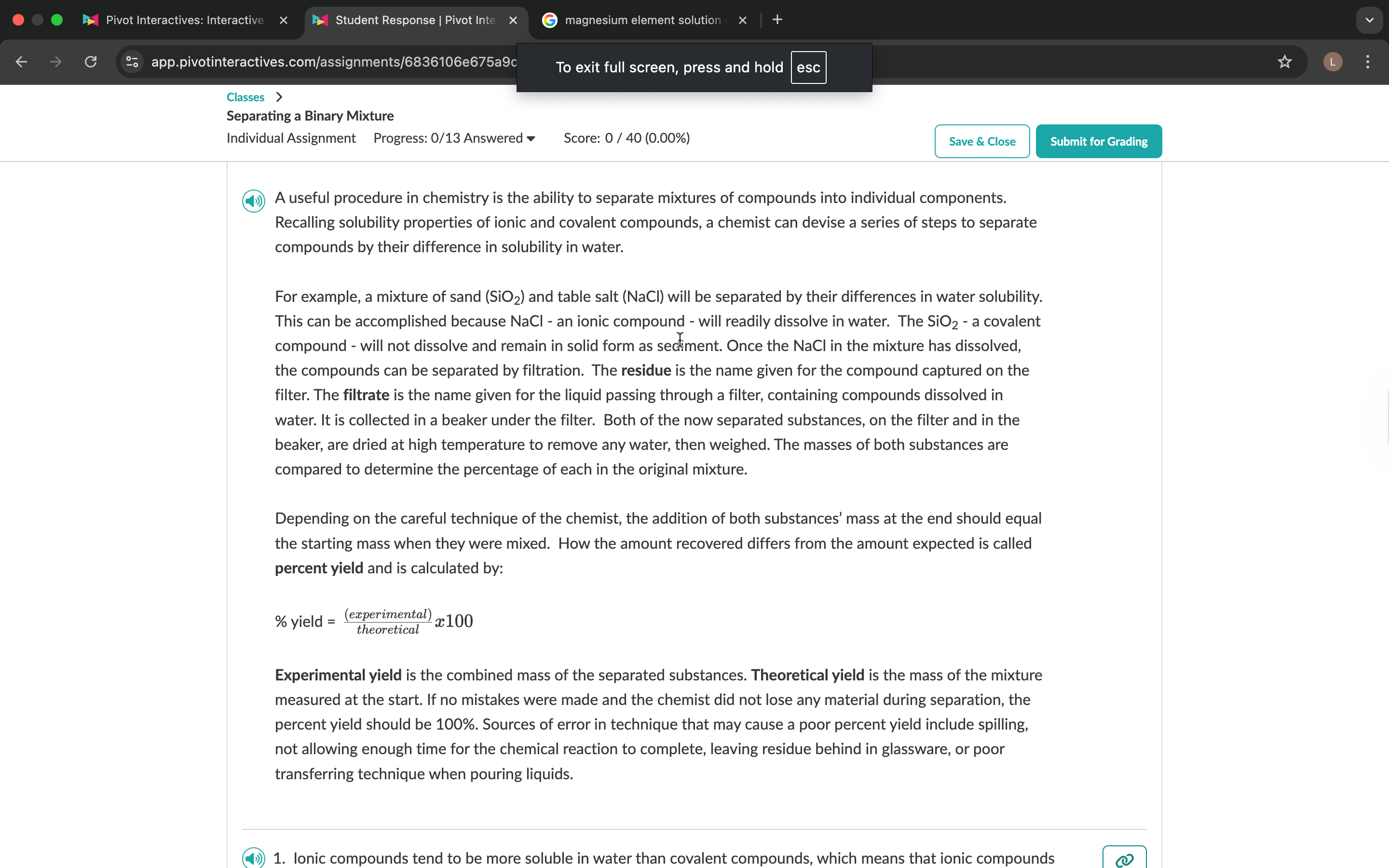
Ionic compounds tend to be more soluble in water Ce: ola lolol Nem Cielo x Be Student Response | Pivot Int oe (s) magnesium element solutio ae CG 23 app.pivotinteractives.com/assignments/6836106e675a9c To exit full screen, press and hold Classes Separating a Binary Mixture Individual Assignment Progress: 0/13 Answered Score: 0 / 40 (0.00%) @) Auseful procedure in chemistry is the ability to separate mixtures of compounds into individual components. Recalling solubility properties of ionic and covalent compounds, a chemist can devise a series of steps to separate compounds by their difference in solubility in water. For example, a mixture of sand (SiO2) and table salt (NaCl) will be separated by their differences in water solubility. This can be accomplished because NaCl - an ionic compound - will readily dissolve in water. The SiO - a covalent compound - will not dissolve and remain in solid form as sediment. Once the NaCl in the mixture has dissolved, the compounds can be separated by filtration. The residue is the name given for the compound captured on the filter. The filtrate is the name given for the liquid passing through a filter, containing compounds dissolved in water. It is collected in a beaker under the filter. Both of the now separated substances, on the filter and in the beaker, are dried at high temperature to remove any water, then weighed. The masses of both substances are compared to determine the percentage of each in the original mixture. Depending on the careful technique of the chemist, the addition of both substances' mass at the end should equal the starting mass when they were mixed. How the amount recovered differs from the amount expected is called percent yield and is calculated by: % yield = (experimental) % yield theoretical +100 Experimental yield is the combined mass of the separated substances. Theoretical yield is the mass of the mixture measured at the start. If no mistakes were made and the chemist did not lose any material during separation, the percent yield should be 100%. Sources of error in technique that may cause a poor percent yield include spilling, not allowing enough time for the chemical reaction to complete, leaving residue behind in glassware, or poor transferring technique when pouring liquids. '@)) 1. lonic compounds tend to be more soluble in water than covalent compounds, which means that ionic compounds @

Step by Step Solution

There are 3 Steps involved in it

1 Expert Approved Answer
Step: 1 Unlock blur-text-image

Question Has Been Solved by an Expert!

Get step-by-step solutions from verified subject matter experts

Step: 2 Unlock
Step: 3 Unlock

Students Have Also Explored These Related Chemistry Questions!