







Question: Is this correct for part A. x = -pi:0.01:pi; plot(x,sin(x)), grid on x = [-i pi+i*pi/2 -1+i*4]; y = sin(x) b) function h = circle(x,y,r)
Is this correct for part A.
x = -pi:0.01:pi; plot(x,sin(x)), grid on
x = [-i pi+i*pi/2 -1+i*4]; y = sin(x)
b) function h = circle(x,y,r)
hold on
th = 0:pi/50:2*pi;
xunit = r * cos(th) + x;
yunit = r * sin(th) + y;
h= plot(xunit, yunit);
S = 1/(12*s);
P = vpa(S,d);
hold off
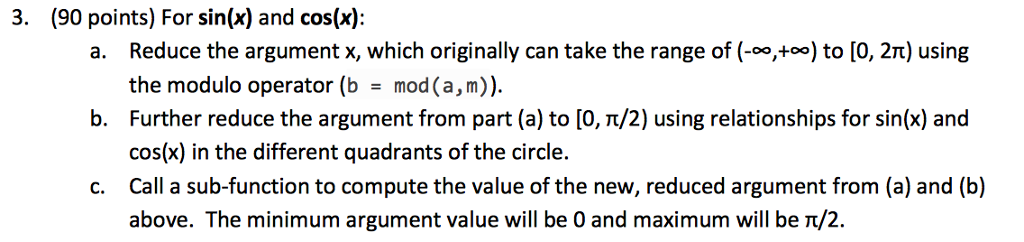
![on x = [-i pi+i*pi/2 -1+i*4]; y = sin(x) b) function h](https://dsd5zvtm8ll6.cloudfront.net/si.experts.images/questions/2024/09/66f32f86814ac_44566f32f85f33e0.jpg) PLease read the additional information. Parts b and C.
PLease read the additional information. Parts b and C.
3. (90 points) For sin(x) and cos(x): a. Reduce the argument x, which originally can take the range of (-oo,+oo) to [0, 2T) using the modulo operator (b mod (a,m)). b. Further reduce the argument from part (a) to [0, TU/2) using relationships for sin(x) and cos(x) in the different quadrants of the circle. c. Call a sub-function to compute the value of the new, reduced argument from (a) and (b) above. The minimum argument value will be 0 and maximum will be t/2. 3. (90 points) For sin(x) and cos(x): a. Reduce the argument x, which originally can take the range of (-oo,+oo) to [0, 2T) using the modulo operator (b mod (a,m)). b. Further reduce the argument from part (a) to [0, TU/2) using relationships for sin(x) and cos(x) in the different quadrants of the circle. c. Call a sub-function to compute the value of the new, reduced argument from (a) and (b) above. The minimum argument value will be 0 and maximum will be t/2
Step by Step Solution
There are 3 Steps involved in it

Get step-by-step solutions from verified subject matter experts
 Study Help