







Question: It can be shown analytically that the long term probability of winning the dice game you have programmed in PA 8-3 is .4929293. Extend that
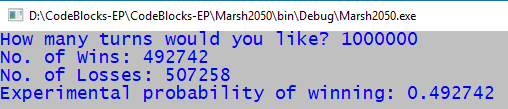
It can be shown analytically that the long term probability of winning the dice game you have programmed in PA 8-3 is .4929293. Extend that program you wrote to run a large number of turns and calculate the empirical (experimental) probability. 1,000,000 times through the for loop took about 2 seconds on a computer similar to those in the classroom. If yours takes longer than 10 seconds there is probably something wrong in your program. It is a good idea to run your loop only 100 or so times the first few times through. Hint: cast your # of wins and losses as float so you don't run into problems with integer division.
#include
#include
#include
using namespace std;
int main()
{
int sum;
int point;
int count;
int x,x2;
srand(time(0));
for (int i=1; i
{
x=rand()%6+1;
x2=rand()%6+1;
if (i ==1) {
point = x+x2;
cout
}
else if (point == 2 || point == 3|| point == 12 && i == i) {
cout
break;
}
else if (point == 7 || point ==11 && i == i) {
cout
break;
}
else {
cout
if (x+x2 == point && point !=7) {
cout
break;
}
if (x+x2 == 7 && i>0 && x+x2 != point) {
cout
break;
}
if (x+x2 != point && i == 7) {
cout
}
;}
}
}
//return 0;
DACodeBlocks-EP CodeBlocks-EP Marsh2050 bin\Debug\Marsh2050.exe How many turns would you like? 1000000 No. of Wins: 49274.2 No. of Losses: 507258 Experimental probability of winning: 0.492742
Step by Step Solution
There are 3 Steps involved in it

Get step-by-step solutions from verified subject matter experts
 Study Help