



Question: it is a course called Special topics in E-Business . it is graded and it's 15% our my general grade please help Read the case
it is a course called Special topics in E-Business . 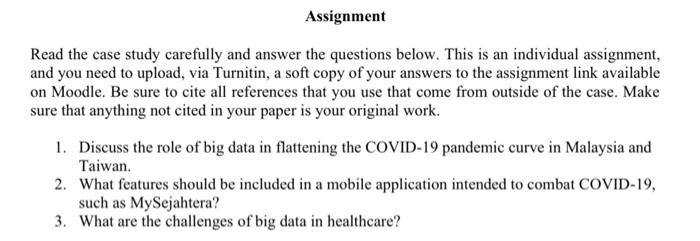
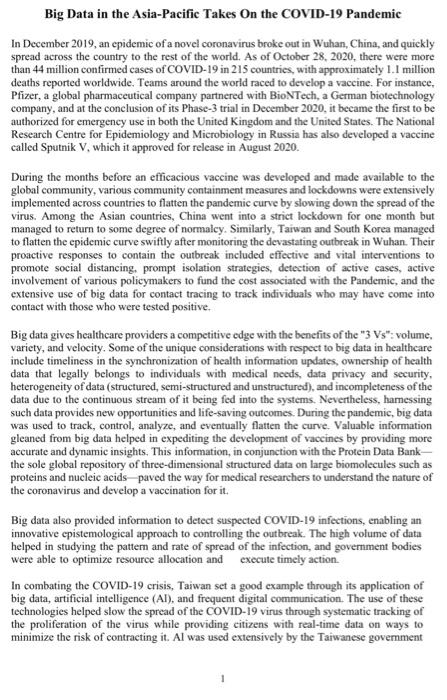
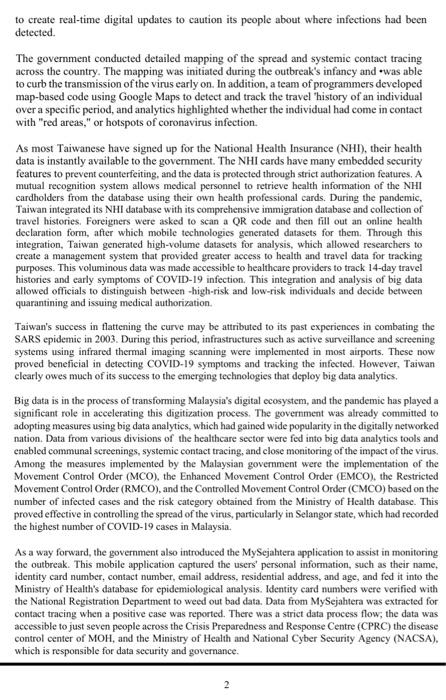
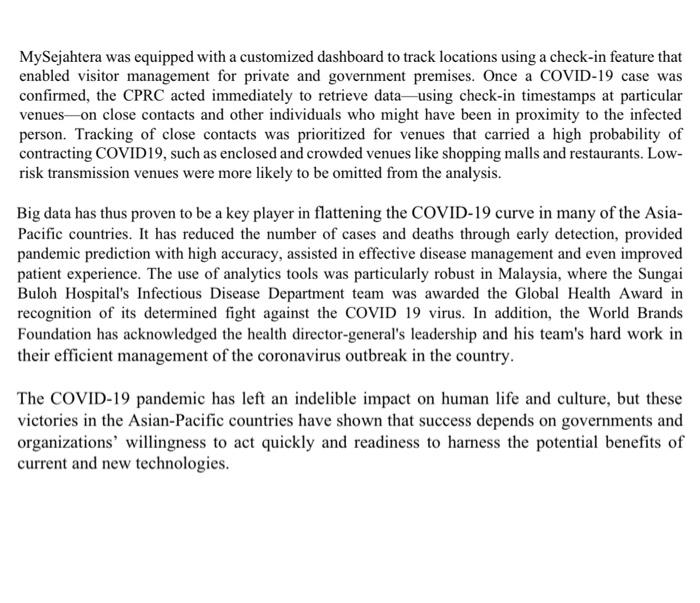
Read the case study carefully and answer the questions below. This is an individual assignment, and you need to upload, via Turnitin, a soft copy of your answers to the assignment link available on Moodle. Be sure to cite all references that you use that come from outside of the case. Make sure that anything not cited in your paper is your original work. 1. Discuss the role of big data in flattening the COVID-19 pandemic curve in Malaysia and Taiwan. 2. What features should be included in a mobile application intended to combat COVID-19, such as MySejahtera? 3. What are the challenges of big data in healtheare? Big Data in the Asia-Pacific Takes On the COVID-19 Pandemic In December 2019, an epidemic of a novel coronavirus broke out in Wuhan, China, and quickly spread across the country to the rest of the world. As of October 28, 2020, there were more than 44 million confirmed cases of COVID- 19 in 215 countries, with approximately 1.1 million deaths reported worldwide. Teams around the world raced to develop a vaccine. For instance, Pfizer, a global pharmaceutical company partnered with BioNTech, a German biotechnology company, and at the conclusion of its Phase-3 trial in December 2020, it became the first to be authorized for emergency use in both the United Kingdom and the United States. The National Research Centre for Epidemiology and Microbiology in Russia has also developed a vaccine called Sputnik V, which it approved for release in August 2020. During the months before an efficacious vaccine was developed and made available to the global community, various community containment measures and lockdowns were extensively implemented across countries to flatten the pandemic curve by slowing down the spread of the virus. Among the Asian countries, China went into a strict lockdown for one month but managed to return to some degree of normalcy. Similarly, Taiwan and South Korea managed to flatten the epidemic curve swiftly after monitoring the devastating outbreak in Wuhan. Their proactive responses to contain the outbreak included effective and vital interventions to promote social distancing, prompt isolation strategies, detection of active cases, active involvement of various policymakers to fund the cost associated with the Pandemic, and the extensive use of big data for contact tracing to track individuals who may have come into contact with those who were tested positive. Big data gives healthcare providers a competitive edge with the benefits of the " 3Vs" ": volume, variety, and velocity. Some of the unique considerations with respect to big data in healthcare include timeliness in the synchronization of health information updates, ownership of health data that legally belongs to individuals with medical needs, data privacy and security, heterogeneity of data (structured, semi-structured and unstructured), and incompleteness of the data due to the continuous stream of it being fed into the systems. Nevertheless, hamessing such data provides new opportunities and life-saving outcomes. During the pandemic, big data was used to track, control, analyze, and eventually flatten the curve. Valuable information gleaned from big data helped in expediting the development of vaccines by providing more accurate and dynamic insights. This information, in conjunction with the Protein Data Bankthe sole global repository of three-dimensional structured data on large biomolecules such as proteins and nucleic acids - paved the way for medical researchers to understand the nature of the coronavirus and develop a vaccination for it. Big data also provided information to detect suspected COVID-19 infections, enabling an innovative epistemological approach to controlling the outbreak. The high volume of data helped in studying the pattem and rate of spread of the infection, and government bodies were able to optimize resource allocation and execute timely action. In combating the COVID-19 crisis, Taiwan set a good example through its application of big data, artificial intelligence (Al), and frequent digital communication. The use of these technologies helped slow the spread of the COVID-19 virus through systematic tracking of the proliferation of the virus while providing citizens with real-time data on ways to minimize the risk of contracting it. Al was used extensively by the Taiwanese govemment to create real-time digital updates to caution its people about where infections had been detected. The government conducted detailed mapping of the spread and systemic contact tracing across the country. The mapping was initiated during the outbreak's infancy and -was able to curb the transmission of the vinus early on. In addition, a team of programmers developed map-based code using Google Maps to detect and track the travel 'history of an individual over a specific period, and analytics highlighted whether the individual had come in contact with "red areas," or hotspots of coronavirus infection. As most Taiwanese have signed up for the National Health Insurance (NHI), their health data is instantly available to the govemment. The NHI cards have many cmbedded security features to prevent counterfeiting, and the data is protected through strict authorization features, A mutual recognition system allows medical personnel to retrieve health information of the NHI cardholders from the database using their own health professional cards. During the pandemic, Taiwan integrated its NHI database with its comprehensive immigration database and collection of travel histories. Foreigners were asked to scan a QR code and then fill out an online health declaration form, after which mobile technologies generated datasets for them. Through this integration. Taiwan generated high-volume datasets for analysis, which allowed researchers to create a management system that provided greater access to health and travel data for tracking purposes. This voluminous data was made accessible to healthcare providers to track 14-day travel histories and early symptoms of COVID-19 infection. This integration and analysis of big data allowed officials to distinguish between -high-risk and low-risk individuals and decide between quarantining and issuing medical authorization. Taiwan's success in flattening the curve may be attributed to its past experiences in combating the SARS epidemic in 2003 . During this period, infrastructures such as active surveillance and screening systems using infrared thermal imaging scanning were implemented in most airports. These now proved beneficial in detecting COVID-19 symptoms and tracking the infected. However, Tajwan clearly owes much of its success to the emerging technologies that deploy big data analytics. Big data is in the process of transforming Malaysia's digital ecosystem, and the pandemic has played a significant role in accelerating this digitization process. The government was already committed to adopting measures using big data analytics, which had gained wide popularity in the digitally networked nation. Data from various divisions of the healtheare sector were fed into big data analytics tools and enabled communal screenings, systemic contact tracing, and close monitoring of the impact of the virus. Among the measures implemented by the Malaysian government were the implementation of the Movement Control Order (MCO), the Enhanced Movement Control Order (EMCO), the Restricted Movement Control Order (RMCO), and the Controlled Movement Control Order (CMCO) based on the number of infected cases and the risk category obtained from the Ministry of Health database. This proved effective in controlling the spread of the vinus, particularly in Selangor state, which had recorded the highest number of COVID-19 cases in Malaysia. As a way forward, the government also introduced the MySejahtera application to assist in monitoring the outbreak. This mobile application captured the users' personal information, such as their name, identity card number, contact number, email address, residential address, and age, and fed it into the Ministry of Health's database for epidemiological analysis. Identity card numbers were verified with the National Registration Department to weed out bad data. Data from MySejahtera was extracted for contact tracing when a positive case was reported. There was a strict data process flow; the data was accessible to just seven people across the Crisis Preparedness and Response Centre (CPRC) the disease control center of MOH, and the Ministry of Health and National Cyber Security Agency (NACSA). which is responsible for data security and governance. 2 MySejahtera was equipped with a customized dashboard to track locations using a check-in feature that enabled visitor management for private and government premises. Once a COVID-19 case was confirmed, the CPRC acted immediately to retrieve data-using check-in timestamps at particular venues - on close contacts and other individuals who might have been in proximity to the infected person. Tracking of close contacts was prioritized for venues that carried a high probability of contracting COVID19, such as enclosed and crowded venues like shopping malls and restaurants. Lowrisk transmission venues were more likely to be omitted from the analysis. Big data has thus proven to be a key player in flattening the COVID-19 curve in many of the AsiaPacific countries. It has reduced the number of cases and deaths through early detection, provided pandemic prediction with high accuracy, assisted in effective disease management and even improved patient experience. The use of analytics tools was particularly robust in Malaysia, where the Sungai Buloh Hospital's Infectious Disease Department team was awarded the Global Health Award in recognition of its determined fight against the COVID 19 virus. In addition, the World Brands Foundation has acknowledged the health director-general's leadership and his team's hard work in their efficient management of the coronavirus outbreak in the country. The COVID-19 pandemic has left an indelible impact on human life and culture, but these victories in the Asian-Pacific countries have shown that success depends on governments and organizations' willingness to act quickly and readiness to harness the potential benefits of current and new technologies it is graded and it's 15% our my general grade please help
Step by Step Solution
There are 3 Steps involved in it
1 Expert Approved Answer
Step: 1 Unlock

Question Has Been Solved by an Expert!
Get step-by-step solutions from verified subject matter experts
Step: 2 Unlock
Step: 3 Unlock