



Question: It is always hoped for that projects will end in the achievement of the initial goals. Unfortunately, that is not always the case. In the
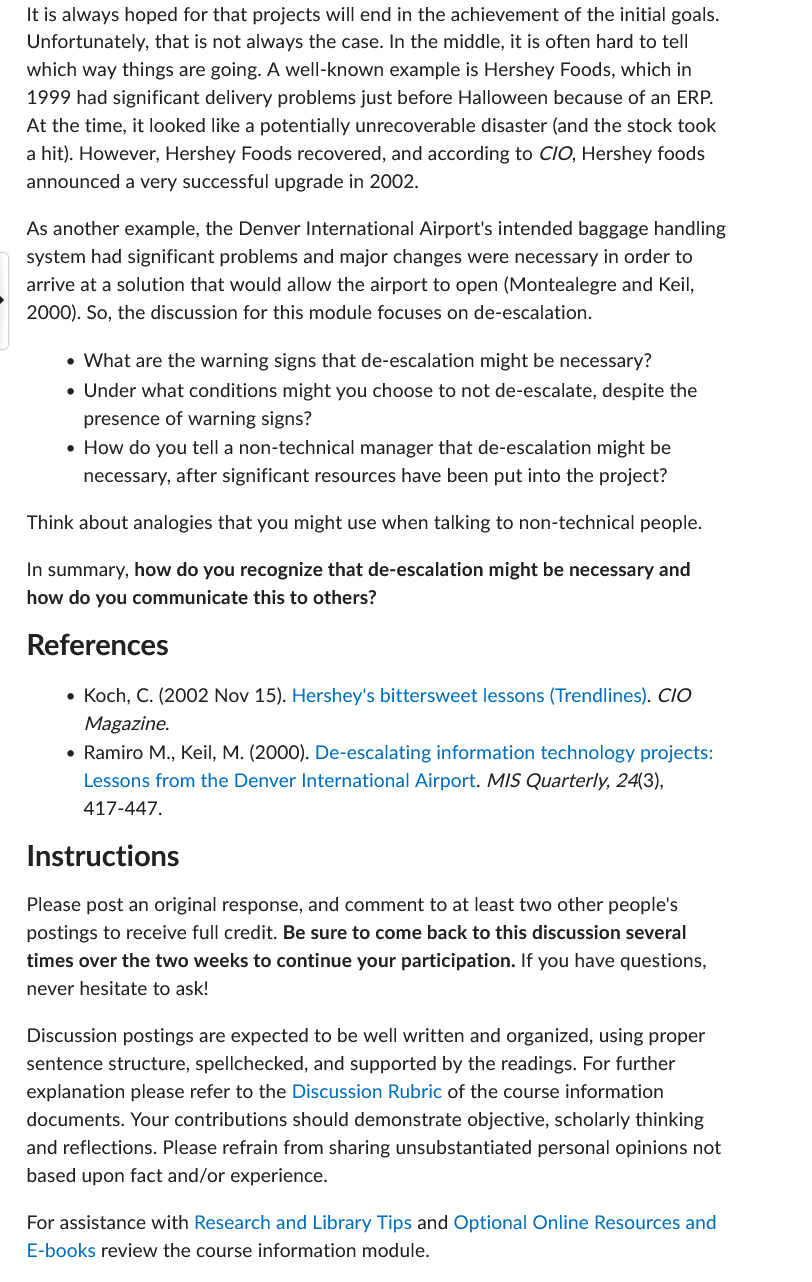
It is always hoped for that projects will end in the achievement of the initial goals. Unfortunately, that is not always the case. In the middle, it is often hard to tell which way things are going. A well-known example is Hershey Foods, which in 1999 had significant delivery problems just before Halloween because of an ERP. At the time, it looked like a potentially unrecoverable disaster (and the stock took a hit). However, Hershey Foods recovered, and according to C/O, Hershey foods announced a very successful upgrade in 2002. As another example, the Denver International Airport's intended baggage handling system had significant problems and major changes were necessary in order to arrive at a solution that would allow the airport to open (Montealegre and Keil, 2000). So, the discussion for this module focuses on de-escalation. * What are the warning signs that de-escalation might be necessary? Under what conditions might you choose to not de-escalate, despite the presence of warning signs? How do you tell a non-technical manager that de-escalation might be necessary, after significant resources have been put into the project? Think about analogies that you might use when talking to non-technical people. In summary, how do you recognize that de-escalation might be necessary and how do you communicate this to others? References e Koch, C. {2002 Nov 15). Hershey's bittersweet lessons (Trendlines). C/O Magazine. + Ramiro M., Keil, M. (2000). De-escalating information technology projects: Lessons from the Denver International Airport. MIS Quarterly, 24(3), 417-447. Instructions Please post an original response, and comment to at least two other people's postings to receive full credit. Be sure to come back to this discussion several times over the two weeks to continue your participation. If you have questions, never hesitate to ask! Discussion postings are expected to be well written and organized, using proper sentence structure, spellchecked, and supported by the readings. For further explanation please refer to the Discussion Rubric of the course information documents. Your contributions should demonstrate objective, scholarly thinking and reflections. Please refrain from sharing unsubstantiated personal opinions not based upon fact and/or experience. For assistance with Research and Library Tips and Optional Online Resources and E-books review the course information module
Step by Step Solution
There are 3 Steps involved in it

Get step-by-step solutions from verified subject matter experts