







Question: It is stated that if all variables in a Bayesian network are binary, the probability distribution over some variable X with n parents PaX
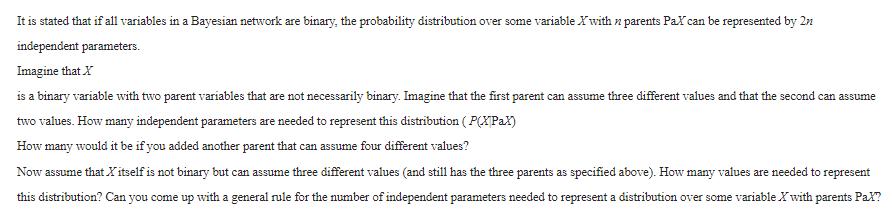
It is stated that if all variables in a Bayesian network are binary, the probability distribution over some variable X with n parents PaX can be represented by 2n independent parameters. Imagine that X is a binary variable with two parent variables that are not necessarily binary. Imagine that the first parent can assume three different values and that the second can assume two values. How many independent parameters are needed to represent this distribution (P(XPaX) How many would it be if you added another parent that can assume four different values? Now assume that X itself is not binary but can assume three different values (and still has the three parents as specified above). How many values are needed to represent this distribution? Can you come up with a general rule for the number of independent parameters needed to represent a distribution over some variable X with parents Pa?
Step by Step Solution
3.34 Rating (160 Votes )
There are 3 Steps involved in it
media pointerfileservicefileHTUFFm5Sw... View full answer

Get step-by-step solutions from verified subject matter experts
 Study Help