







Question: It might be very helpful if anyone can answer one of theseThanks 1. Given a simple, undirected graph G- (V, E), a square is four
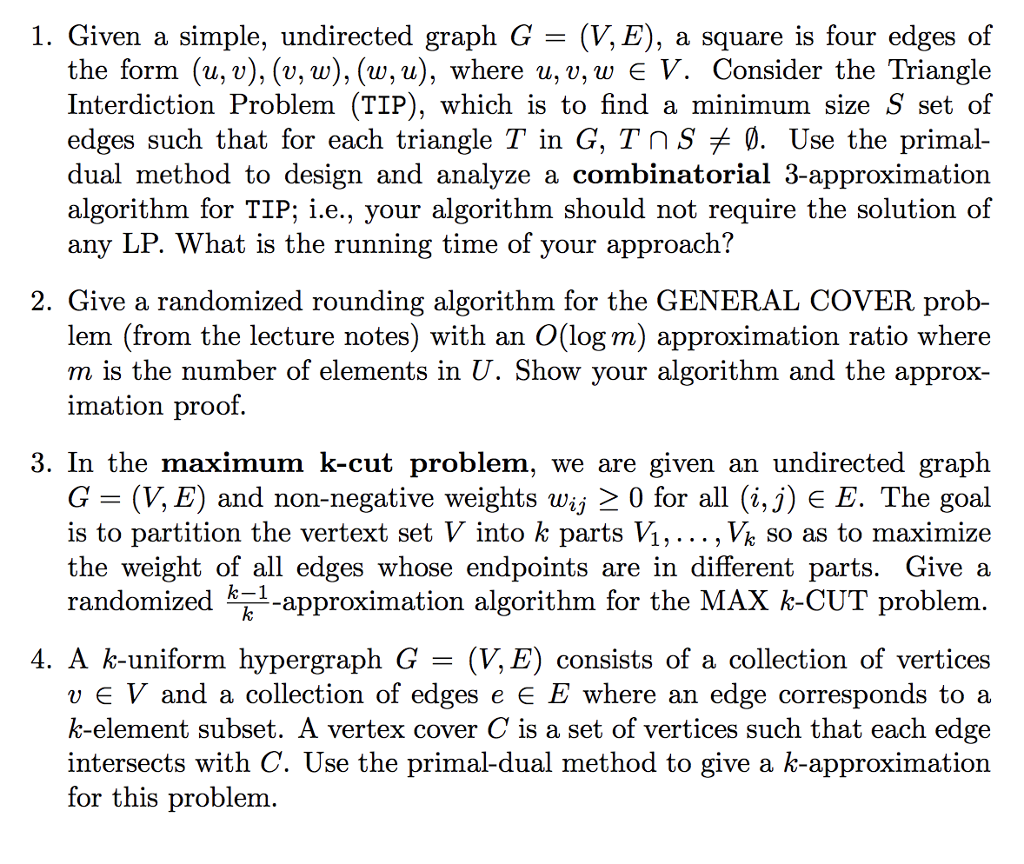
It might be very helpful if anyone can answer one of theseThanks
1. Given a simple, undirected graph G- (V, E), a square is four edges of the form (u, v), (v, w), (w, u), where u, v, w E V. Consider the Triangle Interdiction Problem (TIP), which is to find a minimum size S set of edges such that for each triangle T in G, TnS . Use the primal- dual method to design and analyze a combinatorial 3-approximation algorithm for TIP; i.e., your algorithm should not require the solution of any LP. What is the running time of your approach? 2. Give a randomized rounding algorithm for the GENERAL COVER prob- lem (from the lecture notes) with an O(log m) approximation ratio where m is the number of elements in U. Show your algorithm and the approx- imation proof. 3. In the maximum k-cut problem, we are given an undirected graph G (V. E) and non-negative weights wij 0 for all (i, j) E E. The goal so as to maximize the weight of all edges whose endpoints are in different parts. Give a randomized *^-approximation algorithm for the MAX k-CUT problem is to partition the vertext set V into k parts Vi,... , Vh k-1 4. A k-uniform hypergraph G- (V, E) consists of a collection of vertices v E V and a collection of edges e E E where an edge corresponds to a k-element subset. A vertex cover C is a set of vertices such that each edge intersects with C. Use the primal-dual method to give a k-approximation for this problem 1. Given a simple, undirected graph G- (V, E), a square is four edges of the form (u, v), (v, w), (w, u), where u, v, w E V. Consider the Triangle Interdiction Problem (TIP), which is to find a minimum size S set of edges such that for each triangle T in G, TnS . Use the primal- dual method to design and analyze a combinatorial 3-approximation algorithm for TIP; i.e., your algorithm should not require the solution of any LP. What is the running time of your approach? 2. Give a randomized rounding algorithm for the GENERAL COVER prob- lem (from the lecture notes) with an O(log m) approximation ratio where m is the number of elements in U. Show your algorithm and the approx- imation proof. 3. In the maximum k-cut problem, we are given an undirected graph G (V. E) and non-negative weights wij 0 for all (i, j) E E. The goal so as to maximize the weight of all edges whose endpoints are in different parts. Give a randomized *^-approximation algorithm for the MAX k-CUT problem is to partition the vertext set V into k parts Vi,... , Vh k-1 4. A k-uniform hypergraph G- (V, E) consists of a collection of vertices v E V and a collection of edges e E E where an edge corresponds to a k-element subset. A vertex cover C is a set of vertices such that each edge intersects with C. Use the primal-dual method to give a k-approximation for this
Step by Step Solution
There are 3 Steps involved in it

Get step-by-step solutions from verified subject matter experts
 Study Help