Question: It seems to be uploaded backwards. 1. Spatial model with 3 policy choices: Consider three policy options that will be voted on in round-robin tournaments
It seems to be uploaded backwards.
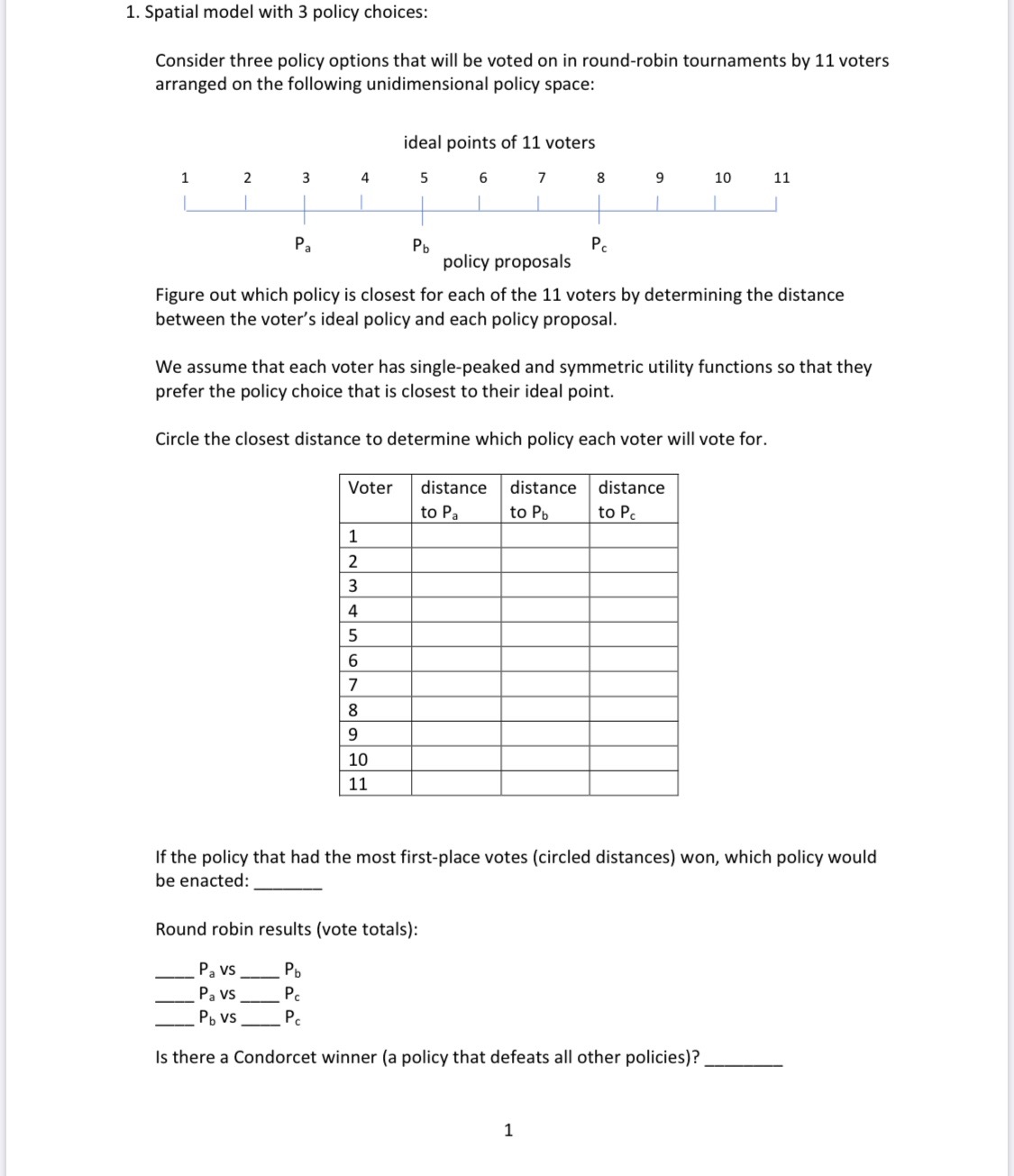
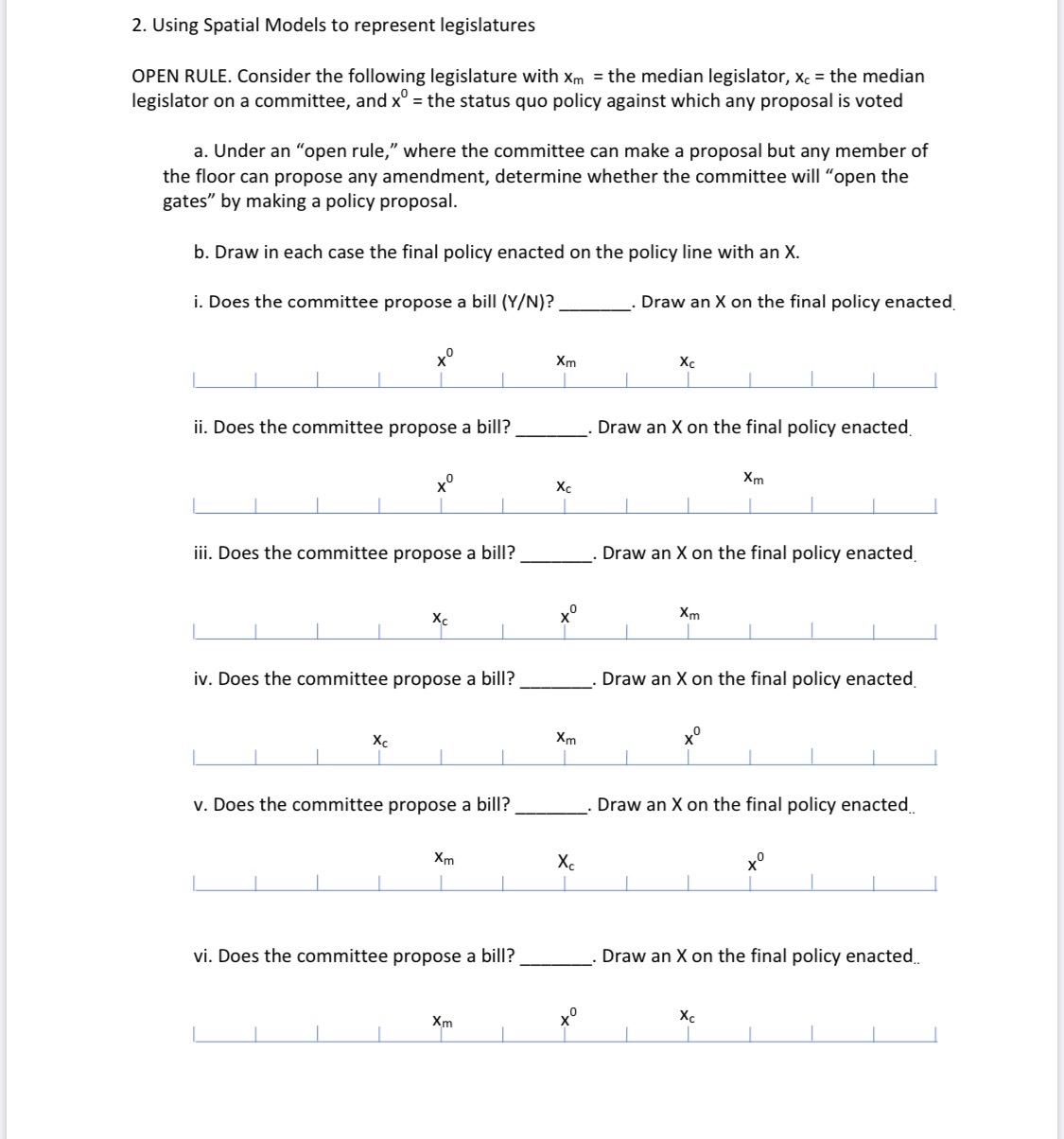
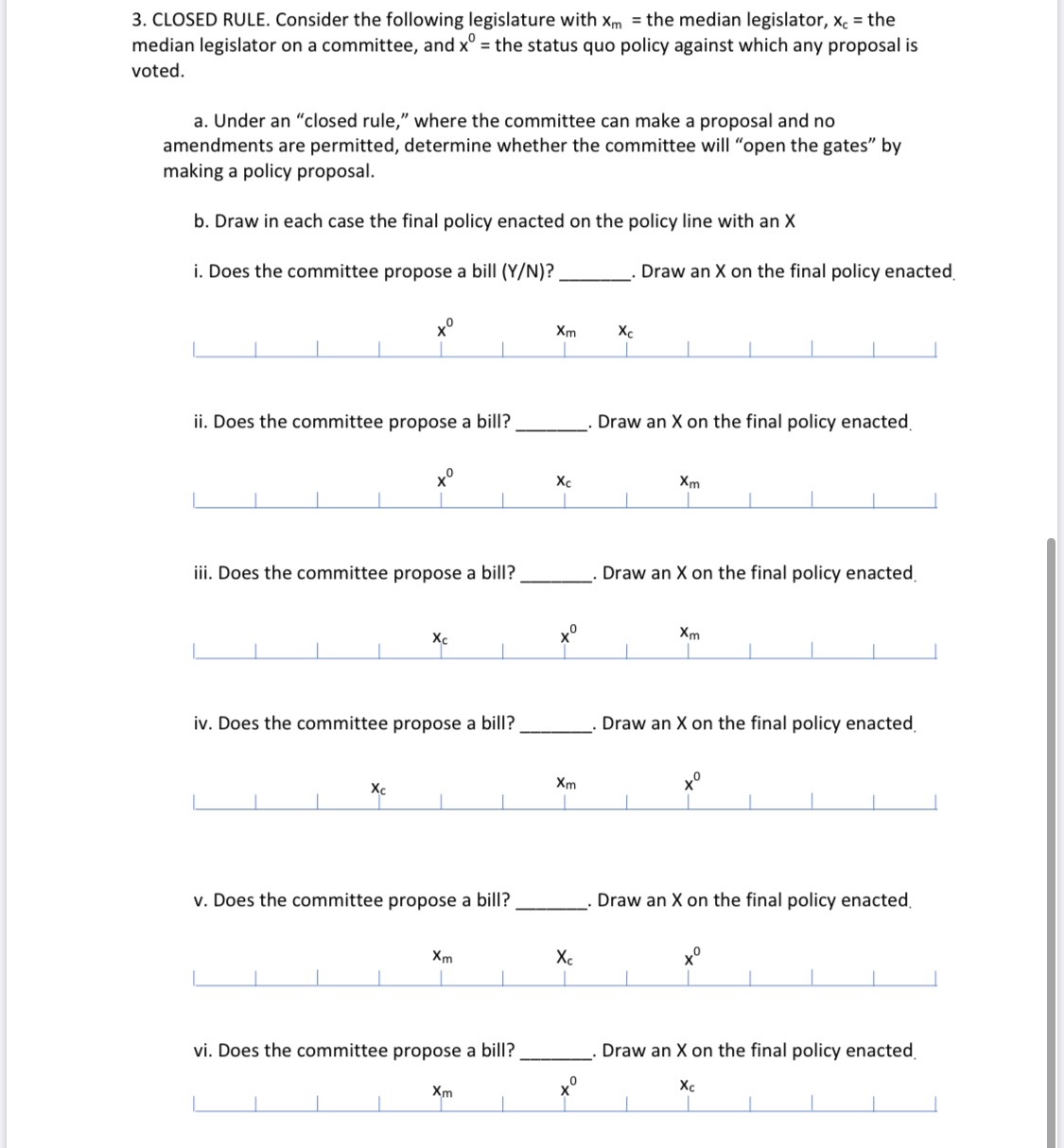
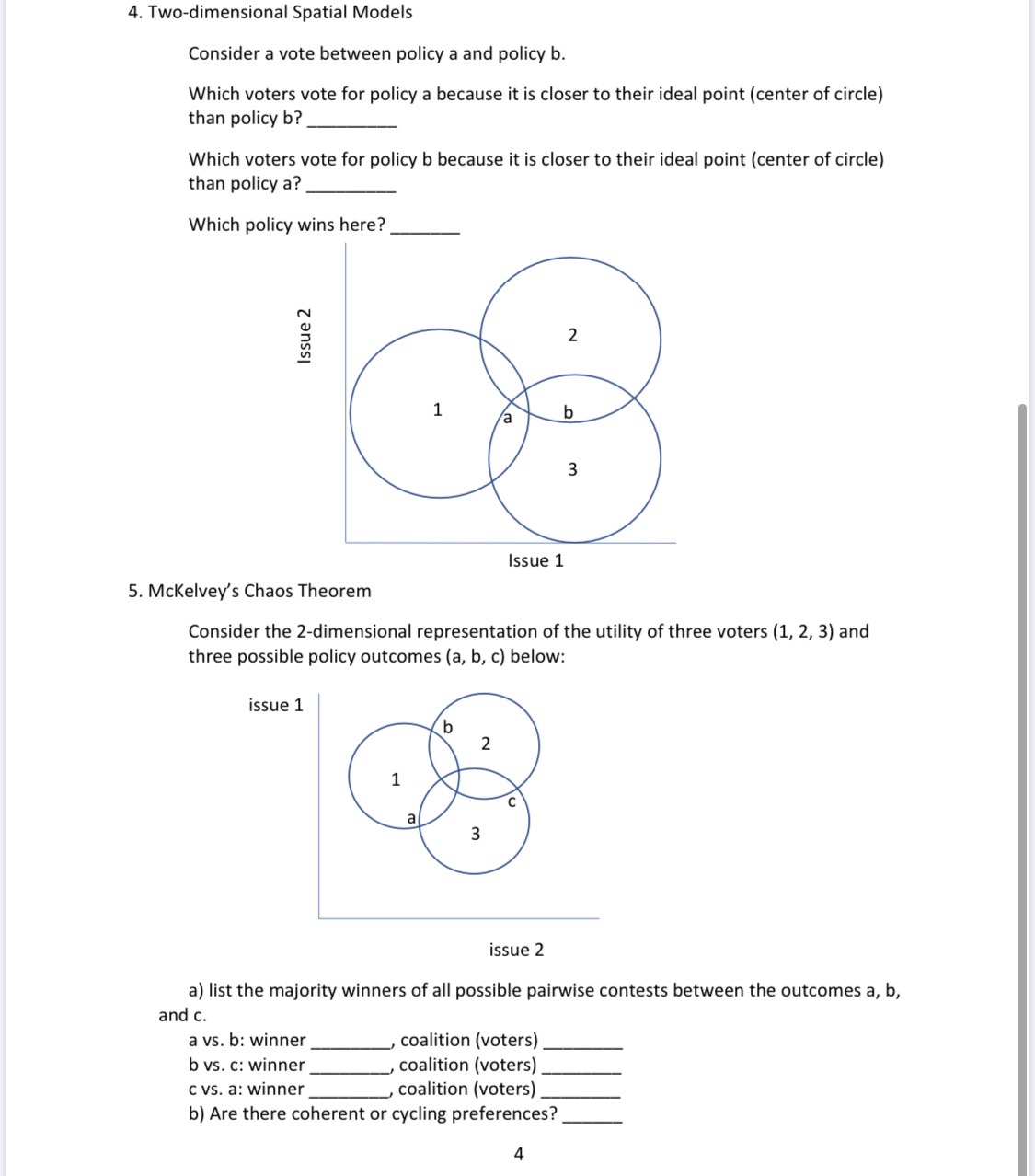
1. Spatial model with 3 policy choices: Consider three policy options that will be voted on in round-robin tournaments by 11 voters arranged on the following unidimensional policy space: ideal points of 11 voters policy proposals Figure out which policy is closest for each of the 11 voters by determining the distance between the voter's ideal policy and each policy proposal. We assume that each voter has single-peaked and symmetric utility functions so that they prefer the policy choice that is closest to their ideal point. Circle the closest distance to determine which policy each voter will vote for. If the policy that had the most first-place votes (circled distances) won, which policy would be enacted: Round robin results (vote totals): Pa VS Pb Pa VS P: P, vs Pc Is there a Condorcet winner (a policy that defeats all other policies)? 2. Using Spatial Models to represent legislatures OPEN RULE. Consider the following legislature with xm = the median legislator, xc = the median legislator on a committee, and x" = the status quo policy against which any proposal is voted a. Under an \"open rule,\" where the committee can make a proposal but any member of the oor can propose any amendment, determine whether the committee will \"open the gates\" by making a policy proposal. b. Draw in each case the final policy enacted on the policy line with an X. i. Does the committee propose a bill (Y/N}? | | | l | | ii. Does the committee propose a bill? . Draw an X on the final policy enacted_ Km 3': I | | l | | | . Draw an X on the final policy enacted x\" xc xm I | | E | | I | | l | I | iii. Does the committee propose a bill? . Draw an X on the final policy enacted 0 x X X m I | I I It I I I I I I I I iv. Does the committee propose a bill? . Draw an X on the nal policy enacted xc Km xl |_|_|_;|_l_l_l_|_l+l_l v. Does the committee propose a bill? xn-I vi. Does the committee propose a bill? . Draw an X on the nal policy enacted_ . Draw an X on the nal policy enacted. 3. CLOSED RULE. Consider the following legislature with mm = the median legislator, x: = the median legislator on a committee, and x" = the status quo policy against which any proposal is voted. a. Under an \"closed rule,\" where the committee can make a proposal and no amendments are permitted, determine whether the committee will \"open the gates\" by making a policy proposal. b. Draw in each case the final policy enacted on the policy line with an X i. Does the committee propose a bill (YIN)? . Draw an X on the final policy enacted, ii. Does the committee propose a bill? . Draw an X on the final policy enacted X Kc Xm l_|_|_l_|_l_l_l_l_l_l_l_i iii. Does the committee propose a bill? . Draw an X on the final policy enacted, D x ' 1' I\" l iv. Does the committee propose a bill? . Draw an X on the final policy enacted Kc \"111 X it. Does the committee propose a bill? . Draw an X on the nal policy enacted xm X: x0 I l | l | l vi. Does the committee propose a bill? . Draw an X on the nal policy enacted I41_A_IJ'\"_A_'I'D_A_XT_I_J_A_A 4. Two-dimensional Spatial Models Consider a vote between policy a and policy b. Which voters vote for policy a because it is closer to their ideal point (center of circle) than policy b? Which voters vote for policy b because it is closer to their ideal point (center of circle) than policy 3? Which policy wins here? Issue 2 5. McKelvey's Chaos Theorem Consider the 2-dimensional representation of the utility of three voters (1, 2, 3) and three possible policy outcomes (3, b, c) below: h i. issue 1 issue 2 a) list the majority winners of all possible pairwise contests between the outcomes 3, b, and c. a vs. b: winner coalition (voters) D vs. c: winner , coalition (voters) c vs. a: winner , coalition (voters) b) Are there coherent or cycling preferences? 4









 Study Help